


The association between gallstones and metabolic syndrome in urban Han Chinese: a longitudinal cohort study
- PMID: 27443986
- PMCID: PMC4957232
- DOI: 10.1038/srep29937
The association between gallstones and metabolic syndrome in urban Han Chinese: a longitudinal cohort study
Abstract
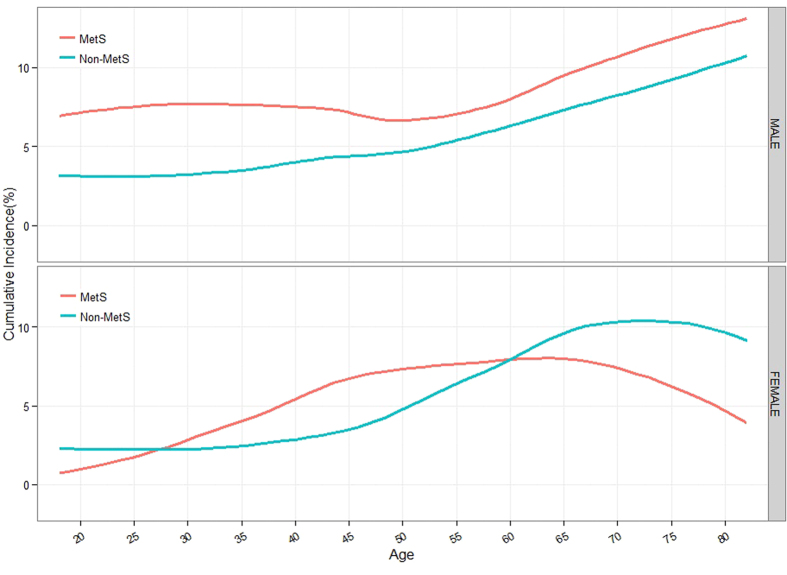
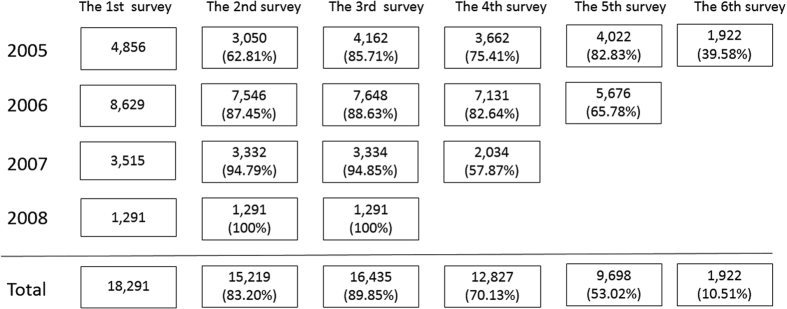
The precise association between metabolic syndrome (MetS) and gallstone disease remains unclear in China. This study aimed to clarify the relationship between MetS and gallstone and evaluate whether counts of metabolic abnormalities had influence on gallstone disease. We fitted gender-specific generalized estimating equation (GEE) regression models with data from a large-scale longitudinal study over 6-year follow-up to elucidate the real association. This study included 18291 participants with 3 times repeated measures at least who were free from a prior history of gallstone disease and cholecystectomy. A total of 873 cases of gallstones occurred during 6-year follow-up. The incidence density of gallstone in the group of subjects with MetS was higher than the group without MetS (10.27 vs 5.79). The GEE analyses confirmed and clarified the association between MetS and gallstone disease in males (RR = 1.33, P = 0.0020), while this association was not significant in females (RR = 1.15, P = 0.4962). With numbers of metabolic syndrome components increasing, the risk of gallstone disease showed corresponding increasing in males. In conclusion, the associations of MetS and gallstone are different in males and in females. And the risk of gallstone disease increases with the number of components of MetS for males but not for females.
Figures
References
-
- Xu Y. The trend analysis in the development for the prevalence of gallstones. Nei Mongol Journal of Traditional Chinese Medicine 14, 71–72 (2011).
-
- Grundy S. M. Cholesterol gallstones: a fellow traveler with metabolic syndrome? Am J Clin Nutr 80, 1–2 (2004). - PubMed
-
- Halldestam I. Incidence of and potential risk factors for gallstone disease in a general population sample. Brit J Surg 96, 1315–1322 (2009). - PubMed
-
- Stinton L. M., Myers R. P. & Shaffer E. A. Epidemiology of gallstones. Gastroenterol Clin North Am 39, 157–169 (2010). - PubMed
Publication types
MeSH terms
LinkOut - more resources
Full Text Sources
Other Literature Sources
Medical
