


The transition from childhood to adolescence is marked by a general decrease in amygdala reactivity and an affect-specific ventral-to-dorsal shift in medial prefrontal recruitment
- PMID: 27445112
- PMCID: PMC5205575
- DOI: 10.1016/j.dcn.2016.06.005
The transition from childhood to adolescence is marked by a general decrease in amygdala reactivity and an affect-specific ventral-to-dorsal shift in medial prefrontal recruitment
Abstract
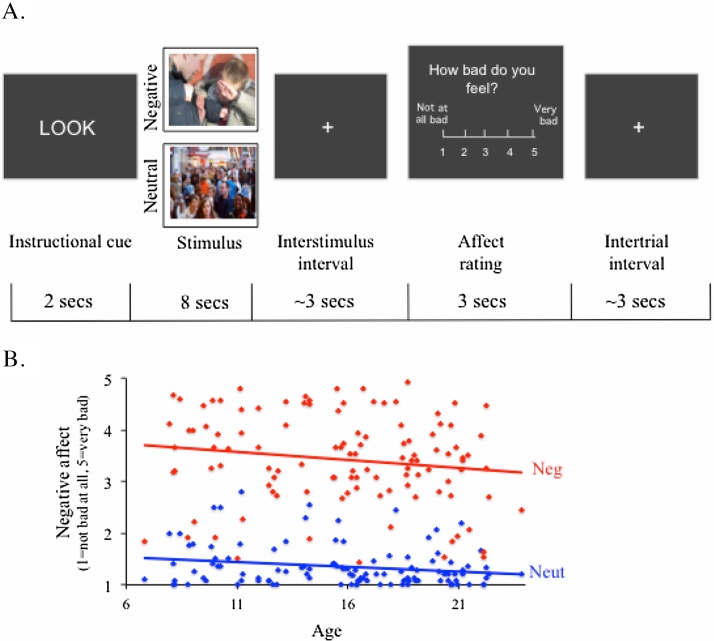
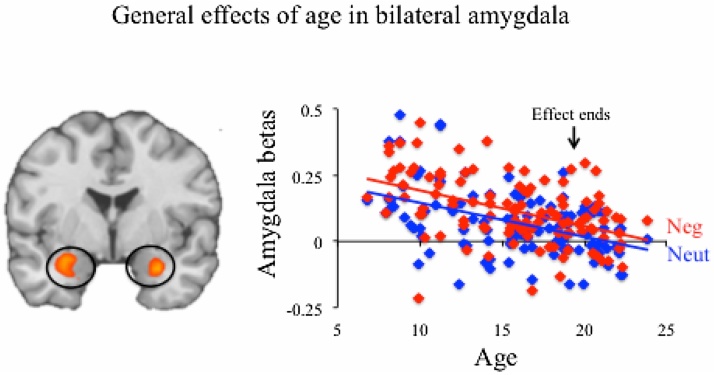
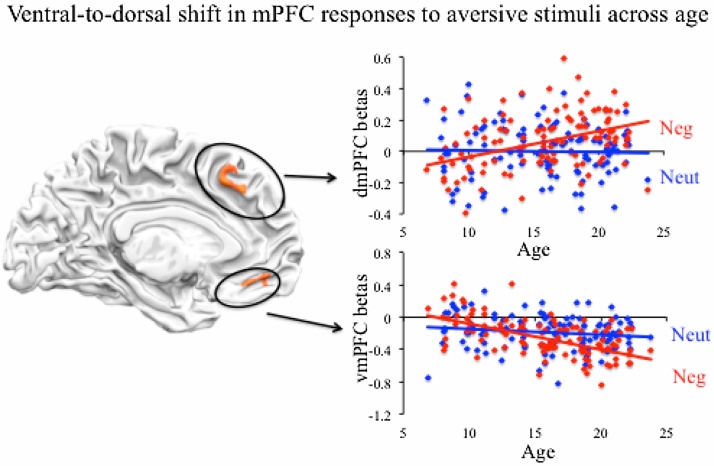
Understanding how and why affective responses change with age is central to characterizing typical and atypical emotional development. Prior work has emphasized the role of the amygdala and prefrontal cortex (PFC), which show age-related changes in function and connectivity. However, developmental neuroimaging research has only recently begun to unpack whether age effects in the amygdala and PFC are specific to affective stimuli or may be found for neutral stimuli as well, a possibility that would support a general, rather than affect-specific, account of amygdala-PFC development. To examine this, 112 individuals ranging from 6 to 23 years of age viewed aversive and neutral images while undergoing fMRI scanning. Across age, participants reported more negative affect and showed greater amygdala responses for aversive than neutral stimuli. However, children were generally more sensitive to both neutral and aversive stimuli, as indexed by affective reports and amygdala responses. At the same time, the transition from childhood to adolescence was marked by a ventral-to-dorsal shift in medial prefrontal responses to aversive, but not neutral, stimuli. Given the role that dmPFC plays in executive control and higher-level representations of emotion, these results suggest that adolescence is characterized by a shift towards representing emotional events in increasingly cognitive terms.
Keywords: Amygdala; Emotion; Neurodevelopment; Prefrontal cortex; fMRI.
Copyright © 2016 The Authors. Published by Elsevier Ltd.. All rights reserved.
Figures
References
-
- Achenbach T.M. University of Vermont, Research Center for Children, Youth, & Families; Burlington, VT: 2001. Manual for the ASEBA School-Age Forms & Profiles.
-
- Anderson A.K., Christoff K., Stappen I., Panitz D., Ghahremani D.G., Glover G., Sobel N. Dissociated neural representations of intensity and valence in human olfaction. Nat. Neurosci. 2003;6(2):196–202. - PubMed
-
- Blakemore S.J. The social brain in adolescence. Nat. Rev. Neurosci. 2008;9(4):267–277. - PubMed
-
- Bouwmeester H., Smits K., Van Ree J.M. Neonatal development of projections to the basolateral amygdala from prefrontal and thalamic structures in rat. J. Comp. Neurol. 2002;450(3):241–255. - PubMed
-
- Bouwmeester H., Wolterink G., van Ree J.M. Neonatal development of projections from the basolateral amygdala to prefrontal, striatal, and thalamic structures in the rat. J. Comp. Neurol. 2002;442(3):239–249. - PubMed
MeSH terms
Grants and funding
LinkOut - more resources
Full Text Sources
Other Literature Sources
Miscellaneous
