


Does a Combination of Virtual Reality, Neuromodulation and Neuroimaging Provide a Comprehensive Platform for Neurorehabilitation? - A Narrative Review of the Literature
- PMID: 27445739
- PMCID: PMC4919322
- DOI: 10.3389/fnhum.2016.00284
Does a Combination of Virtual Reality, Neuromodulation and Neuroimaging Provide a Comprehensive Platform for Neurorehabilitation? - A Narrative Review of the Literature
Erratum in
-
Corrigendum: Does a Combination of Virtual Reality, Neuromodulation and Neuroimaging Provide a Comprehensive Platform for Neurorehabilitation? - A Narrative Review of the Literature.Front Hum Neurosci. 2017 Feb 3;11:53. doi: 10.3389/fnhum.2017.00053. eCollection 2017. Front Hum Neurosci. 2017. PMID: 28167909 Free PMC article.
Abstract
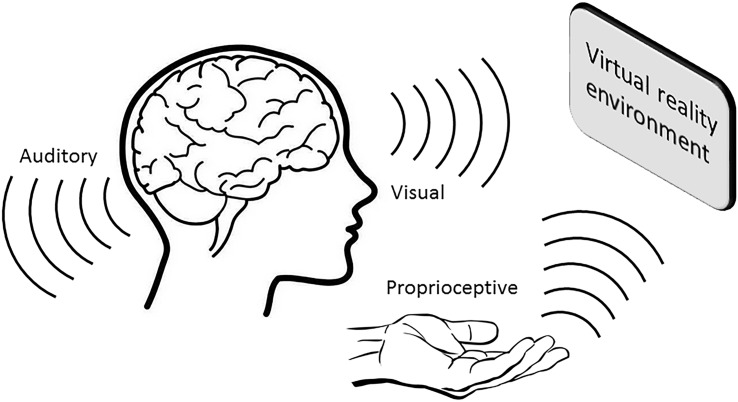
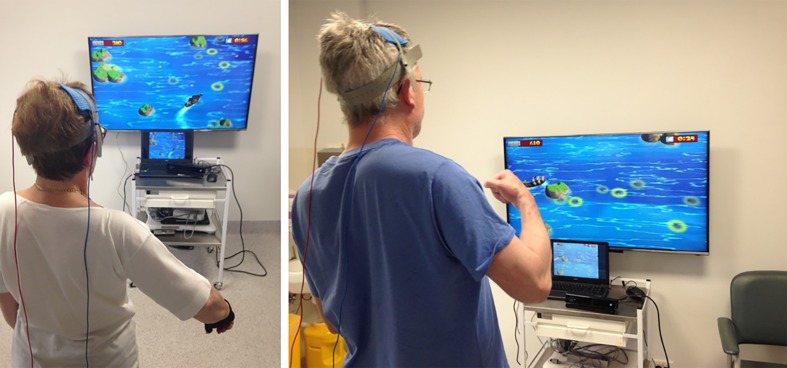
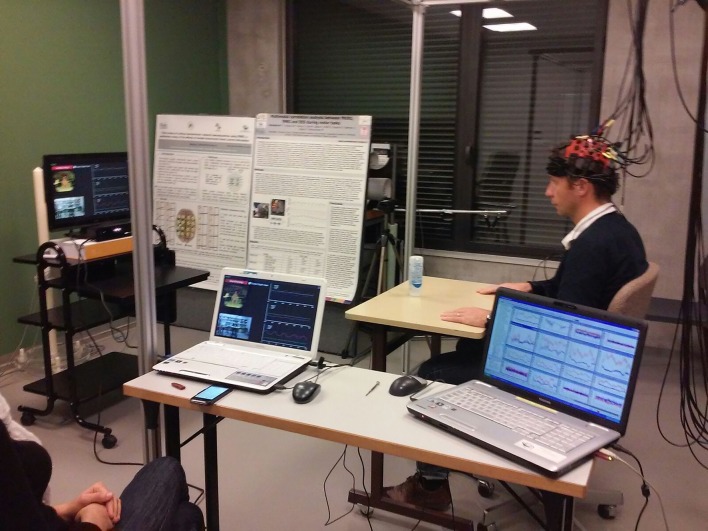
In the last decade, virtual reality (VR) training has been used extensively in video games and military training to provide a sense of realism and environmental interaction to its users. More recently, VR training has been explored as a possible adjunct therapy for people with motor and mental health dysfunctions. The concept underlying VR therapy as a treatment for motor and cognitive dysfunction is to improve neuroplasticity of the brain by engaging users in multisensory training. In this review, we discuss the theoretical framework underlying the use of VR as a therapeutic intervention for neurorehabilitation and provide evidence for its use in treating motor and mental disorders such as cerebral palsy, Parkinson's disease, stroke, schizophrenia, anxiety disorders, and other related clinical areas. While this review provides some insights into the efficacy of VR in clinical rehabilitation and its complimentary use with neuroimaging (e.g., fNIRS and EEG) and neuromodulation (e.g., tDCS and rTMS), more research is needed to understand how different clinical conditions are affected by VR therapies (e.g., stimulus presentation, interactivity, control and types of VR). Future studies should consider large, longitudinal randomized controlled trials to determine the true potential of VR therapies in various clinical populations.
Keywords: EEG; fNIRS; neuroplasticity; neurorehabilitation; tDCS; virtual reality therapy.
Figures
Similar articles
-
Corrigendum: Does a Combination of Virtual Reality, Neuromodulation and Neuroimaging Provide a Comprehensive Platform for Neurorehabilitation? - A Narrative Review of the Literature.Front Hum Neurosci. 2017 Feb 3;11:53. doi: 10.3389/fnhum.2017.00053. eCollection 2017. Front Hum Neurosci. 2017. PMID: 28167909 Free PMC article.
-
Virtual reality in cognitive and motor rehabilitation: facts, fiction and fallacies.Expert Rev Med Devices. 2018 Feb;15(2):107-117. doi: 10.1080/17434440.2018.1425613. Epub 2018 Jan 10. Expert Rev Med Devices. 2018. PMID: 29313388 Review.
-
Clinical Application of Virtual Reality for Upper Limb Motor Rehabilitation in Stroke: Review of Technologies and Clinical Evidence.J Clin Med. 2020 Oct 21;9(10):3369. doi: 10.3390/jcm9103369. J Clin Med. 2020. PMID: 33096678 Free PMC article. Review.
-
How brain imaging provides predictive biomarkers for therapeutic success in the context of virtual reality cognitive training.Neurosci Biobehav Rev. 2021 Jan;120:583-594. doi: 10.1016/j.neubiorev.2020.05.018. Epub 2020 Jun 10. Neurosci Biobehav Rev. 2021. PMID: 32533997 Review.
-
Effects of Virtual Reality Cognitive Training on Neuroplasticity: A Quasi-Randomized Clinical Trial in Patients with Stroke.Biomedicines. 2023 Dec 6;11(12):3225. doi: 10.3390/biomedicines11123225. Biomedicines. 2023. PMID: 38137446 Free PMC article.
Cited by
-
Recognizing Personality Traits Using Consumer Behavior Patterns in a Virtual Retail Store.Front Psychol. 2022 Mar 11;13:752073. doi: 10.3389/fpsyg.2022.752073. eCollection 2022. Front Psychol. 2022. PMID: 35360568 Free PMC article.
-
The benefits of mind wandering on a naturalistic prospective memory task.Sci Rep. 2023 Jul 15;13(1):11432. doi: 10.1038/s41598-023-37996-z. Sci Rep. 2023. PMID: 37454161 Free PMC article. Clinical Trial.
-
Functional Living Skills: A Non-Immersive Virtual Reality Training for Individuals with Major Neurocognitive Disorders.Sensors (Basel). 2021 Aug 26;21(17):5751. doi: 10.3390/s21175751. Sensors (Basel). 2021. PMID: 34502642 Free PMC article.
-
Analysis of Human Gait Using Hybrid EEG-fNIRS-Based BCI System: A Review.Front Hum Neurosci. 2021 Jan 25;14:613254. doi: 10.3389/fnhum.2020.613254. eCollection 2020. Front Hum Neurosci. 2021. PMID: 33568979 Free PMC article. Review.
-
A Scoping Review of Cognitive Training in Neurodegenerative Diseases via Computerized and Virtual Reality Tools: What We Know So Far.Brain Sci. 2021 Apr 21;11(5):528. doi: 10.3390/brainsci11050528. Brain Sci. 2021. PMID: 33919244 Free PMC article.
References
-
- Ang K. K., Guan C., Phua K. S., Wang C., Zhao L., Teo W. P., et al. (2015). Facilitating effects of transcranial direct current stimulation on motor imagery brain-computer interface with robotic feedback for stroke rehabilitation. Arch. Phys. Med. Rehabil. 96 S79–S87. 10.1016/j.apmr.2014.08.008 - DOI - PubMed
-
- Ayaz H., Onaral B., Izzetoglu K., Shewokis P. A., Mckendrick R., Parasuraman R. (2013). Continuous monitoring of brain dynamics with functional near infrared spectroscopy as a tool for neuroergonomic research: empirical examples and a technological development. Front. Hum. Neurosci. 7:871 10.3389/fnhum.2013.00871 - DOI - PMC - PubMed
Publication types
LinkOut - more resources
Full Text Sources
Other Literature Sources
Medical
