. 2016 Jun 28:7:254.
doi: 10.3389/fphys.2016.00254. eCollection 2016.

The Relationship between CmADHs and the Diversity of Volatile Organic Compounds of Three Aroma Types of Melon (Cucumis melo)

Affiliations

The Relationship between CmADHs and the Diversity of Volatile Organic Compounds of Three Aroma Types of Melon (Cucumis melo)

Hao Chen et al. Front Physiol. .

Abstract

Alcohol dehydrogenase (ADH) plays an important role in aroma volatile compounds synthesis of plants. In this paper, we tried to explore the relationship between CmADHs and the volatile organic compounds (VOCs) in oriental melon. Three different aroma types of melon were used as materials. The principle component analysis of three types of melon fruit was conducted. We also measured the CmADHs expression level and enzymatic activities of ADH and alcohol acyl-transferase (AAT) on different stages of fruit ripening. An incubation experiment was carried out to investigate the effect of substrates and inhibitor (4-MP, 4-methylpyrazole) on CmADHs expression, ADH activity, and the main compounds of oriental melon. The results illustrated that ethyl acetate, hexyl acetate (E,Z)-3,6-nonadien-1-ol and 2-ethyl-2hexen-1-ol were the four principal volatile compounds of these three types of melon. AAT activity was increasing with fruit ripening, and the AAT activity in CH were the highest, whereas ADH activity peaked on 32 DAP, 2 days before maturation, and the ADH activity in CB and CG were higher than that in CH. The expression pattern of 11 CmADH genes from 24 to 36 day after pollination (DAP) was found to vary in three melon varieties. CmADH4 was only expressed in CG and the expression levels of CmADH3 and CmADH12 in CH and CB were much higher than that in CG, and they both peaked 2 days before fruit ripening. Ethanol and 4-MP decreased the reductase activity of ADH, the expression of most CmADHs and ethyl acetate or hexyl acetate contents of CB, except for 0.1 mM 4-MP, while aldehyde improved the two acetate ester contents. In addition, we found a positive correlation between the expression of CmADH3 and CmADH12 and the key volatile compound of CB. The relationship between CmADHs and VOCs synthesis of oriental melon was discussed.

Keywords: alcohol dehydrogenase; fruit ripening; gene expression; oriental melon; volatiles organic compounds.


Figures
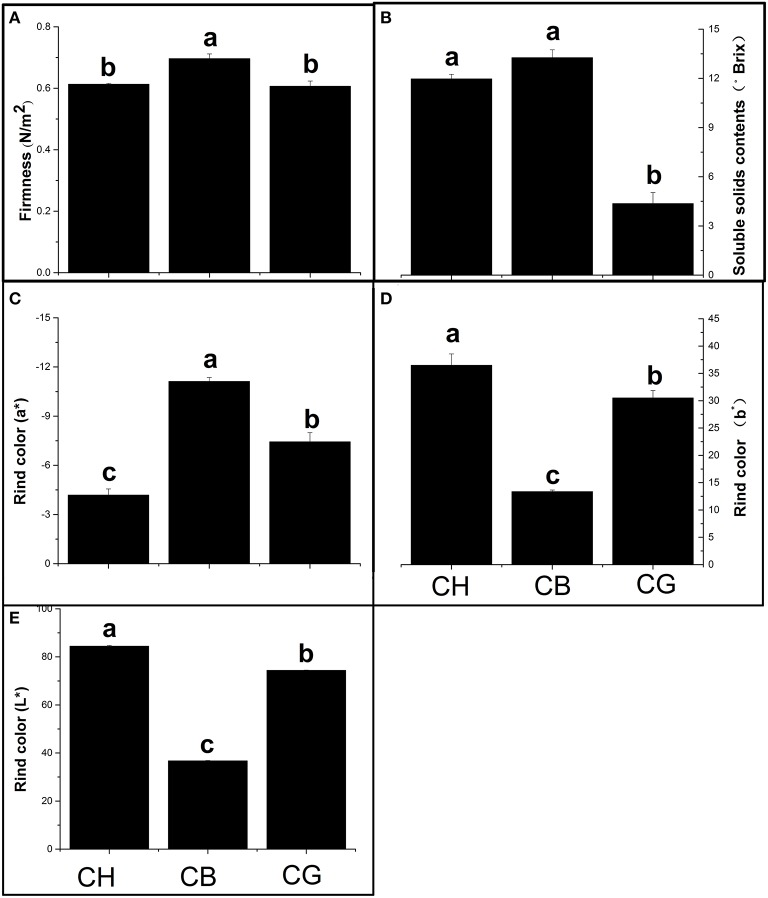
Figure 1
Figure 1
Different physiological characteristics of three types of melon at their maturity. (A) Firmness, (B) Soluble solids contents of melon flesh, (C–E) Pericarp color (a* means the red/green ratio and b* represents the yellow/blue ratio, L* represents the brightness of rind). Duncan's multiple range tests have been performed with different letters above the columns represent significant differences (P < 0.05) between different types of melon.
Figure 2
Figure 2
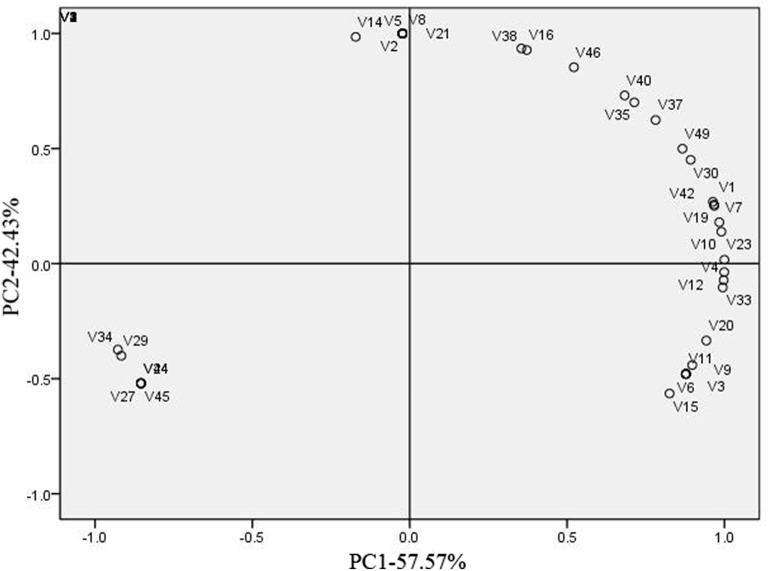
Principal component analysis (PCA) of aroma volatiles identified in three types of melon at mature period. Loading plots of the two main PCA of the aroma volatiles identified in three types of melon at mature period. One hundred percent of the variability in the volatile compounds in the melon cultivars could be explained by two principal PCs. PC1 explained 57.57% of the variability, while PC2 explained 42.43% of the variability. Each sample consisted of three replicates. Codes were corresponding to the volatile compounds number in Table S1.
Figure 3
Figure 3
Four principal volatile compounds of three types of melon at mature period. All of the data for volatile compounds are means ± SE value of three replicates.
Figure 4
Figure 4
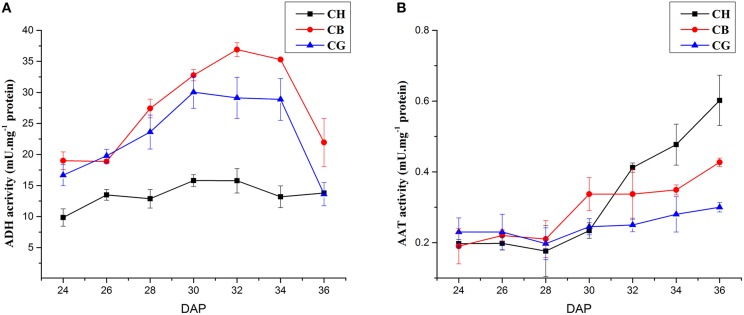
ADH and AAT activities in three aroma types of melon at different DAP. (A) ADH activities in three types of melon. (B) AAT activities in three types of melon. Each experiment was performed in triplicate and the means ± SE value of their activities were shown in the line chart.
Figure 5
Figure 5
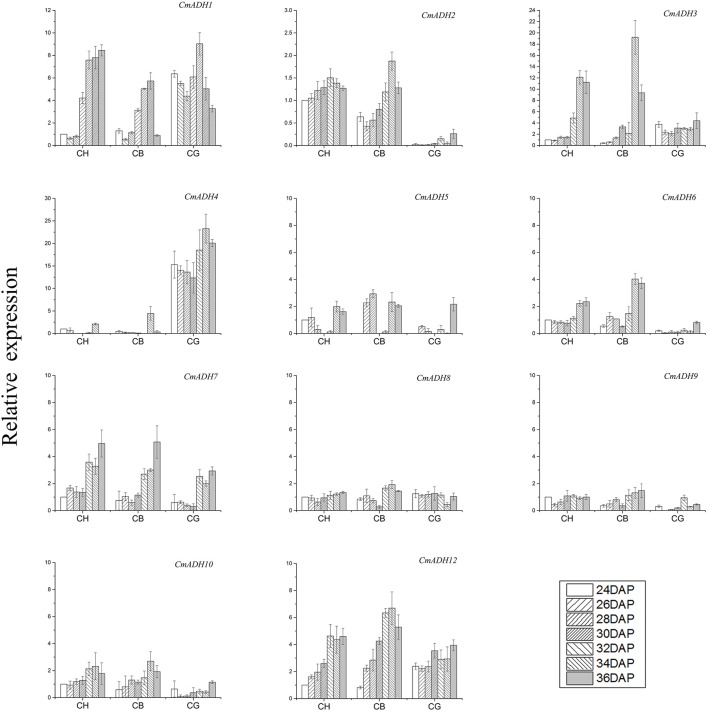
Gene expression of CmADHs in three types of melon on different DAP. Expression levels of each gene are showed as a ratio relative to the ADH/18SrRNA ratios for CH on 24DAP, which was set to 1. Each experiment was performed in triplicate and the means ± SE value of their content were shown in the figure.
Figure 6
Figure 6
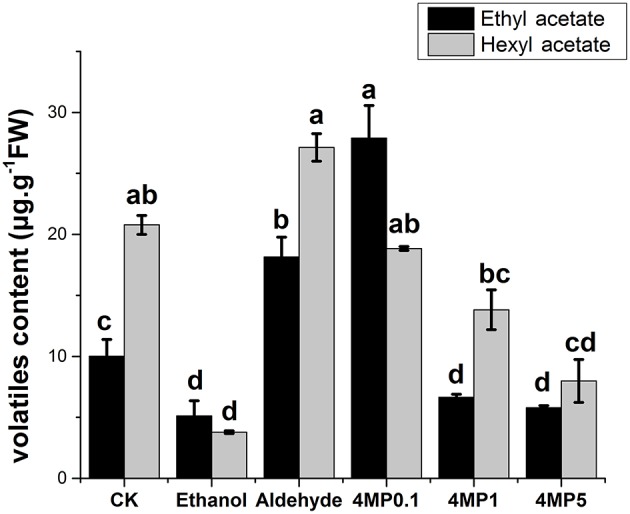
Ethyl acetate and Hexyl acetate content in “CB” oriental melon in incubation experiment. Flesh melon were incubated with 5 mM ethanol (Ethanol), 5 mM aldehyde (Aldehyde), 0.1 mM 4-methylpyrazole (4MP0.1), 1 mM 4-methylpyrazole (4MP1), and 5 mM 4-methylpyrazole (4MP5). Melon incubated with distilled water was taken as a control. Duncan's multiple range tests have been performed with different letters above the columns represent significant differences (P < 0.05) between different treatments.
Figure 7
Figure 7
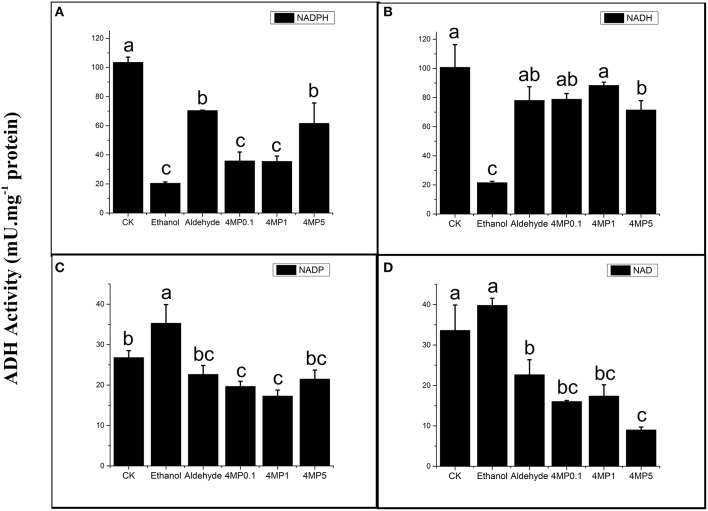
ADH activities depended on four co-factors (0.25 mM NADPH/NADP and NADH/NAD) of CB flesh melon incubated with multiple solutions, including 5 mM ethanol (Ethanol), 5 mM aldehyde (Aldehyde), 0.1 mM 4-methylpyrazole (4MP0.1), 1 mM 4-methylpyrazole (4MP1), and 5 mM 4-methylpyrazole (4MP5) (A–D). (A) ADH activity depended on 0.25 mM NADPH. (B) ADH activity depended on 0.25 mM NADH. (C) ADH activity depended on 0.25 mM NADP. (D) ADH activity depended on 0.25 mM NAD. Flesh melon incubated with distilled water were used as control. Duncan's multiple range tests have been performed with different letters above the columns represent significant differences (P < 0.05) between different treatments.
Figure 8
Figure 8
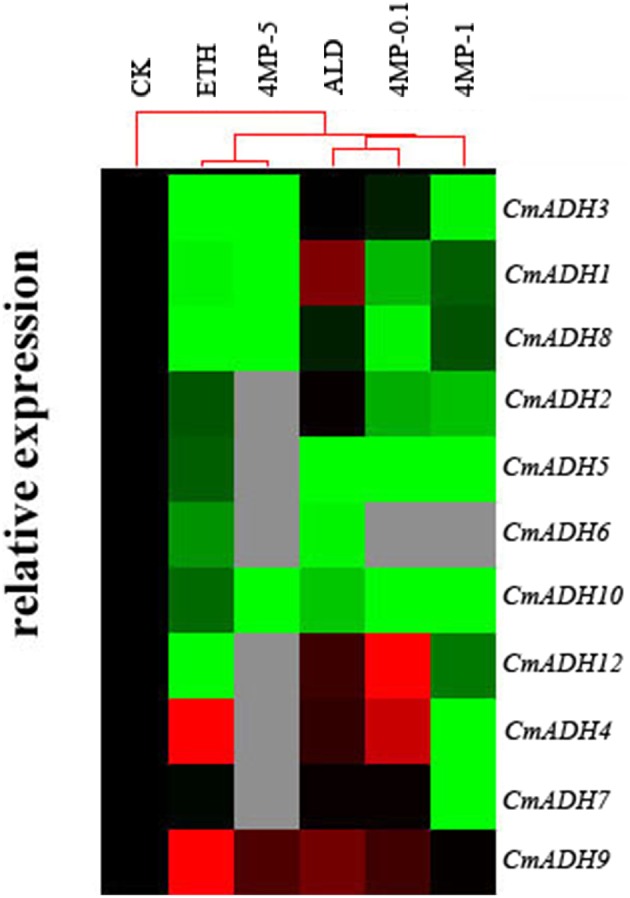
CmADHs gene expression in the incubation experiment of oriental melon “CB” flesh fruit. Expression levels of each gene are showed as a ratio relative to the ADH/18SrRNA ratios for CK, which was set to black. The red cube means transcript level was up-regulated and the green cube means down-regulated on the contrary. All of the data for ADH gene expression are means of three replicates.
Figure 9
Figure 9
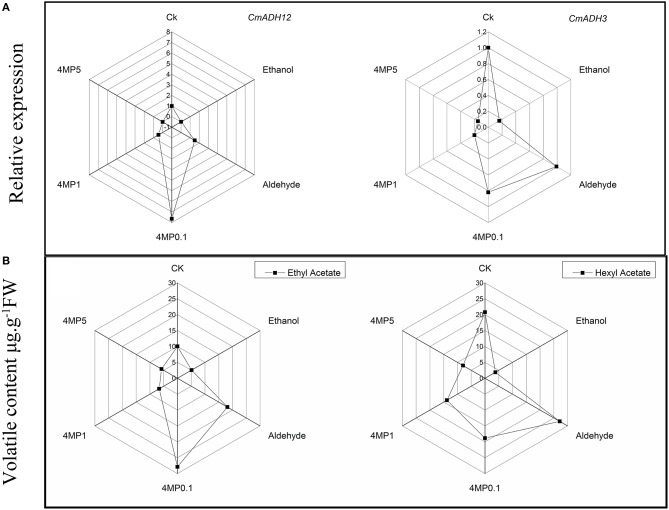
Relative expression of two CmADH genes (CmADH12 and CmADH3) and volatile content of two principle esters (ethyl acetate and hexyl acetate) in incubation experiment. (A) CmADH12 and CmADH3 relative expressions in CB melon incubated with multiple treatments. (B) Volatile content of ethyl acetate and hexyl acetate in CB melon incubated with multiple treatments. The treatments were ethanol (Ethanol), aldehyde (Aldehyde), 0.1mM 4-MP (4MP0.1), 1mM 4-MP (4MP1), and 5mM 4-MP (4MP5). All of the data for ADH gene expression and volatile contents are means of three replicates.

References

    1. Altisent R., Echeverría G., Graell J., López L., Lara I. (2009). Lipoxygenase activity is involved in the regeneration of volatile ester-synthesizing capacity after ultra-low oxygen storage of “Fuji” apple. J. Agric. Food Chem. 57, 4305–4312. 10.1021/jf803930j - DOI - PubMed
    1. Beaulieu J. C., Peiser G., Saltveit M. E. (1997). Acetaldehyde is a causal agent responsible for ethanollnduced ripening inhibition in tomato fruit. Plant Physiol. 113, 431–439. - PMC - PubMed
    1. Bradford M. M. (1976). A rapid and sensitive method for the quantitation of microgram quantities of protein utilizing the principle of protein-dye binding. Anal. Biochem. 72, 248–254. 10.1016/0003-2697(76)90527-3 - DOI - PubMed
    1. Dixon J., Hewett E. W. (2000). Factors affecting apple aroma/flavour volatile concentration: a review. N. Z. J. Crop Hortic. Sci. 28, 155–173. 10.1080/01140671.2000.9514136 - DOI
    1. Echeverría G., Graell J., López M. L., Lara I. (2004). Volatile production, quality and aroma-related enzyme activities during maturation of “Fuji” apples. Postharvest Biol. Technol. 31, 217–227. 10.1016/j.postharvbio.2003.09.003 - DOI