


High-Intensity Intermittent Training Positively Affects Aerobic and Anaerobic Performance in Judo Athletes Independently of Exercise Mode
- PMID: 27445856
- PMCID: PMC4923181
- DOI: 10.3389/fphys.2016.00268
High-Intensity Intermittent Training Positively Affects Aerobic and Anaerobic Performance in Judo Athletes Independently of Exercise Mode
Abstract
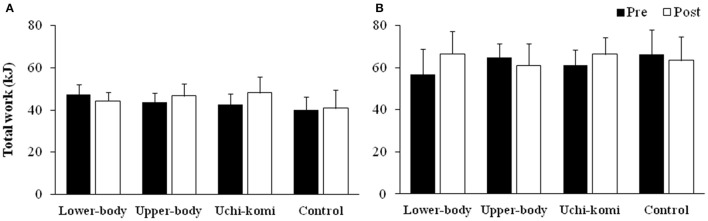
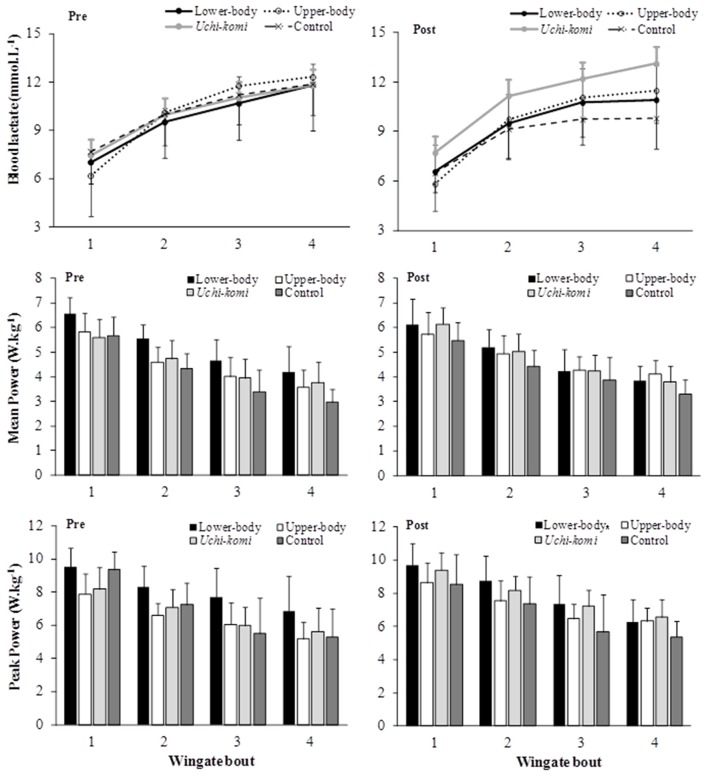
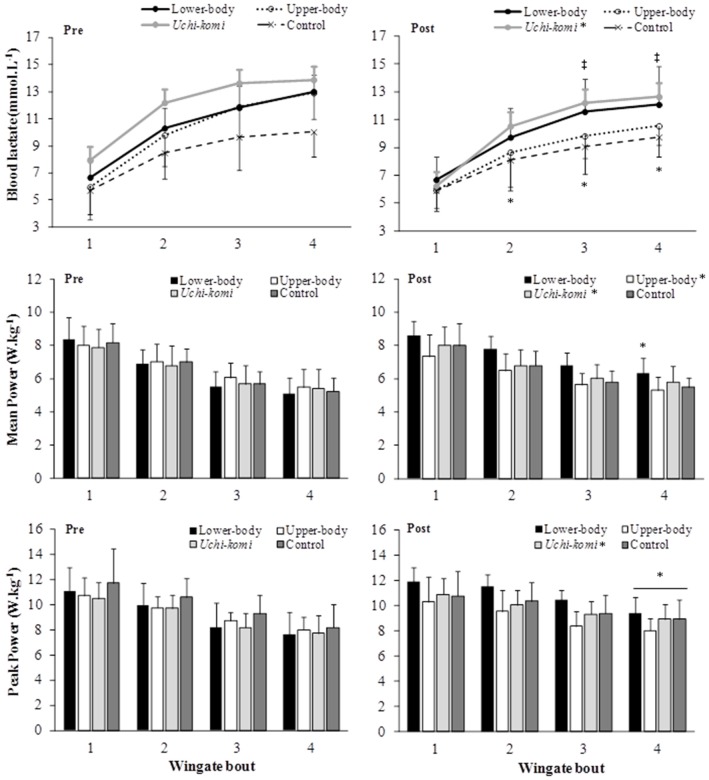
Purpose: The present study investigated the effects of high-intensity intermittent training (HIIT) on lower- and upper-body graded exercise and high-intensity intermittent exercise (HIIE, four Wingate bouts) performance, and on physiological and muscle damage markers responses in judo athletes.
Methods: Thirty-five subjects were randomly allocated to a control group (n = 8) or to one of the following HIIT groups (n = 9 for each) and tested pre- and post-four weeks (2 training d·wk(-1)): (1) lower-body cycle-ergometer; (2) upper-body cycle-ergometer; (3) uchi-komi (judo technique entrance). All HIIT were constituted by two blocks of 10 sets of 20 s of all out effort interspersed by 10 s set intervals and 5-min between blocks.
Results: For the upper-body group there was an increase in maximal aerobic power in graded upper-body exercise test (12.3%). The lower-body group increased power at onset blood lactate in graded upper-body exercise test (22.1%). The uchi-komi group increased peak power in upper- (16.7%) and lower-body (8.5%), while the lower-body group increased lower-body mean power (14.2%) during the HIIE. There was a decrease in the delta blood lactate for the uchi-komi training group and in the third and fourth bouts for the upper-body training group. Training induced testosterone-cortisol ratio increased in the lower-body HIIE for the lower-body (14.9%) and uchi-komi (61.4%) training groups.
Conclusion: Thus, short-duration low-volume HIIT added to regular judo training was able to increase upper-body aerobic power, lower- and upper-body HIIE performance.
Keywords: blood lactate; combat sports; high-intensity intermittent training; hormones; muscle damage markers; oxygen uptake.
Figures
References
LinkOut - more resources
Full Text Sources
Other Literature Sources
Medical
