. 2016 Jun 30:7:1032.
doi: 10.3389/fmicb.2016.01032. eCollection 2016.

Effects of Short-Term Warming and Altered Precipitation on Soil Microbial Communities in Alpine Grassland of the Tibetan Plateau

Affiliations

Effects of Short-Term Warming and Altered Precipitation on Soil Microbial Communities in Alpine Grassland of the Tibetan Plateau

Kaoping Zhang et al. Front Microbiol. .

Erratum in

Abstract

Soil microbial communities are influenced by climate change drivers such as warming and altered precipitation. These changes create abiotic stresses, including desiccation and nutrient limitation, which act on microbes. However, our understanding of the responses of microbial communities to co-occurring climate change drivers is limited. We surveyed soil bacterial and fungal diversity and composition after a 1-year warming and altered precipitation manipulation in the Tibetan plateau alpine grassland. In isolation, warming and decreased precipitation treatments each had no significant effects on soil bacterial community structure; however, in combination of both treatments altered bacterial community structure (p = 0.03). The main effect of altered precipitation specifically impacted the relative abundances of Bacteroidetes and Gammaproteobacteria compared to the control, while the main effect of warming impacted the relative abundance of Betaproteobacteria. In contrast, the fungal community had no significant response to the treatments after 1-year. Using structural equation modeling (SEM), we found bacterial community composition was positively related to soil moisture. Our results indicate that short-term climate change could cause changes in soil bacterial community through taxonomic shifts. Our work provides new insights into immediate soil microbial responses to short-term stressors acting on an ecosystem that is particularly sensitive to global climate change.

Keywords: alpine grassland; climate change; pyrosequencing; soil microbial community structure; soil moisture.


Figures
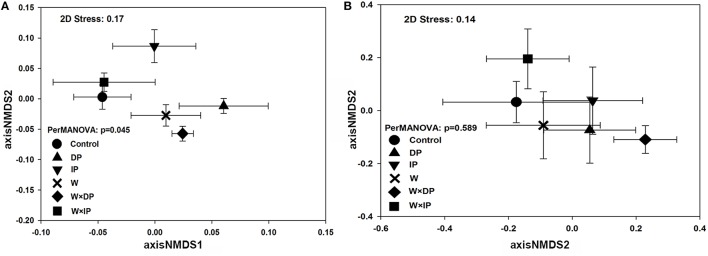
Figure 1
Figure 1
Nonmetric multiple dimension scaling (NMDS) ordination based on Bray-Curtis dissimilarity matrix shows bacterial (A) and fungal (B) community structure among warming and altered precipitation treatments in the experiment sites. Error bars represent the standard error of mean coordinates. DP, decreased precipitation for 50%; IP, increased precipitation for 50%; W, warming for 2°C; W × DP: warming for 2°C and decreased precipitation for 50%; W × IP: warming for 2°C and increased precipitation for 50%.
Figure 2
Figure 2
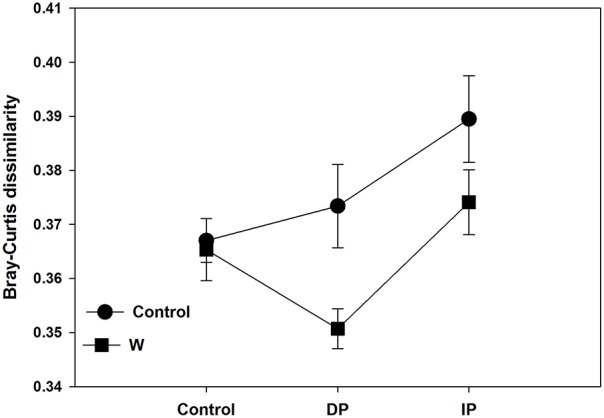
Bacterial Bray-Curtis dissimilarity along the precipitation gradients in each of the two warming treatments. DP, decreased precipitation for 50%; IP, increased precipitation for 50%; W, warming for 2°C.
Figure 3
Figure 3
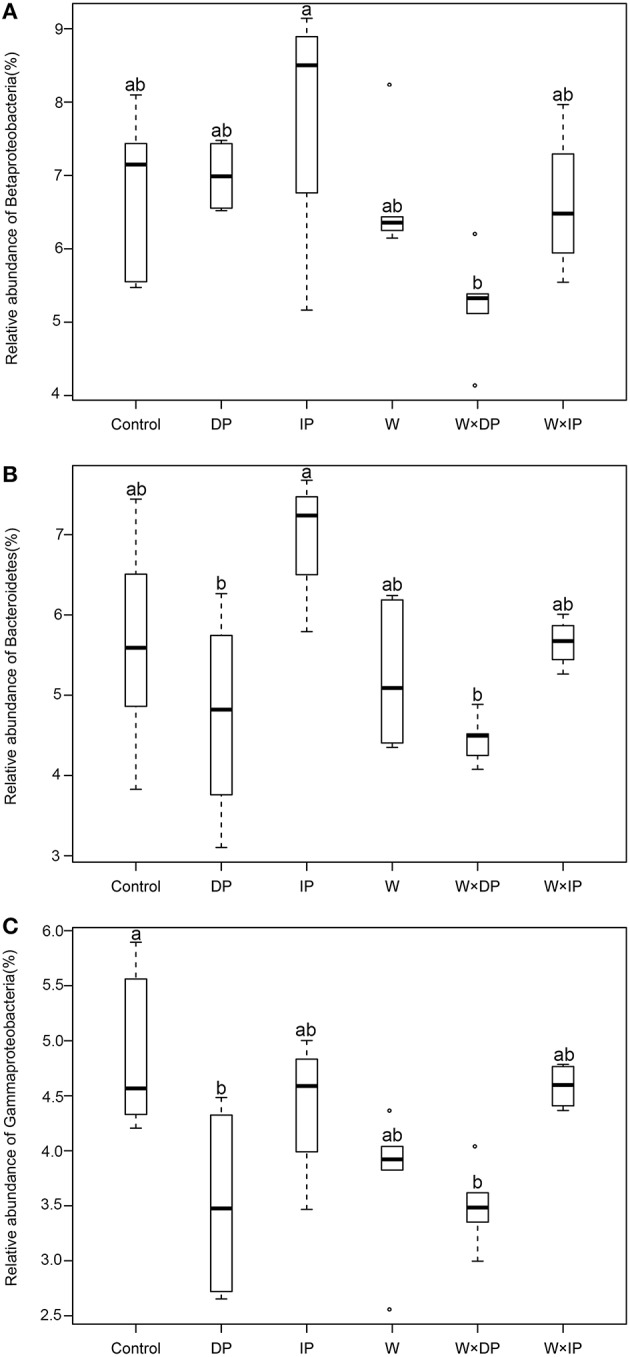
Relative abundance of Betaproteobacteria (A), Bacteroidetes (B), and Gammaproteobacteria (C) under warming and altered precipitation treatments. Different letters indicate statistical differences between control, warming, and altered precipitation plots using Tukey's HSD for multiple comparisons (p < 0.05, mean ± SE). DP, decreased precipitation for 50%; IP, increased precipitation for 50%; W, warming for 2°C; W × DP, warming for 2°C and decreased precipitation for 50%; W × IP, warming for 2°C and increased precipitation for 50%.
Figure 4
Figure 4
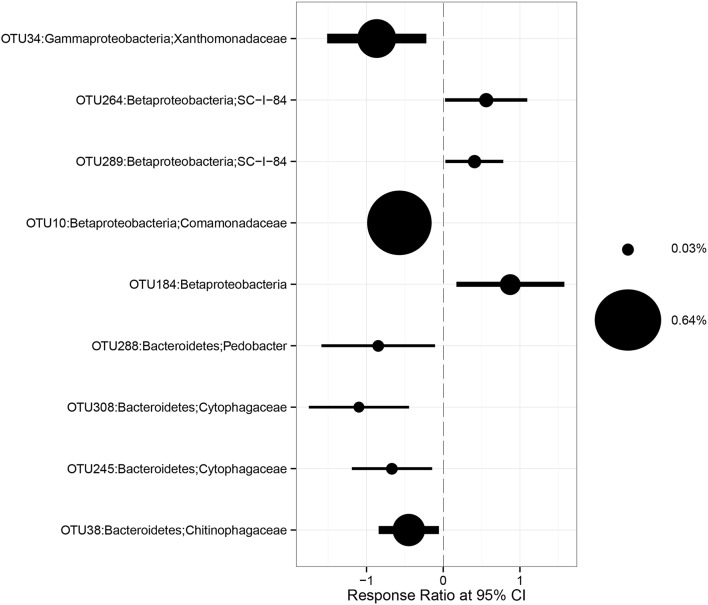
Response ratio method of changes in abundance of OTUs belonging to Bacteroidetes, Betaproteobacteria, and Gammaproteobacteria in W × DP treatment (warming coupling with decreased precipitation) relative to the control.
Figure 5
Figure 5
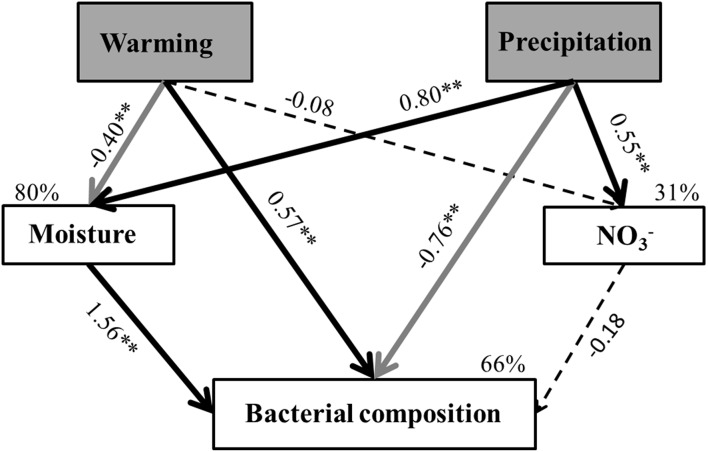
Structural equation model shows the effects of warming and altered precipitation on soil bacterial composition. Causal influences of warming and altered precipitation (exogenous variable; gray rectangle) on soil NO3, soil moisture and bacterial community composition (endogenous variables; white rectangle). The model fit the data well: χ2 = 1.22, df = 2, P = 0.54, GIF = 0.98, RMSEA < 0.001 Numbers on arrows are standardized path coefficients (equivalent to correlation coefficients), asterisks followed the numbers means significant relationships (**p < 0.01 and *p < 0.05). Dark solid arrows indicate significant positive relationships, gray solid arrows indicate significant negative relationships and black dash arrows indicate non-significant path coefficients (p > 0.05). Width of the arrows shows the strength of the causal relationship. Percentages (R2) close to endogenous variables indicate the variance explained by the climatic and soil factors.

References

    1. Bellard C., Bertelsmeier C., Leadley P., Thuiller W., Courchamp F. (2012). Impacts of climate change on the future of biodiversity. Ecol. Lett. 15, 365–377. 10.1111/j.1461-0248.2011.01736.x - DOI - PMC - PubMed
    1. Biddle J. F., Fitz-Gibbon S., Schuster S. C., Brenchley J. E., House C. H. (2008). Metagenomic signatures of the Peru Margin subseafloor biosphere show a genetically distinct environment. Proc. Natl. Acad. Sci. U.S.A. 105, 10583–10588. 10.1073/pnas.0709942105 - DOI - PMC - PubMed
    1. Bouskill N. J., Lim H. C., Borglin S., Salve R., Wood T. E., Silver W. L., et al. (2012). Pre-exposure to drought increases the resistance of tropical forest soil bacterial communities to extended drought. ISME J. 7, 384–394. 10.1038/ismej.2012.113 - DOI - PMC - PubMed
    1. Brzostek E. R., Blair J. M., Dukes J. S., Frey S. D., Hobbie S. E., Melillo J. M., et al. (2012). The effect of experimental warming and precipitation change on proteolytic enzyme activity: positive feedbacks to nitrogen availability are not universal. Glob. Change Biol. 18, 2617–2625. 10.1111/j.1365-2486.2012.02685.x - DOI
    1. Buée M., Reich M., Murat C., Morin E., Nilsson R. H., Uroz S., et al. (2009). 454 Pyrosequencing analyses of forest soil reveal an unexpectedly high fungal diversity. New Phytol. 184, 449–456. 10.1111/j.1469-8137.2009.03003.x - DOI - PubMed

LinkOut - more resources