Review
. 2016 Jun 28:4:29.
doi: 10.3389/fchem.2016.00029. eCollection 2016.

RNA Fluorescence with Light-Up Aptamers

Affiliations
Review

RNA Fluorescence with Light-Up Aptamers

Jonathan Ouellet. Front Chem. .

Abstract

Seeing is not only believing; it also includes understanding. Cellular imaging with GFP in live cells has been transformative in many research fields. Modulation of cellular regulation is tightly regulated and innovative imaging technologies contribute to further understand cellular signaling and physiology. New types of genetically encoded biosensors have been developed over the last decade. They are RNA aptamers that bind with their cognate fluorogen ligands and activate their fluorescence. The emergence and the evolution of these RNA aptamers as well as their conversion into a wide spectrum of applications are examined in a global way.

Keywords: Broccoli; Mango; RNA fluorescence; Spinach; green RNA; light-up aptamers.


Figures

Figure 1
Figure 1
Light-up aptamers. A non-hindered fluorogen can be excited and have its energy dissipated by non-radiative pathway such as molecular vibrations (heat). Once tightly bound by an aptamer, the fluorophore is stabilized and radiative fluorescence decay pathways predominate, leading to a large fluorescence increase.
Figure 2
Figure 2
Spinach and HBI and their optimized derivatives. (A) Secondary structure of the RNA aptamer Spinach determined from its crystal structure. The fluorogen (green) is stabilized on top of the G-quadruplex structure. (B) Secondary structure temperature-optimized Spinach2. (C) Deduced secondary structure of Baby Spinach engineered from the crystal structure essential features. (D) Structure of HBI stabilized within GFP, where the gray regions represent the amino acid segments not involved in the fluorescence. (E) Structure of DFHBI, the fluorogens used for most studies in this review. (F) Structure of DFHBI-1T, the fluorogens with spectral properties more adapted to optics used with GFP fluorescence.
Figure 3
Figure 3
Light-up aptamer as biosensors. (A) The engineered allosteric light-up aptamer is in a misfolded state and cannot bind a fluorogens. (B) Once the metabolite (orange sphere) binds the metabolite-binding aptamer, it promotes the folding of its own stem, which in turns stabilize the formation of the G-quadruplex. (C) The presence of the essential G-quadruplex and its surrounding nucleotides allows the fluorogen (green) to bind the modified light-up aptamer and releases its energy as fluorescence.
Figure 4
Figure 4
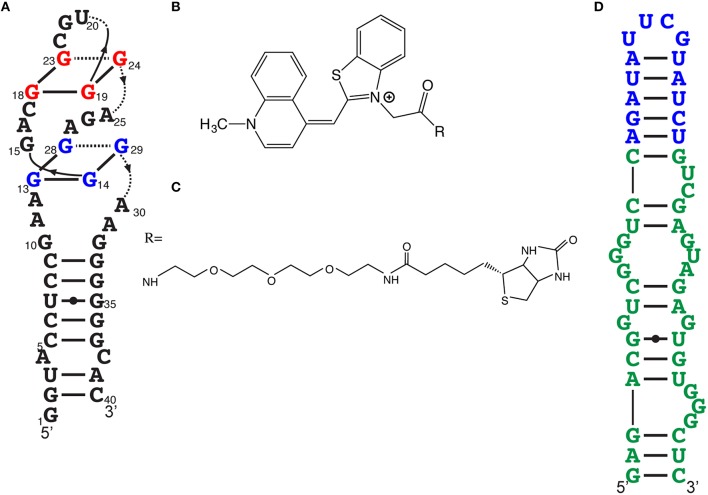
Other efficient light-up aptamers. (A) RNA Mango aptamer predicted secondary structure. (B) Acetylated thiazole orange (TO1), the fluorogen moiety of the Mango ligand. (C) PEGylated biotin, one of the many derivatives essayed, resulting to TO1-biotin, the ligand for RNA Mango. (D) Predicted secondary structure of Broccoli (in green). Effective fluorogens for Broccoli can be DFHBI or DFHBI-1T. The stem-loop in blue is the insertion point to transform this light-up aptamer as a metabolite sensor.

References

    1. Arora A., Sunbul M., Jäschke A. (2015). Dual-colour imaging of RNAs using quencher- and fluorophore-binding aptamers. Nucleic Acids Res. 43, e144. 10.1093/nar/gkv718 - DOI - PMC - PubMed
    1. Ausländer S., Fuchs D., Hürlemann S., Ausländer D., Fussenegger M. (2016). Engineering a ribozyme cleavage-induced split fluorescent aptamer complementation assay. Nucleic Acids Res. 44:e94. 10.1093/nar/gkw117 - DOI - PMC - PubMed
    1. Babendure J. R., Adams S. R., Tsien R. Y. (2003). Aptamers switch on fluorescence of triphenylmethane dyes. J. Am. Chem. Soc. 125, 14716–14717. 10.1021/ja037994o - DOI - PubMed
    1. Bartel D. P., Zapp M. L., Green M. R., Szostak J. W. (1991). HIV-1 Rev regulation involves recognition of non-Watson-Crick base pairs in viral RNA. Cell 67, 529–536. 10.1016/0092-8674(91)90527-6 - DOI - PubMed
    1. Baugh C., Grate D., Wilson C. (2000). 2.8 Å crystal structure of the malachite green aptamer1. J. Mol. Biol. 301, 117–128. 10.1006/jmbi.2000.3951 - DOI - PubMed