Up-regulation of fibroblast growth factor 19 and its receptor associates with progression from fatty liver to hepatocellular carcinoma
- PMID: 27447573
- PMCID: PMC5239555
- DOI: 10.18632/oncotarget.10750
Up-regulation of fibroblast growth factor 19 and its receptor associates with progression from fatty liver to hepatocellular carcinoma
Abstract
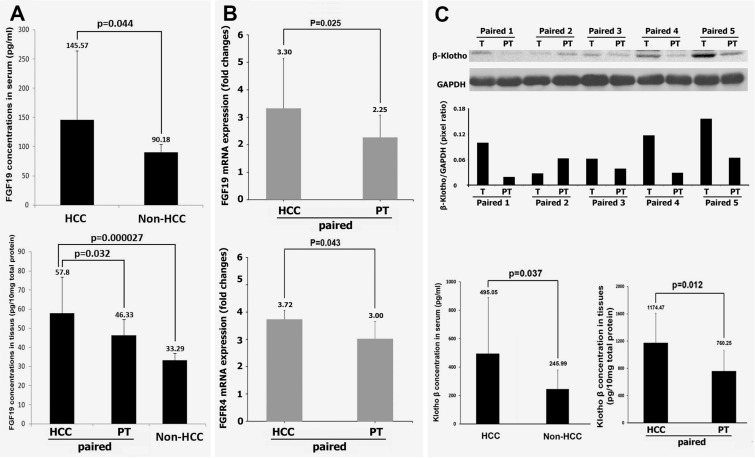
Background: Human fibroblast growth factor 19 (FGF19), its receptor (FGFR4) and EpCAM play an important role in cell proliferation, differentiation, motility, and overexpression have been linked to hepatocellular carcinoma (HCC). The aim of this study was to evaluate the FGF19 signals responsible for the progression of HCC arising from fatty liver.
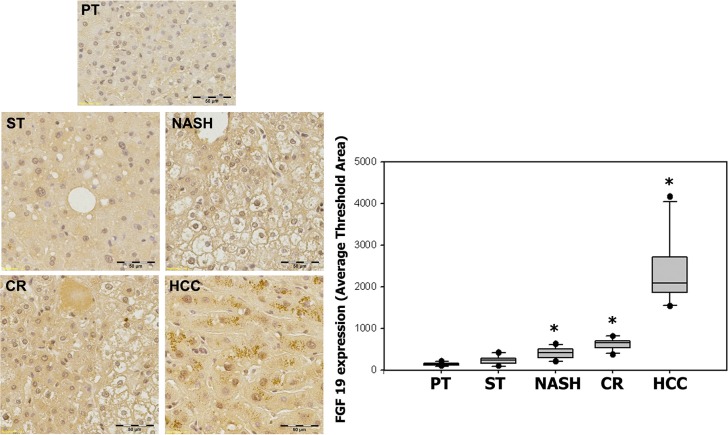
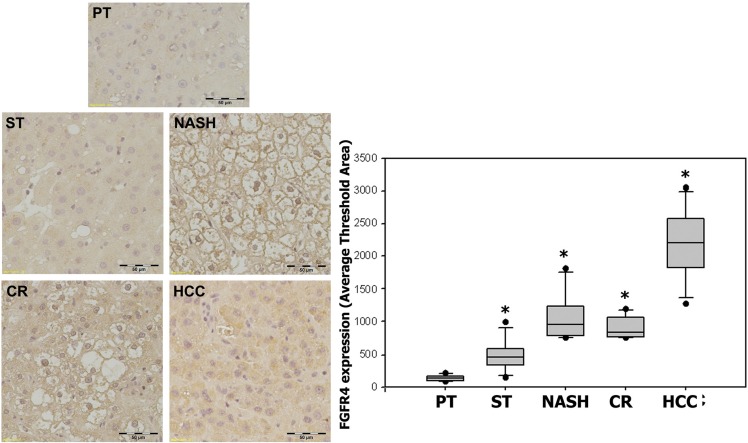
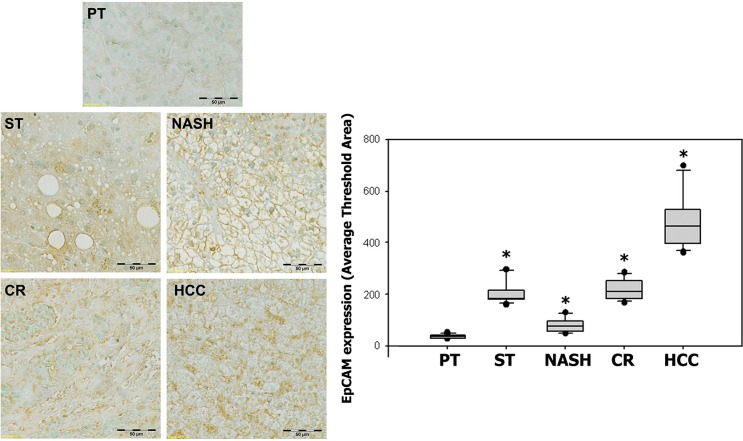
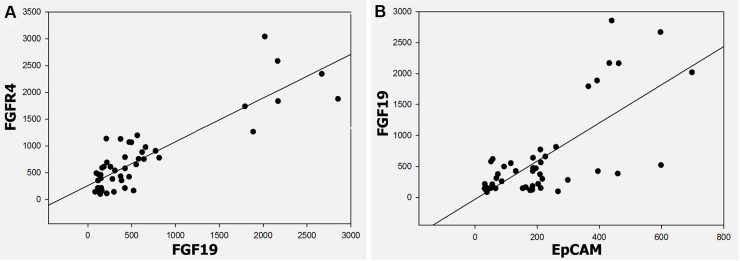
Results: FGF19 level was significantly increased in the HCC patients' serum compared to non-HCC controls. The IHC results demonstrated significant increases of protein expressions of FGF19, FGFR4 and EpCAM in specimens with fatty liver, NASH, cirrhosis, and HCC compared to healthy liver tissue. There was a significant positive correlation between the protein expressions (FGF19, FGFR4, and EpCAM) and histopathologic changes from FL to HCC. Furthermore, FGF19 was positively correlated with FGFR4 and with EpCAM.
Materials and methods: FGF19 protein levels in serum and tissues were determined by ELISA assay. The FGFR4, and EpCAM expression and tissue distribution were further evaluated by immunohistochemical staining in tissue array samples. FGF19, FGFR4 and EpCAM expressions between the different histologic stages of fatty liver steatohepatitis-cirrhosis-HCC carcinogenesis sequence were compared to healthy hepatic tissue.
Conclusions: Overexpression of FGF19/FGFR4 significantly correlated with EpCAM as a marker of hepatic cancer stem cells within the fatty liver-steatosis-cirrhosis-HCC sequence.
Impact: This is the first study to elucidate FGF19/FGFR4 signaling in favor of HCC cells developing as indicated by increased EpCAM within the carcinogenesis sequence from fatty liver to hepatocellular carcinoma. Our study has the potential to yield novel and cost effective screening strategies for HCC patients.
Keywords: FGF19; FGFR4; cancer stem cell; hepatocellular carcinoma.
Conflict of interest statement
All authors have no conflicts of interest.
Figures
References
-
- El-Serag HB. Hepatocellular carcinoma. N Engl J Med. 2011;365:1118–1127. - PubMed
-
- Jemal A, Bray F, Center MM, Ferlay J, Ward E, Forman D. Global cancer statistics. CA Cancer J Clin. 2011;61:69–90. - PubMed
-
- Li T, Qin LX, Gong X, Zhou J, Sun HC, Wang L, Qiu SJ, Ye QH, Fan J. Clinical characteristics, outcome, and risk factors for early and late intrahepatic recurrence of female patients after curative resection of hepatocellular carcinoma. Surgery. 2014;156:651–660. - PubMed
-
- Onnerhag K, Nilsson PM, Lindgren S. Increased risk of cirrhosis and hepatocellular cancer during long-term follow-up of patients with biopsy-proven NAFLD. Scand J Gastroenterol. 2014;49:1111–8. - PubMed
MeSH terms
Substances
LinkOut - more resources
Full Text Sources
Other Literature Sources
Medical
Miscellaneous