. 2017 Jan 1;195(1):104-114.
doi: 10.1164/rccm.201603-0523OC.

Immune Response and Mortality Risk Relate to Distinct Lung Microbiomes in Patients with HIV and Pneumonia

Affiliations

Immune Response and Mortality Risk Relate to Distinct Lung Microbiomes in Patients with HIV and Pneumonia

Meera K Shenoy et al. Am J Respir Crit Care Med. .

Abstract

Rationale: The potential role of the airway microbiota in dictating immune responses and infection outcomes in HIV-associated pneumonia is largely unknown.

Objectives: To investigate whether microbiologically and immunologically distinct subsets of patients with HIV and pneumonia exist and are related to mortality.

Methods: Bronchoalveolar lavage samples from Ugandan patients with HIV and pneumonia (n = 182) were obtained at study enrollment (following antibiotic treatment); patient demographics including 8- and 70-day mortality were collected. Lower airway bacterial community composition was assessed via amplification and sequencing of the V4 region of the 16S ribosomal RNA gene. Host immune response gene expression profiles were generated by quantitative polymerase chain reaction using RNA extracted from bronchoalveolar lavage fluid. Liquid and gas chromatography mass spectrometry was used to profile serum metabolites.

Measurements and main results: Based on airway microbiome composition, most patients segregated into three distinct groups, each of which were predicted to encode metagenomes capable of producing metabolites characteristically enriched in paired serum samples from these patients. These three groups also exhibited differences in mortality; those with the highest rate had increased ceftriaxone administration and culturable Aspergillus, and demonstrated significantly increased induction of airway T-helper cell type 2 responses. The group with the lowest mortality was characterized by increased expression of T-cell immunoglobulin and mucin domain 3, which down-regulates T-helper cell type 1 proinflammatory responses and is associated with chronic viral infection.

Conclusions: These data provide evidence that compositionally and structurally distinct lower airway microbiomes are associated with discrete local host immune responses, peripheral metabolic reprogramming, and different rates of mortality.

Keywords: HIV; immune response; microbiota; mortality; pneumonia.


Figures

Figure 1.
Figure 1.
Antibiotic administration, α-diversity, and probabilistic modeling differentiate bacterial community types within the lower airways of patients with HIV and pneumonia. Principal coordinate analysis of n = 182 lower airway bronchoalveolar lavage bacterial community profiles of Ugandan patients with HIV and pneumonia illustrates that (A) ceftriaxone (in yellow vs. no ceftriaxone in purple), a third-generation cephalosporin, administered at time of bronchoscopy is significantly associated with community composition (PERMANOVA, R2 = 0.061, P < 0.001), as is (B) Shannon diversity (PERMANOVA, R2 = 0.17, P < 0.001, scaled from high [red] to low [blue]). (C) Based on Laplace approximation, for which a lower value indicates a better model fit, Dirichlet multinomial mixtures (DMM) identified two compositionally distinct bacterial microbiota (n = 136 and n = 46) in the lower airways of patients with HIV and pneumonia. (D) Principal coordinate analysis illustrates that DMM-defined lower airway bacterial communities are compositionally distinct (PERMANOVA, R2 = 0.246, P < 0.001). PC = principal coordinate; PERMANOVA = permutational multivariate analysis of variance.
Figure 2.
Figure 2.
Two compositionally distinct lower airway microbial states exist in patients with HIV and pneumonia. (A) Mean community composition of each state at the family level. (B) Lower airway phylogenetic diversity differs significantly across microbial states (one-way analysis of variance [ANOVA], P < 0.001). (C) Principal coordinate analysis plot illustrating weighted UniFrac distances permits visualization of MCS1 (green) and the sister states MCS2A (blue) and MCS2B (red), which collectively explain a significant proportion of bacterial community variation (PERMANOVA, R2 = 0.67, P < 0.001) within the lower airways of this patient population. Patient lower airway communities that do not fit one of these three mean community compositions are depicted in gray. MCS = microbial community state; PC = principal coordinate; PERMANOVA = permutational multivariate ANOVA.
Figure 3.
Figure 3.
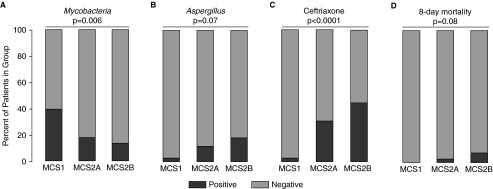
Culture positivity for Mycobacterium or Aspergillus, and antibiotic administration and mortality, differ between microbial community states (MCS). (A) Mycobacterium (chi-square test, P = 0.006) or (B) Aspergillus (P = 0.07) culture positivity, (C) ceftriaxone administration at bronchoscopy (P < 0.0001), and (D) mortality after 1 week of enrollment (P = 0.08) differ among microbial states (positive in black, negative in gray).
Figure 4.
Figure 4.
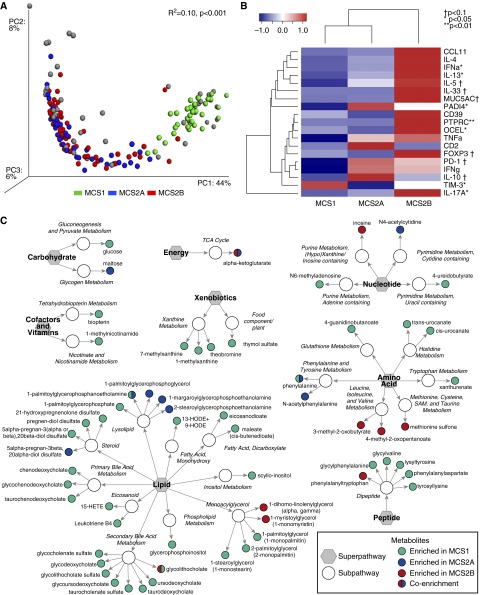
Airway microbial states are predicted to encode distinct metagenomes, and each is shown to induce different lower airway immunologic responses and is associated with significantly different serum metabolomes. (A) Principal coordinate analysis of in silico metagenomic predictions (generated using Phylogenetic Investigation of Communities by Reconstruction of Unobserved States) indicates that the variation in predicted metagenomic content is significantly explained by microbial community states (MCS) designation (PERMANOVA, R2 = 0.10, P < 0.001). Predicted metagenomes of non-MCS samples (gray) share functional similarity with MCS samples. (B) Quantitative real-time polymerase chain reaction array assessing immune-associated gene expression within the lower airways of patients identifies specific cytokines that differ significantly in relative expression across MCS. Pathway significance: *P < 0.05; P < 0.1; **P <  0.01. (C) Comparative liquid and gas chromatography–tandem mass spectrometry metabolomic analysis of paired patient serum identified 60 metabolites that differed significantly among all three groups (Kruskal-Wallis, P < 0.05). Enriched in MCS1 versus MCS 2A and 2B, green; MCS2A versus MCS1 and 2B, blue; MCS2B versus MCS1 and 2A, red; bi-colored circles indicate enrichment in both MCS versus the non-depicted MCS. HETE = hydroxyeicosatetraenoic acid; HODE = hydroxyoctadecadienoic acid; PC = principal coordinate; PERMANOVA = permutational multivariate analysis of variance; SAM = S-adenosyl methionine; TCA = tricarboxylic acid cycle.

Comment in

References

    1. World Health Organization. The gap report. Geneva, Switzerland: Joint United Nations Programme on HIV/AIDS; 2014.
    1. World Health Organization. UNAIDS report on the global AIDS epidemic 2013. Geneva, Switzerland: Joint United Nations Programme on HIV/AIDS; 2013.
    1. Badri M, Ehrlich R, Wood R, Pulerwitz T, Maartens G. Association between tuberculosis and HIV disease progression in a high tuberculosis prevalence area. Int J Tuberc Lung Dis. 2001;5:225–232. - PubMed
    1. Chaisson RE, Martinson NA. Tuberculosis in Africa: combating an HIV-driven crisis. N Engl J Med. 2008;358:1089–1092. - PubMed
    1. French N, Gordon SB, Mwalukomo T, White SA, Mwafulirwa G, Longwe H, Mwaiponya M, Zijlstra EE, Molyneux ME, Gilks CF. A trial of a 7-valent pneumococcal conjugate vaccine in HIV-infected adults. N Engl J Med. 2010;362:812–822. - PMC - PubMed

Publication types

MeSH terms

Substances