


Gut Microbial Membership Modulates CD4 T Cell Reconstitution and Function after Sepsis
- PMID: 27448587
- PMCID: PMC4992581
- DOI: 10.4049/jimmunol.1600940
Gut Microbial Membership Modulates CD4 T Cell Reconstitution and Function after Sepsis
Abstract
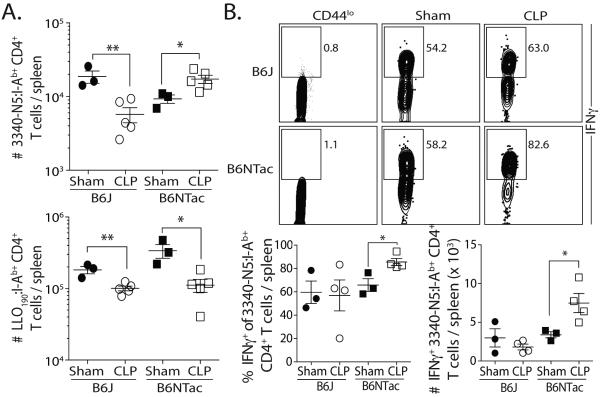
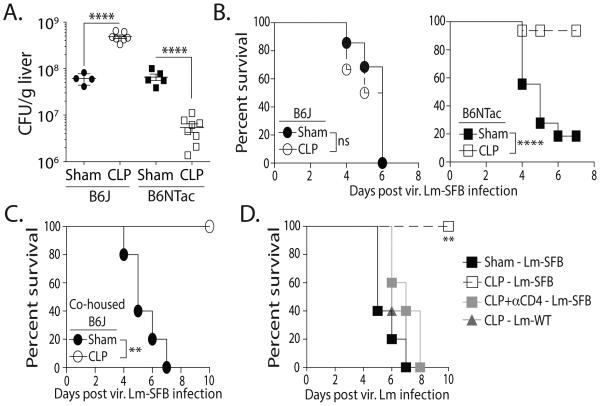
Transient lymphopenia is one hallmark of sepsis, and emergent data indicate the CD4 T cell compartment in sepsis survivors is numerically and functionally altered (when examined at the Ag-specific level) compared with nonseptic control subjects. Previous data from our laboratory demonstrated Ag-independent, lymphopenia-induced homeostatic proliferation to be a contributing mechanism by which CD4 T cells numerically recover in sepsis survivors. However, we reasoned it is also formally possible that some CD4 T cells respond directly to Ag expressed by gut-resident microbes released during polymicrobial sepsis. The effect of gut microbiome leakage on CD4 T cells is currently unknown. In this study, we explored the number and function of endogenous CD4 T cells specific for segmented filamentous bacterium (SFB) after cecal ligation and puncture (CLP)-induced sepsis using mice that either contained or lacked SFB as a normal gut-resident microbe. Interestingly, SFB-specific CD4 T cells underwent Ag-driven proliferation in CLP-treated SFB(+), but not in SFB(-), mice. Moreover, CLP-treated SFB(+) mice showed resistance to secondary lethal infection with recombinant SFB Ag-expressing virulent Listeria (but not wild-type virulent Listeria), suggesting the CLP-induced polymicrobial sepsis primed for a protective response by the SFB-specific CD4 T cells. Thus, our data demonstrate that the numerical recovery and functional responsiveness of Ag-specific CD4 T cells in sepsis survivors is, in part, modulated by the intestinal barrier's health discreetly defined by individual bacterial populations of the host's microbiome.
Copyright © 2016 by The American Association of Immunologists, Inc.
Figures
References
-
- Shankar-Hari M, Phillips GS, Levy ML, Seymour CW, Liu VX, Deutschman CS, Angus DC, Rubenfeld GD, Singer M, F. Sepsis Definitions Task Developing a New Definition and Assessing New Clinical Criteria for Septic Shock: For the Third International Consensus Definitions for Sepsis and Septic Shock (Sepsis-3) JAMA. 2016;315:775–787. - PMC - PubMed
-
- Vulliamy PE, Perkins ZB, Brohi K, Manson J. Persistent lymphopenia is an independent predictor of mortality in critically ill emergency general surgical patients. Eur. J. Trauma Emerg. Surg. 2015 - PubMed
-
- Hamers L, Kox M, Pickkers P. Sepsis-induced immunoparalysis: mechanisms, markers, and treatment options. Minerva Anestesiol. 2015;81:426–439. - PubMed
-
- Hotchkiss RS, Tinsley KW, Swanson PE, Schmieg RE, Jr., Hui JJ, Chang KC, Osborne DF, Freeman BD, Cobb JP, Buchman TG, Karl IE. Sepsis-induced apoptosis causes progressive profound depletion of B and CD4+ T lymphocytes in humans. J. Immunol. 2001;166:6952–6963. - PubMed
Publication types
MeSH terms
Substances
Grants and funding
LinkOut - more resources
Full Text Sources
Other Literature Sources
Medical
Research Materials
Miscellaneous
