


Design Principles for SuCESsFul Biosensors: Specific Fluorophore/Analyte Binding and Minimization of Fluorophore/Scaffold Interactions
- PMID: 27448945
- PMCID: PMC5048519
- DOI: 10.1016/j.jmb.2016.07.004
Design Principles for SuCESsFul Biosensors: Specific Fluorophore/Analyte Binding and Minimization of Fluorophore/Scaffold Interactions
Abstract
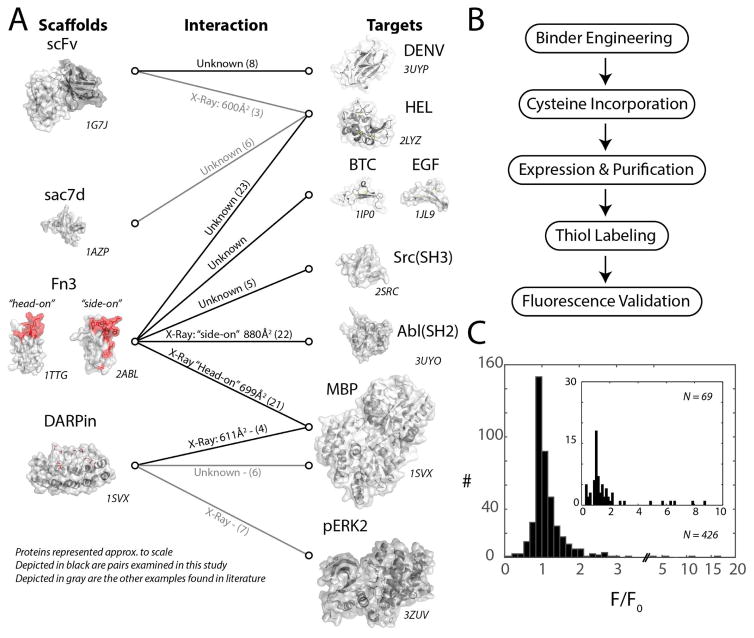
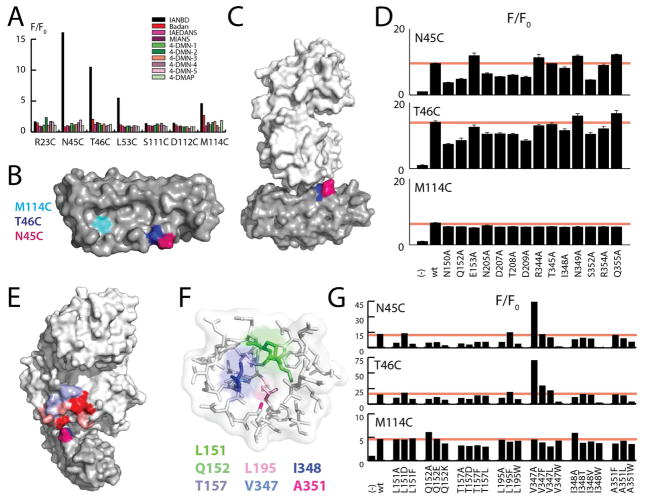
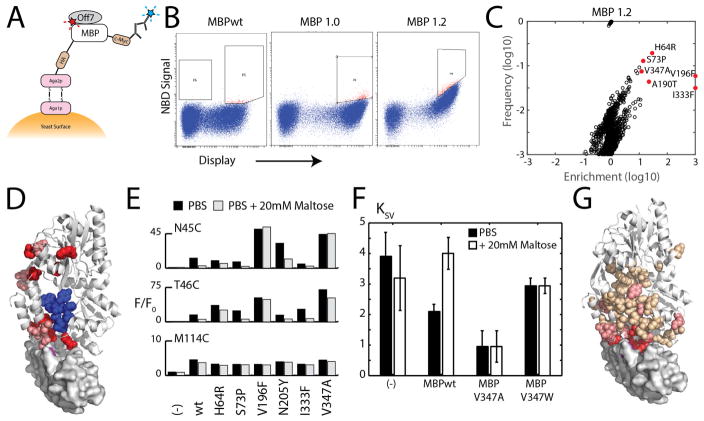
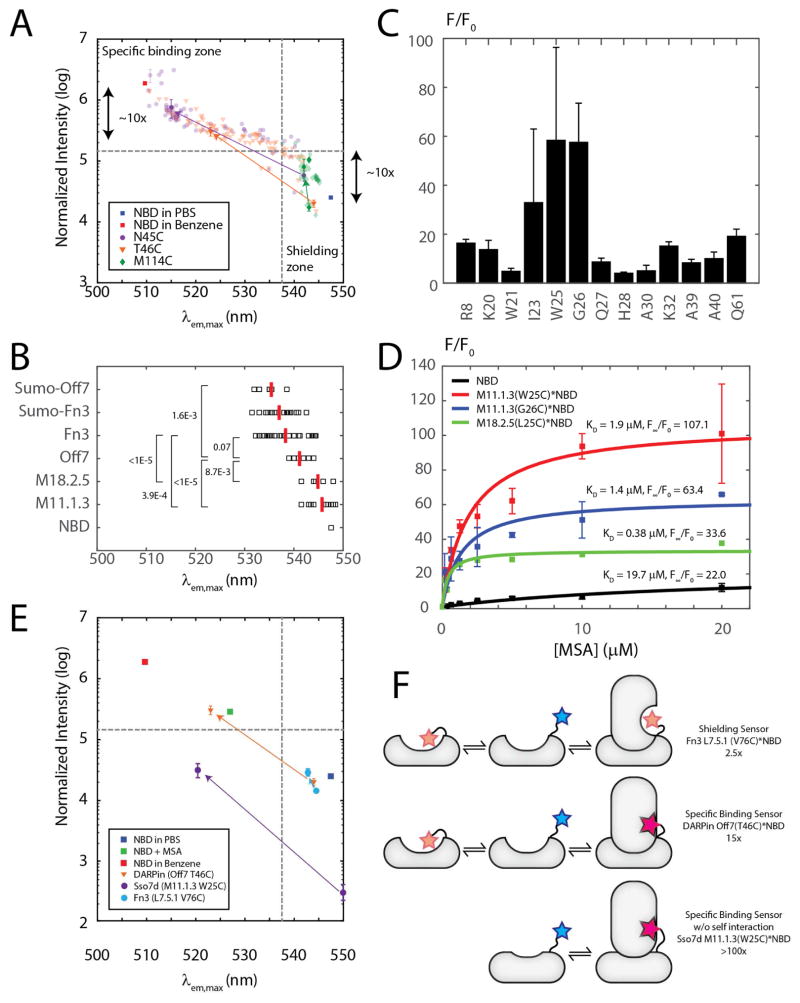
Quantifying protein location and concentration is critical for understanding function in situ. Scaffold conjugated to environment-sensitive fluorophore (SuCESsFul) biosensors, in which a reporting fluorophore is conjugated to a binding scaffold, can, in principle, detect analytes of interest with high temporal and spatial resolution. However, their adoption has been limited due to the extensive empirical screening required for their development. We sought to establish design principles for this class of biosensor by characterizing over 400 biosensors based on various protein analytes, binding proteins, and fluorophores. We found that the brightest readouts are attained when a specific binding pocket for the fluorophore is present on the analyte. Also, interaction of the fluorophore with the binding protein it is conjugated to can raise background fluorescence, considerably limiting sensor dynamic range. Exploiting these two concepts, we designed biosensors that attain a 100-fold increase in fluorescence upon binding to analyte, an order of magnitude improvement over the previously best-reported SuCESsFul biosensor. These design principles should facilitate the development of improved SuCESsFul biosensors.
Keywords: Sso7d scaffold; directed evolution; protein engineering; sensors; solvatochromism.
Copyright © 2016 Elsevier Ltd. All rights reserved.
Conflict of interest statement
The authors declare no competing financial interests.
Figures
References
-
- Zadran S, et al. Fluorescence resonance energy transfer (FRET)-based biosensors: visualizing cellular dynamics and bioenergetics. Appl Microbiol Biotechnol. 2012;96:895–902. - PubMed
-
- Renard M, et al. Knowledge-based design of reagentless fluorescent biosensors from recombinant antibodies. J Mol Biol. 2002;318:429–42. - PubMed
-
- Brient-Litzler E, Pluckthun A, Bedouelle H. Knowledge-based design of reagentless fluorescent biosensors from a designed ankyrin repeat protein. Protein Eng Des Sel. 2010;23:229–41. - PubMed
Publication types
MeSH terms
Substances
Grants and funding
LinkOut - more resources
Full Text Sources
Other Literature Sources
