


Potentially Preventable 30-Day Hospital Readmissions at a Children's Hospital
- PMID: 27449421
- PMCID: PMC5557411
- DOI: 10.1542/peds.2015-4182
Potentially Preventable 30-Day Hospital Readmissions at a Children's Hospital
Abstract
Background and objectives: Hospital readmission rates are increasingly used to assess quality. Little is known, however, about potential preventability of readmissions among children. Our objective was to evaluate potential preventability of 30-day readmissions using medical record review and interviews.
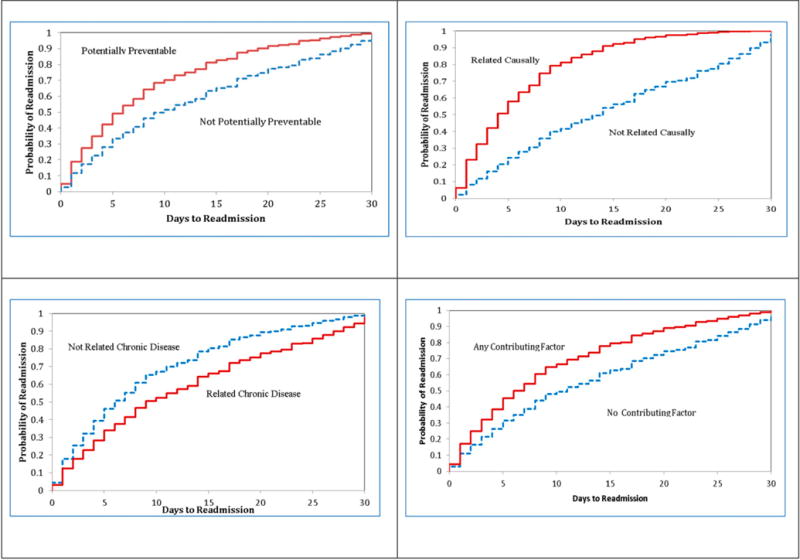
Methods: A cross-sectional study in 305 children (<18 years old) readmitted within 30 days to a freestanding children's hospital between December 2012 and February 2013. Interviews (N = 1459) were conducted with parents/guardians, patients (if ≥13 years old), inpatient clinicians, and primary care providers. Reviewers evaluated medical records, interview summaries, and transcripts, and then rated potential preventability. Multivariate regression analysis was used to identify factors associated with potentially preventable readmission. Adjusted event curves were generated to model days to readmission.
Results: Of readmissions, 29.5% were potentially preventable. Potentially preventable readmissions occurred sooner after discharge than non-potentially preventable readmissions (5 vs 9 median days; P < .001). The odds of a readmission being potentially preventable were greatest when the index admission and readmission were causally related (adjusted odds ratio [AOR]: 2.6; 95% confidence interval [CI]: 1.0-6.8) and when hospital (AOR: 16.3; 95% CI: 5.9-44.8) or patient (AOR: 7.1; 95% CI: 2.5-20.5) factors were identified. Interviews provided new information about the readmission in 31.2% of cases.
Conclusions: Nearly 30% of 30-day readmissions to a children's hospital may be potentially preventable. Hospital and patient factors are associated with potential preventability and may provide targets for quality improvement efforts. Interviews contribute important information and should be considered when evaluating readmissions.
Copyright © 2016 by the American Academy of Pediatrics.
Conflict of interest statement
Figures
Comment in
-
Preventing Pediatric Readmissions: How Does the Hospital Fit In?Pediatrics. 2016 Aug;138(2):e20161643. doi: 10.1542/peds.2016-1643. Pediatrics. 2016. PMID: 27449419 No abstract available.
References
-
- Hansen LO, Young RS, Hinami K, Leung A, Williams MV. Interventions to reduce 30-day rehospitalization: a systematic review. Ann Intern Med. 2011;155(8):520–528. - PubMed
-
- Centers for Medicare and Medicaid Services. Readmissions reduction program. Published April 26 2013. Available at: www.cms.gov/Medicare/Medicare-Fee-for-Service-Payment/AcuteInpatientPPS/.... Accessed May 20, 2013.
-
- Agency for Healthcare Research and Quality Centers for Medicare and Medicaid Services. Pediatric All-Condition Readmission Measure. Available at: www.ahrq.gov/sites/default/files/wysiwyg/policymakers/chipra/factsheets/...p008-1-ef.pdf. Accessed August 17, 2015.
-
- Patient Protection and Affordable Care Act. Vol Stat. 2010;119:318–319. Available at: www.gpo.gov/fdsys/pkg/PLAW-111publ148. pdfAccessed September 8, 2015.
Publication types
MeSH terms
Grants and funding
LinkOut - more resources
Full Text Sources
Other Literature Sources
