


Daily longitudinal self-monitoring of mood variability in bipolar disorder and borderline personality disorder
- PMID: 27449555
- PMCID: PMC5296237
- DOI: 10.1016/j.jad.2016.06.065
Daily longitudinal self-monitoring of mood variability in bipolar disorder and borderline personality disorder
Abstract
Background: Traditionally, assessment of psychiatric symptoms has been relying on their retrospective report to a trained interviewer. The emergence of smartphones facilitates passive sensor-based monitoring and active real-time monitoring through time-stamped prompts; however there are few validated self-report measures designed for this purpose.
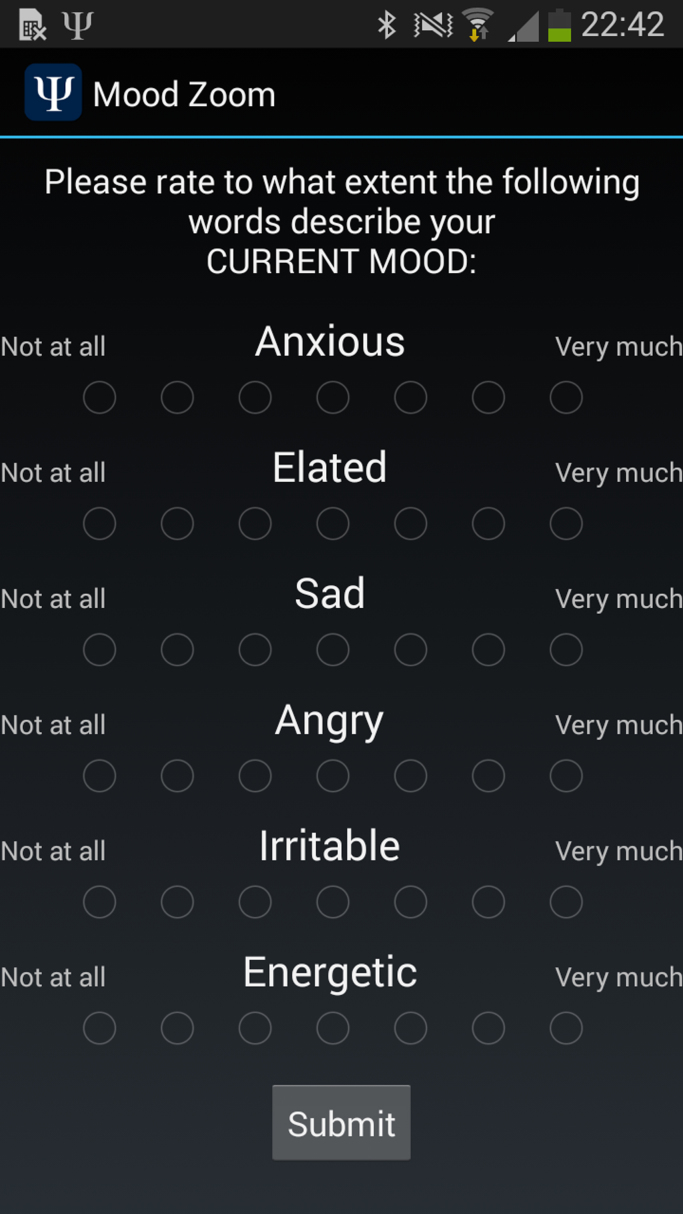
Methods: We introduce a novel, compact questionnaire, Mood Zoom (MZ), embedded in a customised smart-phone application. MZ asks participants to rate anxiety, elation, sadness, anger, irritability and energy on a 7-point Likert scale. For comparison, we used four standard clinical questionnaires administered to participants weekly to quantify mania (ASRM), depression (QIDS), anxiety (GAD-7), and quality of life (EQ-5D). We monitored 48 Bipolar Disorder (BD), 31 Borderline Personality Disorders (BPD) and 51 Healthy control (HC) participants to study longitudinal (median±iqr: 313±194 days) variation and differences of mood traits by exploring the data using diverse time-series tools.
Results: MZ correlated well (|R|>0.5,p<0.0001) with QIDS, GAD-7, and EQ-5D. We found statistically strong (|R|>0.3,p<0.0001) differences in variability in all questionnaires for the three cohorts. Compared to HC, BD and BPD participants exhibit different trends and variability, and on average had higher self-reported scores in mania, depression, and anxiety, and lower quality of life. In particular, analysis of MZ variability can differentiate BD and BPD which was not hitherto possible using the weekly questionnaires.
Limitations: All reported scores rely on self-assessment; there is a lack of ongoing clinical assessment by experts to validate the findings.
Conclusions: MZ could be used for efficient, long-term, effective daily monitoring of mood instability in clinical psychiatric practice.
Keywords: Bipolar disorder; Borderline personality disorder; Digital health; Mood assessment; Mood monitoring; Patient reported outcome measures.
Copyright © 2016 The Authors. Published by Elsevier B.V. All rights reserved.
Figures
Comment in
-
Mood Zoom could be a promising tool for daily mood variability monitoring, potentially differentiating bipolar from borderline patients.Evid Based Ment Health. 2017 May;20(2):e9. doi: 10.1136/eb-2017-102629. Epub 2017 Apr 11. Evid Based Ment Health. 2017. PMID: 28400391 Free PMC article. No abstract available.
References
-
- Altman E.G. The Altman Self-rating Mania Scale. Biol. Psychiatry. 1997;42(10):948–955. - PubMed
-
- American Psychiatry Association . Diagnostic and Statistical Manual of Mental Disorders. 5th ed. (DSM-5), American Psychiatric Publishing; Arlington: 2013.
-
- Anastasi A. Psychological Testing. 5th ed. Macmillan; New York: 1982.
-
- Anderson I.M., Haddad P.M., Scott J. Bipolar disorder. BMJ. 2012;345:e8508. - PubMed
MeSH terms
LinkOut - more resources
Full Text Sources
Other Literature Sources
Medical
