


Electronic Alert System for Improving Stroke Prevention Among Hospitalized Oral-Anticoagulation-Naïve Patients With Atrial Fibrillation: A Randomized Trial
- PMID: 27451467
- PMCID: PMC5015408
- DOI: 10.1161/JAHA.116.003776
Electronic Alert System for Improving Stroke Prevention Among Hospitalized Oral-Anticoagulation-Naïve Patients With Atrial Fibrillation: A Randomized Trial
Abstract
Background: Many patients with atrial fibrillation (AF) do not receive oral anticoagulants (OAC) for the prevention of stroke and systemic embolism. We aimed to improve the prescription of (OAC) among hospitalized patients with AF.
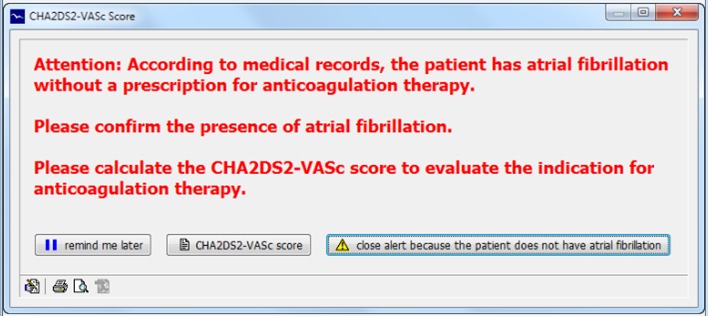
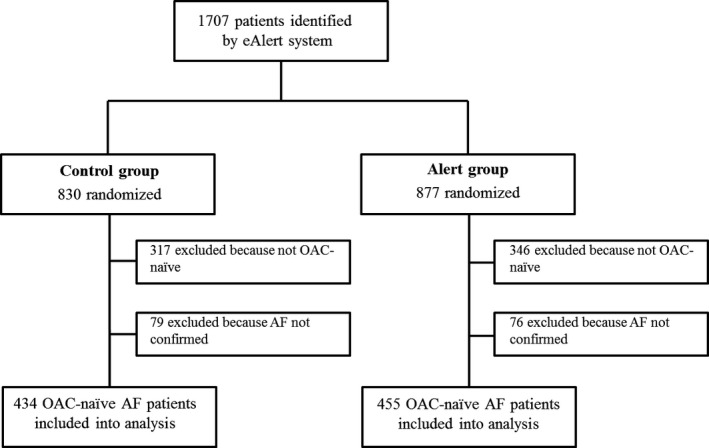
Methods and results: We developed a computer-based electronic alert system for identifying hospitalized OAC-naïve patients with AF. The alert system contained a CHA2DS2-VASc score calculation tool and provided recommendations for OAC prescription. The alert system was tested in a 1:1 randomized controlled trial at the University Hospital Bern: Patients with suspected AF without an active prescription order were allocated to an alert group in which an alert was issued in the electronic patient chart and order entry system or to a control group in which no alert was issued. The primary end point was the rate of adequate OAC prescription at hospital discharge, defined as prescription in OAC-naïve men and women with CHA2DS2-VASc score ≥1 and ≥2, respectively. Overall, 889 OAC-naïve patients (455 from the alert group and 434 from the control group) were eligible for analysis. Although the CHA2DS2-VASc score module was used in only 48 (10.5%) patients from the alert group, 100 (22.0%) patients from the alert group versus 69 (15.9%) from the control group received adequate OAC prescription (relative risk 1.38; P=0.021). OAC or antiplatelet therapy was prescribed in 325 (71.4%) patients from the alert group versus 271 (62.4%) from the control group (P=0.004).
Conclusions: Versus standard care, the alert system modestly improved OAC prescription among consecutive hospitalized AF patients.
Clinical trial registration: URL: https://www.clinicaltrials.gov. Unique identifier: NCT02455102.
Keywords: anticoagulants; arrhythmia; atrial fibrillation; electronic alert system; embolism.
© 2016 The Authors. Published on behalf of the American Heart Association, Inc., by Wiley Blackwell.
Figures
References
-
- Schnabel RB, Yin X, Gona P, Larson MG, Beiser AS, McManus DD, Newton‐Cheh C, Lubitz SA, Magnani JW, Ellinor PT, Seshadri S, Wolf PA, Vasan RS, Benjamin EJ, Levy D. 50 year trends in atrial fibrillation prevalence, incidence, risk factors, and mortality in the Framingham Heart Study: a cohort study. Lancet. 2015;386:154–162. - PMC - PubMed
-
- Chugh SS, Havmoeller R, Narayanan K, Singh D, Rienstra M, Benjamin EJ, Gillum RF, Kim YH, McAnulty JH Jr, Zheng ZJ, Forouzanfar MH, Naghavi M, Mensah GA, Ezzati M, Murray CJ. Worldwide epidemiology of atrial fibrillation: a Global Burden of Disease 2010 Study. Circulation. 2014;129:837–847. - PMC - PubMed
-
- Steger C, Pratter A, Martinek‐Bregel M, Avanzini M, Valentin A, Slany J, Stöllberger C. Stroke patients with atrial fibrillation have a worse prognosis than patients without: data from the Austrian Stroke registry. Eur Heart J. 2004;25:1734–1740. - PubMed
-
- Kirchhof P, Auricchio A, Bax J, Crijns H, Camm J, Diener HC, Goette A, Hindricks G, Hohnloser S, Kappenberger L, Kuck KH, Lip GY, Olsson B, Meinertz T, Priori S, Ravens U, Steinbeck G, Svernhage E, Tijssen J, Vincent A, Breithardt G. Outcome parameters for trials in atrial fibrillation: executive summary. Eur Heart J. 2007;28:2803–2817. - PubMed
-
- Goto S, Bhatt DL, Rother J, Alberts M, Hill MD, Ikeda Y, Uchiyama S, D'Agostino R, Ohman EM, Liau CS, Hirsch AT, Mas JL, Wilson PW, Corbalán R, Aichner F, Steg PG; REACH Registry Investigators . Prevalence, clinical profile, and cardiovascular outcomes of atrial fibrillation patients with atherothrombosis. Am Heart J. 2008;156:855–863. - PubMed
Publication types
MeSH terms
Substances
Associated data
LinkOut - more resources
Full Text Sources
Other Literature Sources
Medical
