


Cannabinoid receptor 1 (CNR1) gene variant moderates neural index of cognitive disruption during nicotine withdrawal
- PMID: 27453054
- PMCID: PMC6027743
- DOI: 10.1111/gbb.12311
Cannabinoid receptor 1 (CNR1) gene variant moderates neural index of cognitive disruption during nicotine withdrawal
Abstract
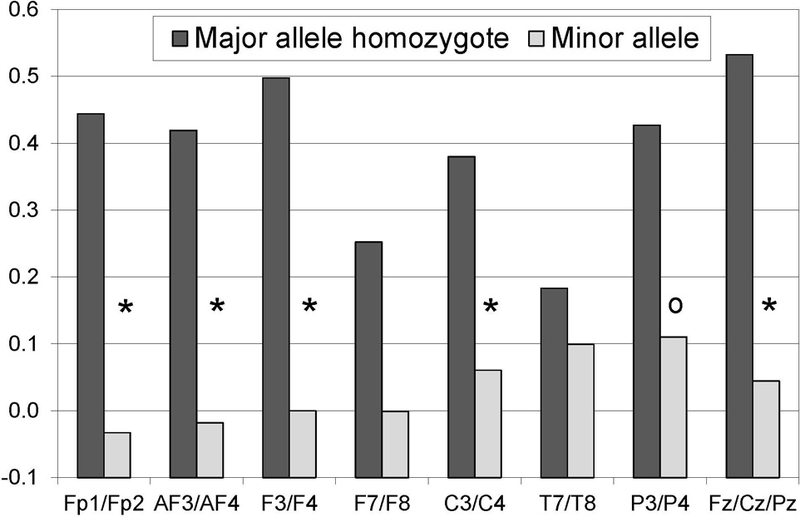
Nicotine withdrawal-related disruption of cognitive control may contribute to the reinforcement of tobacco use. Identification of gene variants that predict this withdrawal phenotype may lead to tailored pharmacotherapy for smoking cessation. Variation on the cannabinoid receptor 1 gene (CNR1) has been related to nicotine dependence, and CNR1 antagonists may increase attention and memory functioning. We targeted CNR1 variants as moderators of a validated neural marker of nicotine withdrawal-related cognitive disruption. CNR1 polymorphisms comprising the 'TAG' haplotype (rs806379, rs1535255 and rs2023239) were tested independently, as no participants in this sample possessed this haplotype. Nicotine withdrawal-related cognitive disruption was indexed as increased resting electroencephalogram (EEG) alpha-1 power density across 17 electrodes. Seventy-three Caucasian Non-Hispanic smokers (≥15 cigarettes per day) visited the laboratory on two occasions following overnight smoking/nicotine deprivation. Either two nicotine or two placebo cigarettes were smoked prior to collecting EEG data at each session. Analyses showed that rs806379 moderated the effects of nicotine deprivation increasing slow wave EEG (P = 0.004). Smokers homozygous for the major allele exhibited greater nicotine withdrawal-related cognitive disruption. The current findings suggest potential efficacy of cannabinoid receptor antagonism as a pharmacotherapy approach for smoking cessation among individuals who exhibit greater nicotine withdrawal-related cognitive disruption.
Keywords: Alpha-1; CNR1; EEG; ERP; cannabinoid; cognitive control; genetics; nicotine withdrawal; smoking.
© 2016 John Wiley & Sons Ltd and International Behavioural and Neural Genetics Society.
Conflict of interest statement
Conflict of Interest
None of the authors have potential conflicts of interest (financial or other) regarding information reported herein. David Drobes has served as an expert witness in litigation against tobacco companies.
Figures
References
-
- Clarke AR, Barry RJ, Bond D, McCarthy R, Selikowitz M (2002) Effects of stimulant medications on the EEG of children with attention-deficit/hyperactivity disorder. Psychopharmacology 164, 277–284. - PubMed
-
- Cohen C, Perrault G, Voltz C, Steinberg R & Soubrie P (2002) SR141716, a central cannabinoid (CB1) receptor antagonist, blocks the motivational and dopamine-releasing effects of nicotine in rats. Behav Pharmacol 13, 451–463. - PubMed
-
- Degroot A, Kofalvi A, Wade MR, Davis RJ, Rodrigues RJ, Rebola N, Cunha RA & Nomikos GG (2006) CB1 receptor antagonism increases hippocampal acetylcholine release: site and mechanism of action. Mol Pharmacol 70, 1236–1245. - PubMed
-
- Dien J (2010) Evaluating two‐step PCA of ERP data with geomin, infomax, oblimin, promax, and varimax rotations. Psychophysiology 47, 170–183. - PubMed
MeSH terms
Substances
Grants and funding
LinkOut - more resources
Full Text Sources
Other Literature Sources
