


Childhood Trauma and Illicit Drug Use in Adolescence: A Population-Based National Comorbidity Survey Replication-Adolescent Supplement Study
- PMID: 27453084
- PMCID: PMC4964281
- DOI: 10.1016/j.jaac.2016.05.010
Childhood Trauma and Illicit Drug Use in Adolescence: A Population-Based National Comorbidity Survey Replication-Adolescent Supplement Study
Abstract
Objective: Although potentially traumatic events (PTEs) are established risk factors for substance use disorders among adults, little is known about associations with drug use during adolescence, an important developmental stage for drug use prevention. We examined whether childhood PTEs were associated with illicit drug use among a representative sample of US adolescents.
Method: Data were drawn from the National Comorbidity Survey Replication-Adolescent Supplement (NCS-A), which included adolescents aged 13 to 18 years (N = 9,956). Weighted logistic regression models estimated risk ratios for lifetime use of marijuana, cocaine, nonmedical prescription drugs, other drugs, and multiple drugs.
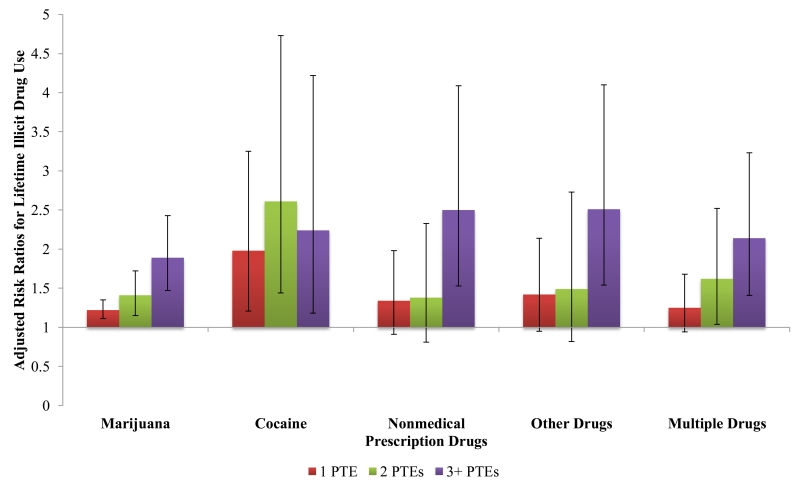
Results: Exposure to any PTE before age 11 years was reported by 36% of the sample and was associated with higher risk for use of marijuana (risk ratio [RR] = 1.50), cocaine (RR = 2.78), prescription drugs (RR = 1.80), other drugs (RR = 1.90), and multiple drugs (RR = 1.74). A positive monotonic relationship was observed between number of PTEs and marijuana, other drug, and multiple drug use. Interpersonal violence was associated with all drug use outcomes. Accidents and unspecified events were associated with higher risk for marijuana, cocaine, and prescription drug use.
Conclusion: Potentially traumatic events in childhood are associated with risk for illicit drug use among US adolescents. These findings add to the literature by illustrating a potentially modifiable health behavior that may be a target for intervention. The results also highlight that adolescents with a trauma history are a high-risk group for illicit drug use and may benefit from trauma-focused prevention efforts that specifically address traumatic memories and coping strategies for dealing with stressful life events.
Keywords: adolescents; childhood trauma; illicit drugs; maltreatment; substance use.
Copyright © 2016 American Academy of Child and Adolescent Psychiatry. Published by Elsevier Inc. All rights reserved.
Figures
Comment in
-
Early Childhood Traumatic Events and Adolescent-Onset Illicit Drug Use: Implications for Prevention and Treatment.J Am Acad Child Adolesc Psychiatry. 2016 Aug;55(8):643-4. doi: 10.1016/j.jaac.2016.05.013. J Am Acad Child Adolesc Psychiatry. 2016. PMID: 27453076 No abstract available.
References
-
- Substance Abuse and Mental Health Services Administration (SAMHSA) Results from the 2013 national survey on drug use and health: Summary of national findings. Substance Abuse and Mental Health Services Administration; Rockville, MD: 2013.
-
- Faden VB. Trends in initiation of alcohol use in the United States 1975 to 2003. Alcohol Clin Exp Res. 2006;30:1011–1022. - PubMed
-
- Rothman EF, Edwards EM, Heeren T, Hingson RW. Adverse childhood experiences predict earlier age of drinking onset: results from a representative US sample of current or former drinkers. Pediatrics. 2008;122:e298–304. - PubMed
-
- Bounoua N, Ali B, Lim A, et al. Early initiation of alcohol and illicit drug use: Associations with psychopathology among inpatient substance users. Drug Alcohol Depend. 2015;146:e227.
-
- Hawkins JD, Catalano RF, Miller JY. Risk and protective factors for alcohol and other drug problems in adolescence and early adulthood: Implications for substance abuse prevention. Psychol Bull. 1992;112:64–105. - PubMed
Publication types
MeSH terms
Grants and funding
LinkOut - more resources
Full Text Sources
Other Literature Sources
Medical
