


Local Recurrence and Breast Oncological Surgery in Young Women With Breast Cancer: The POSH Observational Cohort Study
- PMID: 27455160
- PMCID: PMC5639998
- DOI: 10.1097/SLA.0000000000001930
Local Recurrence and Breast Oncological Surgery in Young Women With Breast Cancer: The POSH Observational Cohort Study
Abstract
Objective: To assess clinical and surgical factors affecting local recurrence and survival in young breast cancer patients in the Prospective study of Outcomes in Sporadic versus Hereditary breast cancer (POSH).
Background: Emerging data suggest young age is a predictor of increased local recurrence.
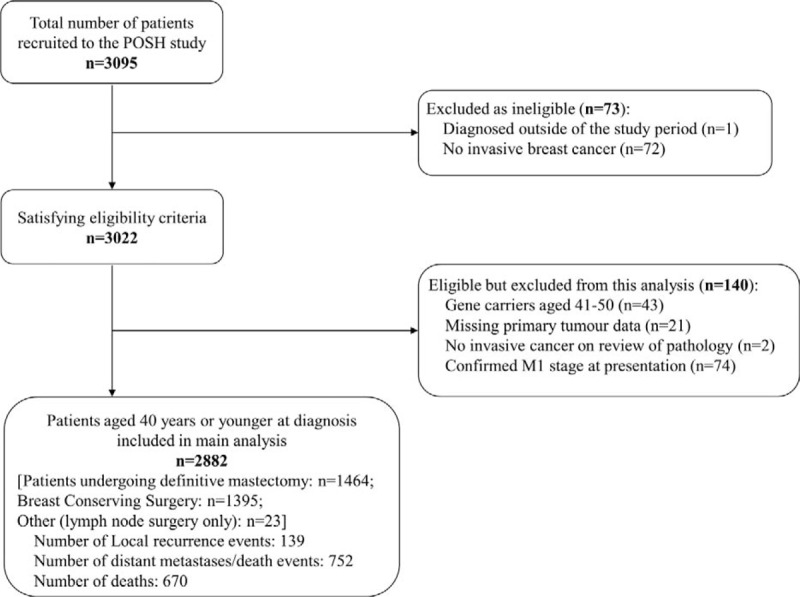
Methods: POSH is a prospective cohort of 3024 women of 18 to 40 years with breast cancer. Cohort characteristics were grouped by mastectomy or BCS. Endpoints were local-recurrence interval (LRI), distant disease-free interval (DDFI), and overall survival (OS); described using cumulative-hazard and Kaplan-Meier plots and multivariable analyses by Flexible Parametric and Cox regression models.
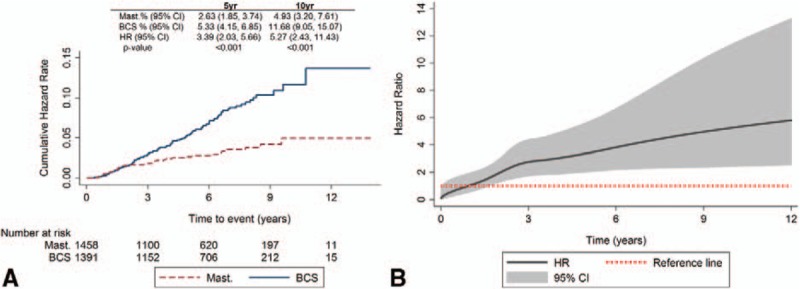
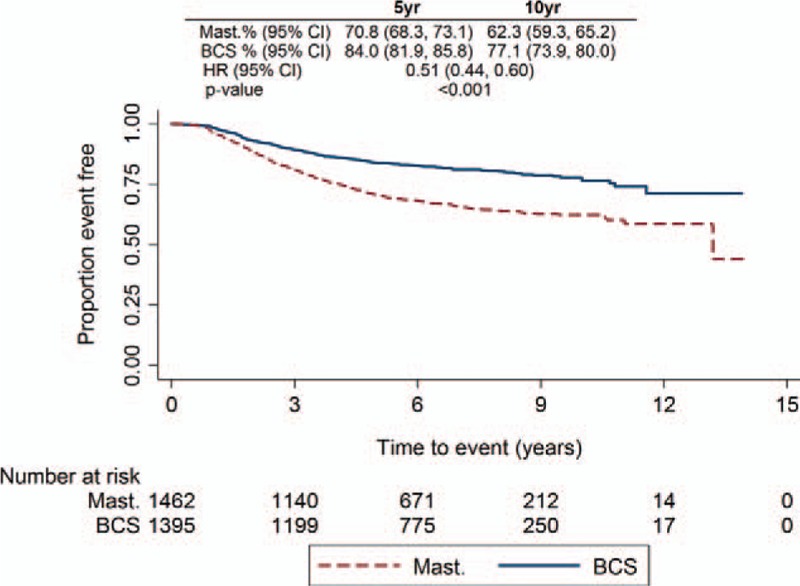
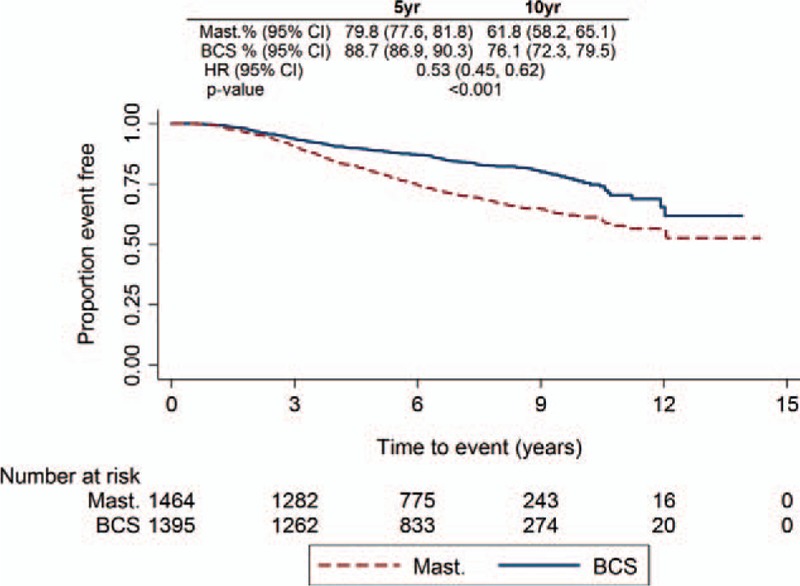
Results: Mastectomy was performed in 1464 patients and breast-conserving surgery (BCS) in 1395. Patients undergoing mastectomy had larger tumors and higher proportions of positive family history, estrogen receptor+, progesterone receptor+, and/or human epidermal growth factor receptor 2+ tumors. Local events accounted for 15% of recurrences. LRI by surgical type varied over time with LRI similar at 18 months (1.0% vs 1.0%, P = 0.348) but higher for BCS at 5 and 10 years (5.3% vs 2.6%, P < 0.001; and 11.7% vs 4.9%, P < 0.001, respectively). Similar results were found in the adjusted model. Conversely, distant-metastases and deaths were lower for BCS but not after adjusting for prognostic factors. After mastectomy chest-wall radiotherapy was associated with improved LRI (hazard ratio, HR = 0.46, P = 0.015). Positive surgical margins, and development of local recurrence predicted for reduced DDFI (HR = 0.50, P < 0.001; and HR = 0.29, P = 0.001, respectively).
Conclusions: Surgical extent appears less important for DDFI than completeness of excision or, where appropriate, chest-wall radiotherapy. Despite higher local-recurrence rates for BCS, surgical type does not influence DDFI or OS after adjusting for known prognostic factors in young breast cancer patients.
Conflict of interest statement
The authors declare no conflict of interest.
Figures
References
-
- Cancer Research UK. Breast Cancer Statistics. Available at: http://www.cancerresearchuk.org/health-professional/breast-cancer-incide... Accessed January 25, 2016.
-
- Collins LC, Marotti JD, Gelber S, et al. Pathologic features and molecular phenotype by patient age in a large cohort of young women with breast cancer. Breast Cancer Res Treat 2012; 131:1061–1066. - PubMed
-
- Narod SA. Breast Cancer in young women. Nat Rev Clin Oncol 2012; 9:460–470. - PubMed
-
- King TA. Selecting local therapy in the young breast cancer patient. J Surg Oncol 2011; 103:330–336. - PubMed
-
- van Nes JGH, van de Velde CJH. The preferred treatment for young women with breast cancer—mastectomy versus breast conservation. Breast 2006; 15 (S2):S3–S10. - PubMed
Publication types
MeSH terms
Grants and funding
LinkOut - more resources
Full Text Sources
Other Literature Sources
Medical
Research Materials
