


Injectable and Glucose-Responsive Hydrogels Based on Boronic Acid-Glucose Complexation
- PMID: 27455412
- PMCID: PMC5242094
- DOI: 10.1021/acs.langmuir.5b04755
Injectable and Glucose-Responsive Hydrogels Based on Boronic Acid-Glucose Complexation
Abstract
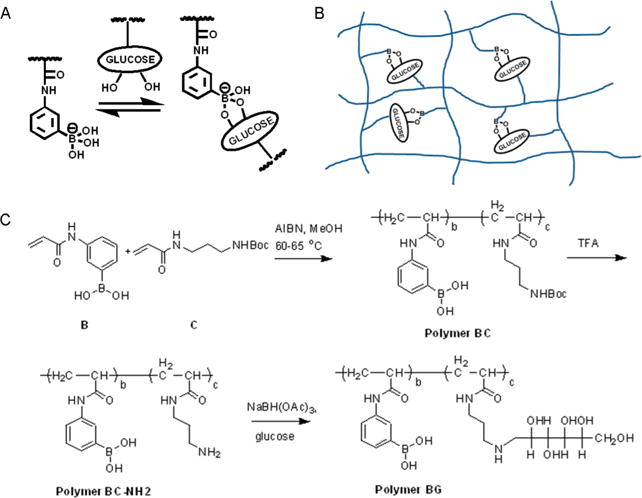
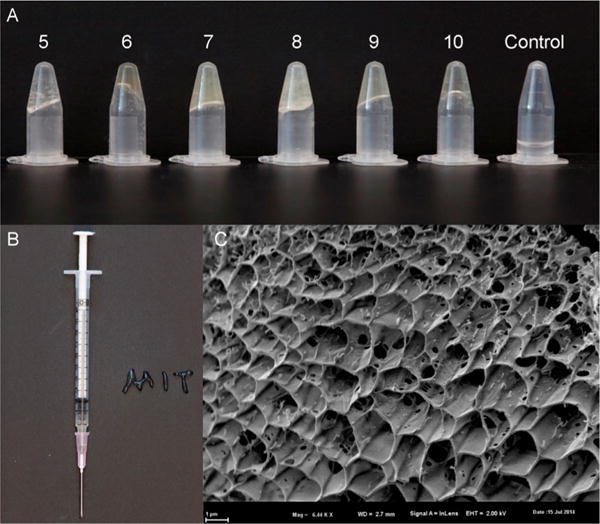
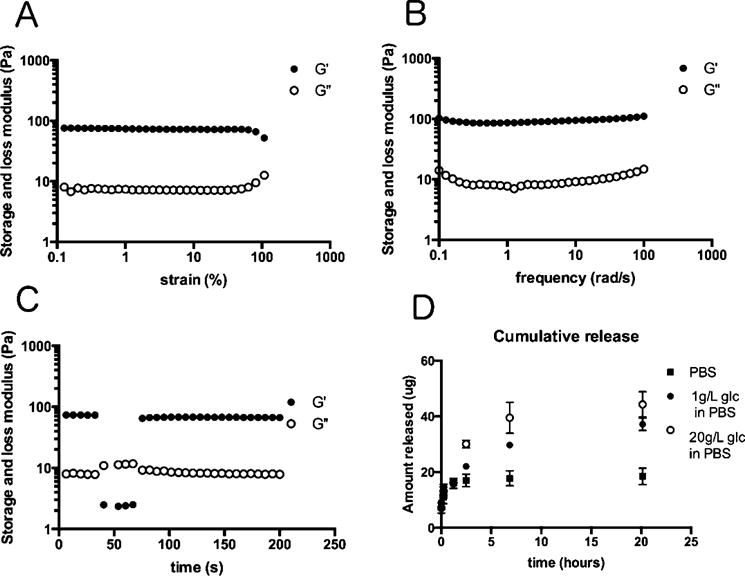
Injectable hydrogels have been widely used for a number of biomedical applications. Here, we report a new strategy to form an injectable and glucose-responsive hydrogel using the boronic acid-glucose complexation. The ratio of boronic acid and glucose functional groups is critical for hydrogel formation. In our system, polymers with 10-60% boronic acid, with the balance being glucose-modified, are favorable to form hydrogels. These hydrogels are shear-thinning and self-healing, recovering from shear-induced flow to a gel state within seconds. More importantly, these polymers displayed glucose-responsive release of an encapsulated model drug. The hydrogel reported here is an injectable and glucose-responsive hydrogel constructed from the complexation of boronic acid and glucose within a single component polymeric material.
Conflict of interest statement
Notes The authors declare no competing financial interest.
Figures
References
-
- Appel EA, del Barrio J, Loh XJ, Scherman OA. Supramolecular polymeric hydrogels. Chem Soc Rev. 2012;41(18):6195–214. - PubMed
-
- Appel EA, Loh XJ, Jones ST, Dreiss CA, Scherman OA. Sustained release of proteins from high water content supra-molecular polymer hydrogels. Biomaterials. 2012;33(18):4646–52. - PubMed
-
- Kanchwala SK, Holloway L, Bucky LP. Reliable soft tissue augmentation: a clinical comparison of injectable soft-tissue fillers for facial-volume augmentation. Ann Plast Surg. 2005;55(1):30–5. - PubMed
-
- Li Y, Rodrigues J, Tomas H. Injectable and biodegradable hydrogels: gelation, biodegradation and biomedical applications. Chem Soc Rev. 2012;41(6):2193–221. - PubMed
Publication types
MeSH terms
Substances
Grants and funding
LinkOut - more resources
Full Text Sources
Other Literature Sources
