. 2016 Jul 25;11(1):102.
doi: 10.1186/s13023-016-0485-0.

Increased red cell distribution width in Fanconi anemia: a novel marker of stress erythropoiesis

Affiliations

Increased red cell distribution width in Fanconi anemia: a novel marker of stress erythropoiesis

Rosa Sousa et al. Orphanet J Rare Dis. .

Abstract

Background: Red cell distribution width (RDW), a classical parameter used in the differential diagnosis of anemia, has recently been recognized as a marker of chronic inflammation and high levels of oxidative stress (OS). Fanconi anemia (FA) is a genetic disorder associated to redox imbalance and dysfunctional response to OS. Clinically, it is characterized by progressive bone marrow failure, which remains the primary cause of morbidity and mortality. Macrocytosis and increased fetal hemoglobin, two indicators of bone marrow stress erythropoiesis, are generally the first hematological manifestations to appear in FA. However, the significance of RDW and its possible relation to stress erythropoiesis have never been explored in FA. In the present study we analyzed routine complete blood counts from 34 FA patients and evaluated RDW, correlating with the hematological parameters most consistently associated with the FA phenotype.

Results: We showed, for the first time, that RDW is significantly increased in FA. We also showed that increased RDW is correlated with thrombocytopenia, neutropenia and, most importantly, highly correlated with anemia. Analyzing sequential hemograms from 3 FA patients with different clinical outcomes, during 10 years follow-up, we confirmed a consistent association between increased RDW and decreased hemoglobin, which supports the postulated importance of RDW in the evaluation of hematological disease progression.

Conclusions: This study shows, for the first time, that RDW is significantly increased in FA, and this increment is correlated with neutropenia, thrombocytopenia, and highly correlated with anemia. According to the present results, it is suggested that increased RDW can be a novel marker of stress erythropoiesis in FA.

Keywords: Bone marrow failure (BMF); Fanconi anemia (FA); Oxidative stress (OS); Red cell distribution width (RDW); Stress erythropoiesis.


Figures
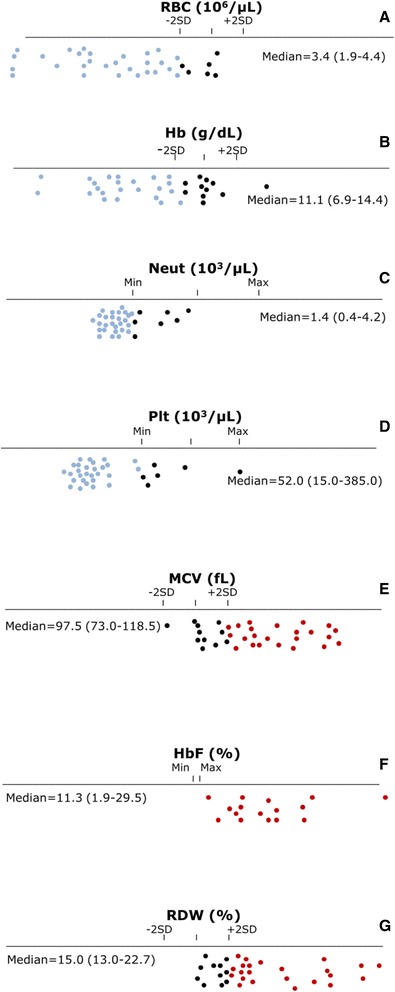
Fig. 1
Fig. 1
Graphic representation of hematological values from 34 FA patients. Normal ranges with minimum and maximal standard deviation (−2SD, +2SD) or minimal and maximal percentage (Min, Max) were established according to internal laboratorial reference values, with age and gender adjustments. Median value (min-max) of this Fanconi anemia (FA) population is indicated for each parameter. a red blood cells (RBC) counts (x106/µL). b hemoglobin (Hb) values (%). c neutrophil (Neut) counts (x103/µL). d platelet (Plt) counts (x103/µL). e mean corpuscular volume (MCV) value (fL). f fetal hemoglobin (HbF) values (%). g red cell distribution width (RDW) values (%)
Fig. 2
Fig. 2
Correlation between RDW hematological parameters most relevant for FA characterization. Red cell distribution width (RDW) values and hematological parameters most relevant for Fanconi anemia (FA) characterization were depicted from routine complete blood counts of 34 FA patients. All values are provided with standard measurement units; p-values >0.05 are not significant, p-values <0.01 are significant (**) and p-values <0.001 are highly significant (***)
Fig. 3
Fig. 3
Correlation between RDW and Hb values in sequential follow-up hemograms from 3 FA patients. Red cell distribution width (RDW) values and hemoglobin (Hb) values were depicted from sequential hemograms, routinely evaluated during 10 years follow-up, of 3 Fanconi anemia (FA) patients with different clinical outcomes: an adult patient clinically stable (P32); a young patient with a previous progression to bone marrow failure (BMF) that reverted to a stable condition (P9); a patient with severe BMF since childhood who initiated androgen treatment after 10 years follow-up (P7). All values are provided with standard measurement units

References

    1. Salvagno GL, Sanchis-Gomar F, Picanza A, Lippi G. Red blood cell distribution width: a simple parameter with multiple clinical applications. Crit Rev Clin Lab Sci. 2015;52(2):86–105. doi: 10.3109/10408363.2014.992064. - DOI - PubMed
    1. Tsuboi S, Miyauchi K, Kasai T, Ogita M, Dohi T, Miyazaki T, et al. Impact of red blood cell distribution width on long-term mortality in diabetic patients after percutaneous coronary intervention. Circ J. 2013;77(2):456–61. doi: 10.1253/circj.CJ-12-0730. - DOI - PubMed
    1. Semba RD, Patel KV, Ferrucci L, Sun K, Roy CN, Guralnik JM, et al. Serum antioxidants and inflammation predict red cell distribution width in older women: the Women’s Health and Aging Study I. Clin Nutr. 2010;29(5):600–4. doi: 10.1016/j.clnu.2010.03.001. - DOI - PMC - PubMed
    1. Friedman JS, Lopez MF, Fleming MD, Rivera A, Martin FM, Welsh ML, et al. SOD2-deficiency anemia: protein oxidation and altered protein expression reveal targets of damage, stress response, and antioxidant responsiveness. Blood. 2004;104(8):2565–73. doi: 10.1182/blood-2003-11-3858. - DOI - PubMed
    1. Duxin JP, Walter JC. What is the DNA repair defect underlying Fanconi anemia? Curr Opin Cell Biol. 2015;37:49–60. doi: 10.1016/j.ceb.2015.09.002. - DOI - PMC - PubMed

LinkOut - more resources
