Review
. 2016 Aug;29(4):573-91.
doi: 10.1007/s10534-016-9952-2. Epub 2016 Jul 25.

Iron uptake and transport across physiological barriers

Affiliations
Review

Iron uptake and transport across physiological barriers

Kari A Duck et al. Biometals. 2016 Aug.

Abstract

Iron is an essential element for human development. It is a major requirement for cellular processes such as oxygen transport, energy metabolism, neurotransmitter synthesis, and myelin synthesis. Despite its crucial role in these processes, iron in the ferric form can also produce toxic reactive oxygen species. The duality of iron's function highlights the importance of maintaining a strict balance of iron levels in the body. As a result, organisms have developed elegant mechanisms of iron uptake, transport, and storage. This review will focus on the mechanisms that have evolved at physiological barriers, such as the intestine, the placenta, and the blood-brain barrier (BBB), where iron must be transported. Much has been written about the processes for iron transport across the intestine and the placenta, but less is known about iron transport mechanisms at the BBB. In this review, we compare the established pathways at the intestine and the placenta as well as describe what is currently known about iron transport at the BBB and how brain iron uptake correlates with processes at these other physiological barriers.

Keywords: Blood–brain barrier; Gut; HFE; Iron transport; Placenta.


Figures
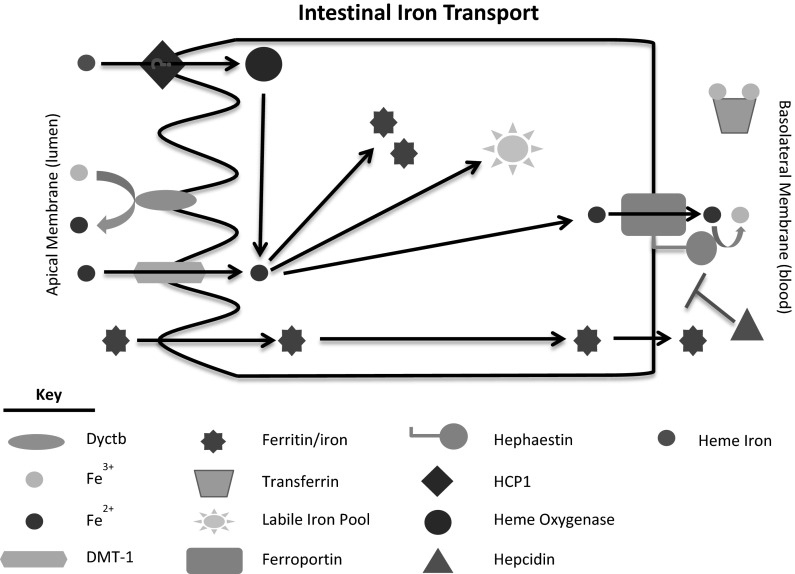
Fig. 1
Fig. 1
Schematic of intestinal iron transport. Briefly, the primary mechanism by which iron is taken up by the enterocyte is through DMT-1 on the luminal membrane after reduction by Dyctb. Iron has also been suggested to be transported as heme through HCP1 and as ferritin, but these mechanisms are controversial (heme) or less investigated (ferritin). Once in the intracellular labile iron pool, the iron can be stored in ferritin or exported into the body circulation through ferroportin. The ferroxidase, hephaestin, converts the ferrous iron that is released to ferric iron for use by transferrin
Fig. 2
Fig. 2
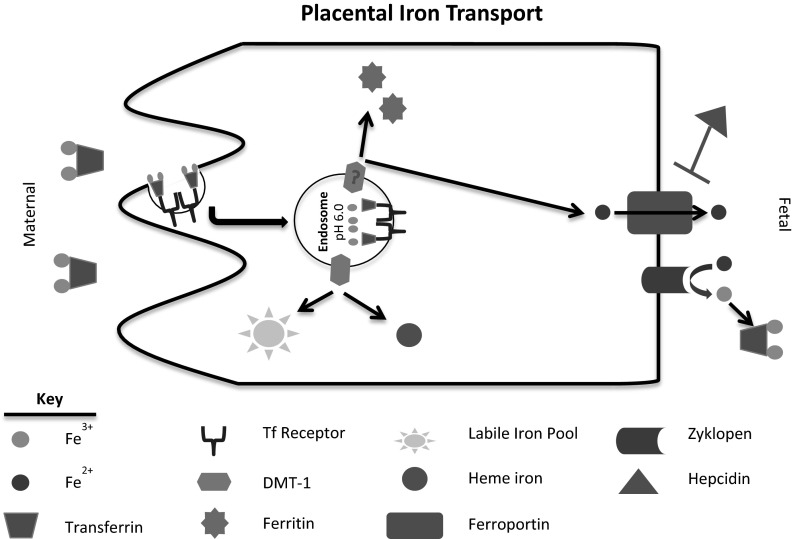
Schematic of placental iron transport. In brief, placental iron transport is completely transferrin-dependent. Transferrin binds to transferrin receptor on the maternal membrane and is endocytosed. The pH decrease in the endosome causes iron to dissociate from transferrin after which it can be transported into the cytoplasm through DMT-1. Once in the cytoplasm, iron can be stored in ferritin, associate with heme, be incorporated into the labile iron pool, or be transported to the fetal circulation through ferroportin. The ferroxidase on the placenta is called zyklopen and functions to convert the ferrous iron released by ferroportin to ferric iron, which is then usable by transferrin
Fig. 3
Fig. 3
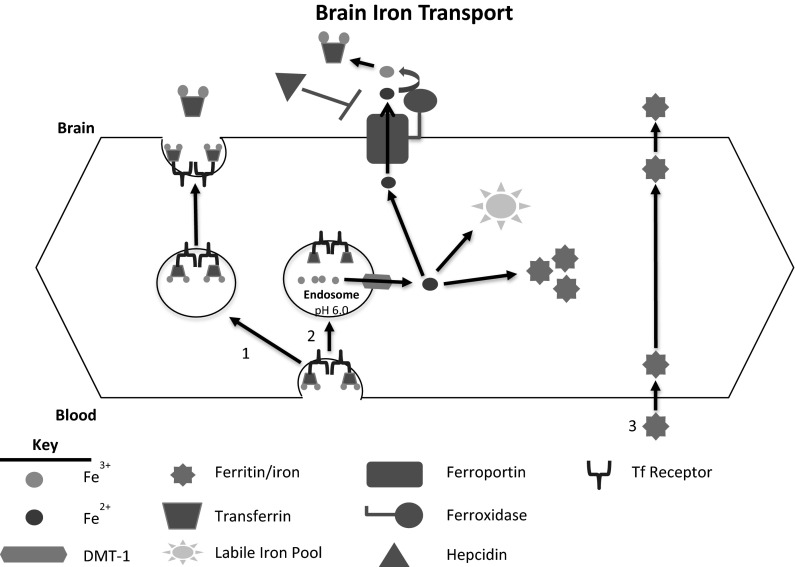
Schematic of brain iron uptake. The process by which iron crosses the BBB has recently been modeled (Simpson et al. 2015). Route 1 represents the currently accepted paradigm of the endothelial cell as a passive conduit in which transferrin binds to its receptor on the luminal membrane, traverses the cell and is deposited into the brain. Route 2 represents the more realistic and data-based model in which transferrin is endocytosed after binding to transferrin receptor. The iron is then released by transferrin within the endosome and transported into the cytoplasm through DMT-1. The intracellular iron can be stored in ferritin or it can be released into the brain through ferroportin. This model accounts for the iron needs of the endothelial cells. Route 3 depicts a potential mechanism by which ferritin can transport iron across the BBB. The possibility of this mechanism has been demonstrated, but further study is required to better understand it
Fig. 4
Fig. 4
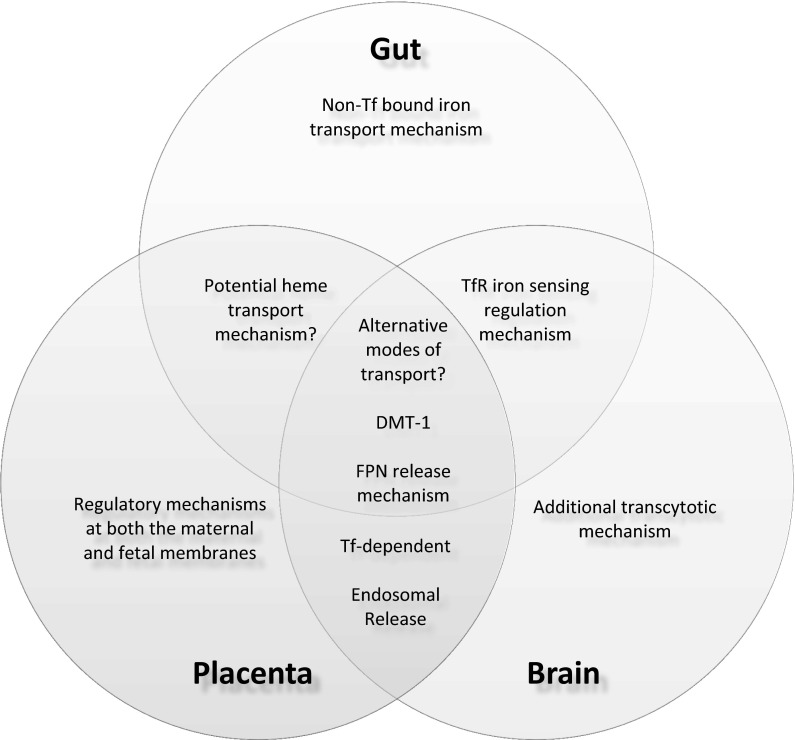
Similarities and differences in iron transport at physiological barriers. When comparing iron transport at the gut, the placenta, and the BBB, there are three key similarities seen at all barriers. First, each barrier appears to demonstrate presently unidentified alternative transport mechanisms. Secondly, DMT-1 is involved in iron trafficking at each barrier. Finally, all three barriers also utilize ferroportin on their basolateral membrane for iron export. Evaluation of each overall mechanism suggests that the BBB is most similar to the placenta. Iron transport at both barriers is primarily transferrin-dependent and involves a mechanism by which iron is released from transferrin in the endosome for export into the intercellular iron pool. Unlike either of the other barriers, the gut requires uptake of non-transferrin bound iron. The BBB appears to be unique in its ability to transcytose transferrin-bound iron. Additionally, the potential for heme transport has been hypothesized in both the placenta and the gut, but there is no evidence to suggest that this occurs at the BBB. In terms of regulation, the BBB demonstrates transferrin–transferrin receptor feedback signaling that is similar to what is observed in the crypt cells of the gut. Meanwhile, the placental regulatory system is unique in that iron transport is under the control of both the mother and the fetus

References

    1. Abbott NJ. Astrocyte-endothelial interactions and blood-brain barrier permeability. J Anat. 2002;200:629–638. doi: 10.1046/j.1469-7580.2002.00064.x. - DOI - PMC - PubMed
    1. Abbott NJ, Patabendige AA, Dolman DE, Yusof SR, Begley DJ. Structure and function of the blood-brain barrier. Neurobiol Dis. 2010;37:13–25. doi: 10.1016/j.nbd.2009.07.030. - DOI - PubMed
    1. Allen RP, Earley CJ. Restless legs syndrome: a review of clinical and pathophysiologic features. J Clin Neurophysiol. 2001;18:128–147. doi: 10.1097/00004691-200103000-00004. - DOI - PubMed
    1. Allen RP, Barker PB, Wehrl FW, Song HK, Earley CJ. MRI measurement of brain iron in patients with restless legs syndrome. Neurology. 2001;56:263–265. doi: 10.1212/WNL.56.2.263. - DOI - PubMed
    1. Altamura S, Muckenthaler MU. Iron toxicity in diseases of aging: Alzheimer’s disease, Parkinson’s disease ands atherosclerosis. J Alzheimer’s Dis. 2009;16:879–895. - PubMed