


Temporal Trends in Late Preterm and Early Term Birth Rates in 6 High-Income Countries in North America and Europe and Association With Clinician-Initiated Obstetric Interventions
- PMID: 27458946
- PMCID: PMC5318207
- DOI: 10.1001/jama.2016.9635
Temporal Trends in Late Preterm and Early Term Birth Rates in 6 High-Income Countries in North America and Europe and Association With Clinician-Initiated Obstetric Interventions
Erratum in
-
Data Error in Figure.JAMA. 2016 Oct 18;316(15):1601. doi: 10.1001/jama.2016.14786. JAMA. 2016. PMID: 27755617 No abstract available.
Abstract
Importance: Clinicians have been urged to delay the use of obstetric interventions (eg, labor induction, cesarean delivery) until 39 weeks or later in the absence of maternal or fetal indications for intervention.
Objective: To describe recent trends in late preterm and early term birth rates in 6 high-income countries and assess association with use of clinician-initiated obstetric interventions.
Design: Retrospective analysis of singleton live births from 2006 to the latest available year (ranging from 2010 to 2015) in Canada, Denmark, Finland, Norway, Sweden, and the United States.
Exposures: Use of clinician-initiated obstetric intervention (either labor induction or prelabor cesarean delivery) during delivery.
Main outcomes and measures: Annual country-specific late preterm (34-36 weeks) and early term (37-38 weeks) birth rates.
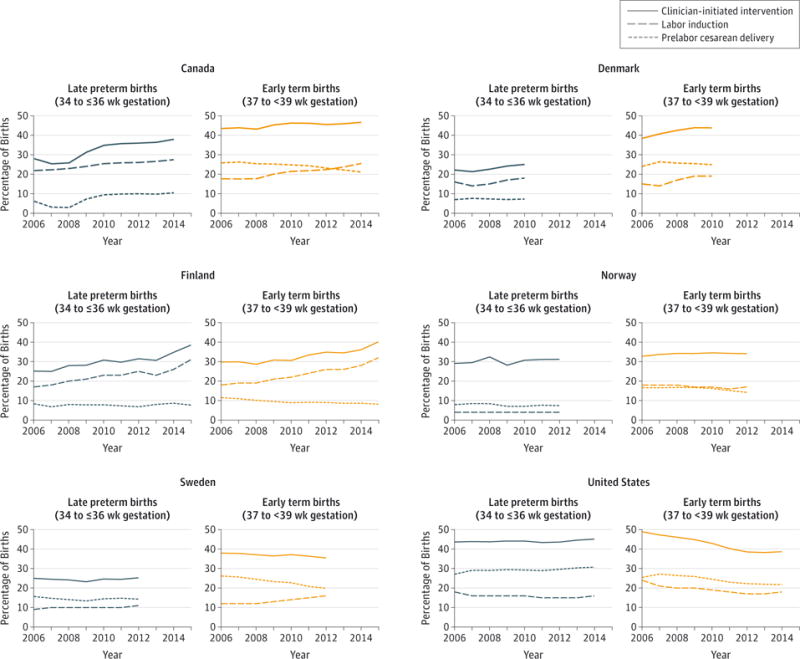
Results: The study population included 2,415,432 Canadian births in 2006-2014 (4.8% late preterm; 25.3% early term); 305,947 Danish births in 2006-2010 (3.6% late preterm; 18.8% early term); 571,937 Finnish births in 2006-2015 (3.3% late preterm; 16.8% early term); 468,954 Norwegian births in 2006-2013 (3.8% late preterm; 17.2% early term); 737,754 Swedish births in 2006-2012 (3.6% late preterm; 18.7% early term); and 25,788,558 US births in 2006-2014 (6.0% late preterm; 26.9% early term). Late preterm birth rates decreased in Norway (3.9% to 3.5%) and the United States (6.8% to 5.7%). Early term birth rates decreased in Norway (17.6% to 16.8%), Sweden (19.4% to 18.5%), and the United States (30.2% to 24.4%). In the United States, early term birth rates decreased from 33.0% in 2006 to 21.1% in 2014 among births with clinician-initiated obstetric intervention, and from 29.7% in 2006 to 27.1% in 2014 among births without clinician-initiated obstetric intervention. Rates of clinician-initiated obstetric intervention increased among late preterm births in Canada (28.0% to 37.9%), Denmark (22.2% to 25.0%), and Finland (25.1% to 38.5%), and among early term births in Denmark (38.4% to 43.8%) and Finland (29.8% to 40.1%).
Conclusions and relevance: Between 2006 and 2014, late preterm and early term birth rates decreased in the United States, and an association was observed between early term birth rates and decreasing clinician-initiated obstetric interventions. Late preterm births also decreased in Norway, and early term births decreased in Norway and Sweden. Clinician-initiated obstetric interventions increased in some countries but no association was found with rates of late preterm or early term birth.
Conflict of interest statement
Dr Morisaki reports receiving grant funding from the Uehara Memorial Foundation, Kanzawa Medical Research Foundation, and the Danone Institute. No other disclosures were reported.
Figures
Comment in
-
Improving Birth Outcomes Key to Improving Global Health.JAMA. 2016 Jul 26;316(4):395-6. doi: 10.1001/jama.2016.9851. JAMA. 2016. PMID: 27458942 No abstract available.
References
-
- The American College of Obstetricians and Gynecologists Committee on Obstetric Practice, The Society for Maternal-Fetal Medicine. Committee opinion number 561. http://www.acog.org/Resources-And-Publications/Committee-Opinions/Commit.... Accessed June 28, 2016.
-
- ACOG Committee on Practice Bulletins—Obstetrics. ACOG practice bulletin No. 107. Obstet Gynecol. 2009;114(2 Pt 1):386–397. - PubMed
-
- American College of Obstetricians and Gynecologists Committee on Obstetric Practice. ACOG committee opinion number 559. http://www.acog.org/Resources-And-Publications/Committee-Opinions/Commit.... Accessed December 15, 2015.
Publication types
MeSH terms
Grants and funding
LinkOut - more resources
Full Text Sources
Other Literature Sources
Medical
