Mothers after Gestational Diabetes in Australia (MAGDA): A Randomised Controlled Trial of a Postnatal Diabetes Prevention Program
- PMID: 27459502
- PMCID: PMC4961439
- DOI: 10.1371/journal.pmed.1002092
Mothers after Gestational Diabetes in Australia (MAGDA): A Randomised Controlled Trial of a Postnatal Diabetes Prevention Program
Abstract
Background: Gestational diabetes mellitus (GDM) is an increasingly prevalent risk factor for type 2 diabetes. We evaluated the effectiveness of a group-based lifestyle modification program in mothers with prior GDM within their first postnatal year.
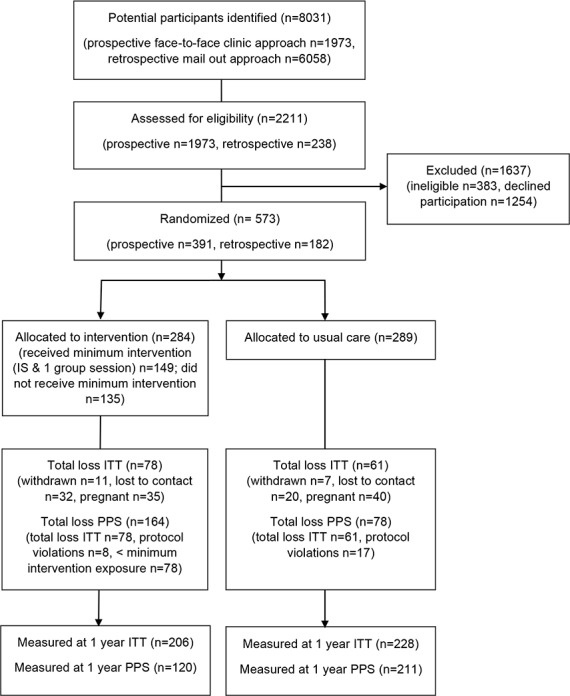
Methods and findings: In this study, 573 women were randomised to either the intervention (n = 284) or usual care (n = 289). At baseline, 10% had impaired glucose tolerance and 2% impaired fasting glucose. The diabetes prevention intervention comprised one individual session, five group sessions, and two telephone sessions. Primary outcomes were changes in diabetes risk factors (weight, waist circumference, and fasting blood glucose), and secondary outcomes included achievement of lifestyle modification goals and changes in depression score and cardiovascular disease risk factors. The mean changes (intention-to-treat [ITT] analysis) over 12 mo were as follows: -0.23 kg body weight in intervention group (95% CI -0.89, 0.43) compared with +0.72 kg in usual care group (95% CI 0.09, 1.35) (change difference -0.95 kg, 95% CI -1.87, -0.04; group by treatment interaction p = 0.04); -2.24 cm waist measurement in intervention group (95% CI -3.01, -1.42) compared with -1.74 cm in usual care group (95% CI -2.52, -0.96) (change difference -0.50 cm, 95% CI -1.63, 0.63; group by treatment interaction p = 0.389); and +0.18 mmol/l fasting blood glucose in intervention group (95% CI 0.11, 0.24) compared with +0.22 mmol/l in usual care group (95% CI 0.16, 0.29) (change difference -0.05 mmol/l, 95% CI -0.14, 0.05; group by treatment interaction p = 0.331). Only 10% of women attended all sessions, 53% attended one individual and at least one group session, and 34% attended no sessions. Loss to follow-up was 27% and 21% for the intervention and control groups, respectively, primarily due to subsequent pregnancies. Study limitations include low exposure to the full intervention and glucose metabolism profiles being near normal at baseline.
Conclusions: Although a 1-kg weight difference has the potential to be significant for reducing diabetes risk, the level of engagement during the first postnatal year was low. Further research is needed to improve engagement, including participant involvement in study design; it is potentially more effective to implement annual diabetes screening until women develop prediabetes before offering an intervention.
Trial registration: Australian New Zealand Clinical Trials Registry ACTRN12610000338066.
Conflict of interest statement
JR was employed by Novartis AG from 2009-2012 and currently holds stocks in Novartis AG.
Figures
Comment in
-
Prescribing Exercise and Lifestyle Training for High Risk Women in Pregnancy and Early Post-partum-Is It Worth It?PLoS Med. 2016 Jul 26;13(7):e1002093. doi: 10.1371/journal.pmed.1002093. eCollection 2016 Jul. PLoS Med. 2016. PMID: 27459631 Free PMC article.
References
-
- International Diabetes Federation. IDF diabetes atlas 7th ed. Brussels: International Diabetes Federation; 2015.
-
- Lindstrom J, Peltonen M, Eriksson JG, Ilanne-Parikka P, Aunola S, Keinanen-Kiukaanniemi S, et al. Improved lifestyle and decreased diabetes risk over 13 years: long-term follow-up of the randomised Finnish Diabetes Prevention Study (DPS). Diabetologia. 2013;56:284–293. 10.1007/s00125-012-2752-5 - DOI - PubMed
Publication types
MeSH terms
LinkOut - more resources
Full Text Sources
Other Literature Sources