


Mobile Apps for Weight Management: A Scoping Review
- PMID: 27460502
- PMCID: PMC4978862
- DOI: 10.2196/mhealth.5115
Mobile Apps for Weight Management: A Scoping Review
Abstract
Background: Obesity remains a major public health concern. Mobile apps for weight loss/management are found to be effective for improving health outcomes in adults and adolescents, and are pursued as a cost-effective and scalable intervention for combating overweight and obesity. In recent years, the commercial market for 'weight loss apps' has expanded at rapid pace, yet little is known regarding the evidence-based quality of these tools for weight control.
Objective: To characterize the inclusion of evidence-based strategies, health care expert involvement, and scientific evaluation of commercial mobile apps for weight loss/management.
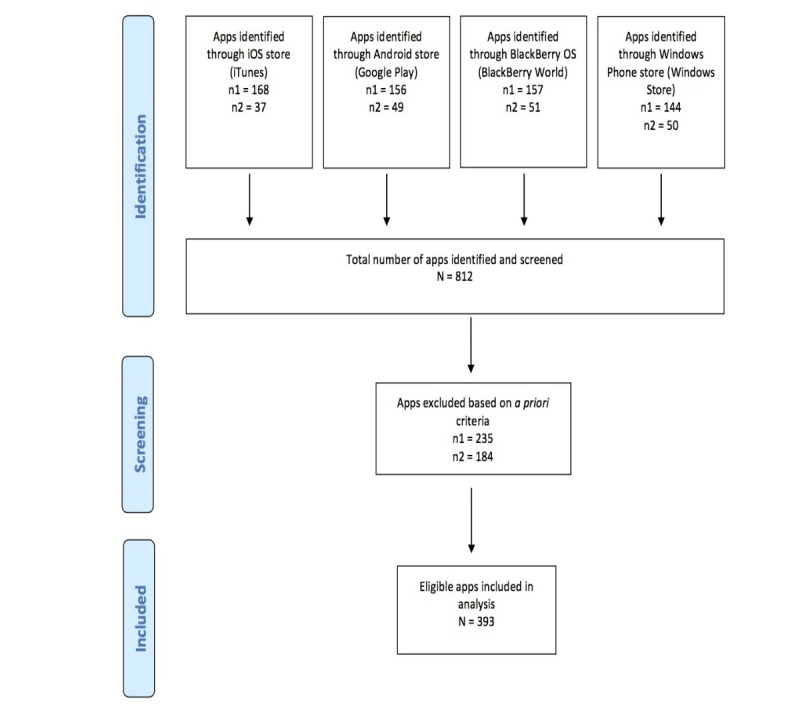
Methods: An electronic search was conducted between July 2014 and July 2015 of the official app stores for four major mobile operating systems. Three raters independently identified apps with a stated goal of weight loss/management, as well as weight loss/management apps targeted to pediatric users. All discrepancies regarding selection were resolved through discussion with a fourth rater. Metadata from all included apps were abstracted into a standard assessment criteria form and the evidence-based strategies, health care expert involvement, and scientific evaluation of included apps was assessed. Evidence-based strategies included: self-monitoring, goal-setting, physical activity support, healthy eating support, weight and/or health assessment, personalized feedback, motivational strategies, and social support.
Results: A total of 393 apps were included in this review. Self-monitoring was most common (139/393, 35.3%), followed by physical activity support (108/393, 27.5%), weight assessment (100/393, 25.4%), healthy eating support (91/393, 23.2%), goal-setting (84/393, 21.4%), motivational strategies (28/393, 7.1%), social support (21/393, 5.3%), and personalized feedback (7/393, 1.8%). Of apps, 0.8% (3/393) underwent scientific evaluation and 0.3% (1/393) reported health care expert involvement. No apps were comprehensive in the assessment criteria, with the majority of apps meeting less than two criteria.
Conclusions: Commercial mobile apps for weight loss/management lack important evidence-based features, do not involve health care experts in their development process, and have not undergone rigorous scientific testing. This calls into question the validity of apps' claims regarding their effectiveness and safety, at a time when the availability and growth in adoption of these tools is rapidly increasing. Collaborative efforts between developers, researchers, clinicians, and patients are needed to develop and test high-quality, evidence-based mobile apps for weight loss/management before they are widely disseminated in commercial markets.
Keywords: mHealth; mobile apps; obesity; smartphones; weight loss.
Conflict of interest statement
Conflicts of Interest: None declared.
References
-
- Speiser PW, Rudolf MCJ, Anhalt H, Camacho-Hubner C, Chiarelli F, Eliakim A, Freemark M, Gruters A, Hershkovitz E, Iughetti L, Krude H, Latzer Y, Lustig RH, Pescovitz OH, Pinhas-Hamiel O, Rogol AD, Shalitin S, Sultan C, Stein D, Vardi P, Werther GA, Zadik Z, Zuckerman-Levin N, Hochberg Z, Obesity Consensus Working Group Childhood obesity. J Clin Endocrinol Metab. 2005;90:1871–1887. doi: 10.1210/jc.2004-1389.jc.2004-1389 - DOI - PubMed
-
- World Health Organization Fact Sheet No 311. 2016. [2016-06-21]. Obesity and Overweight http://www.who.int/mediacentre/factsheets/fs311/en/index.html .
-
- Han JC, Lawlor DA, Kimm SYS. Childhood obesity. Lancet. 2010;375:1737–1748. doi: 10.1016/S0140-6736(10)60171-7. http://europepmc.org/abstract/MED/20451244 S0140-6736(10)60171-7 - DOI - PMC - PubMed
Publication types
LinkOut - more resources
Full Text Sources
Other Literature Sources
