


Pre-eclampsia in American Indians/Alaska Natives and Whites: The Significance of Body Mass Index
- PMID: 27461024
- PMCID: PMC5106312
- DOI: 10.1007/s10995-016-2126-6
Pre-eclampsia in American Indians/Alaska Natives and Whites: The Significance of Body Mass Index
Abstract
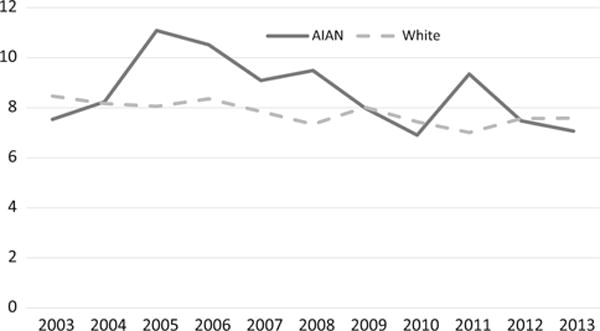
Introduction The prevalence of pre-eclampsia, a major cause of maternal morbidity, varies by race, being greater in African Americans, and lower in Asians and Hispanics than in White women. Little is known about its prevalence in American Indians/Alaska Natives (AI/ANs). We estimated pre-eclampsia risk in AI/ANs compared to Whites, with consideration of the potential effect of obesity, a major risk factor for pre-eclampsia, and a condition disproportionately affecting AI/AN women. Methods This retrospective cohort study of linked birth-hospital discharge data from Washington State (2003-2013) included all AI/AN women and a sample of White first-time mothers with singleton deliveries. Logistic regression was used to estimate odds ratio (OR) and 95 % confidence intervals (CI) for pre-eclampsia risk in AI/ANs compared to Whites, first controlling for several important risk factors, and subsequently with additional adjustment for pre-pregnancy body mass index (BMI). Results AI/ANs had an increased risk of pre-eclampsia compared to Whites after controlling for all covariates except BMI (OR 1.17, 95 % CI 1.06-1.29). After further adjustment for BMI, the racial disparity in pre-eclampsia risk was greatly attenuated (OR 1.05, 95 % CI 0.95-1.16). Discussion This population-based study suggests that any increased risk in AI/ANs relative to Whites may be at least partly due to differences in BMI.
Keywords: American Indian/Alaska Native; Body mass index; Health disparities; Obesity; Overweight; Pre-eclampsia.
Conflict of interest statement
All authors declare that they have no conflict of interest.
Figures
References
MeSH terms
Grants and funding
LinkOut - more resources
Full Text Sources
Other Literature Sources
Medical
