. 2017 Jan;42(2):512-523.
doi: 10.1038/npp.2016.134. Epub 2016 Jul 27.

Constitutive and Acquired Serotonin Deficiency Alters Memory and Hippocampal Synaptic Plasticity

Affiliations

Constitutive and Acquired Serotonin Deficiency Alters Memory and Hippocampal Synaptic Plasticity

Sebastian P Fernandez et al. Neuropsychopharmacology. 2017 Jan.

Abstract

Serotonin (5-HT) deficiency occurs in a number of brain disorders that affect cognitive function. However, a direct causal relationship between 5-HT hypo-transmission and memory and underlying mechanisms has not been established. We used mice with a constitutive depletion of 5-HT brain levels (Pet1KO mice) to analyze the contribution of 5-HT to different forms of learning and memory. Pet1KO mice exhibited a striking deficit in novel object recognition memory, a hippocampal-dependent task. No alterations were found in tasks for social recognition, procedural learning, or fear memory. Viral delivery of designer receptors exclusively activated by designer drugs was used to selectively silence the activity of 5-HT neurons in the raphe. Inhibition of 5-HT neurons in the median raphe, but not the dorsal raphe, was sufficient to impair object recognition in adult mice. In vivo electrophysiology in behaving mice showed that long-term potentiation in the hippocampus of 5-HT-deficient mice was altered, and administration of the 5-HT1A agonist 8-OHDPAT rescued the memory deficits. Our data suggest that hyposerotonergia selectively affects declarative hippocampal-dependent memory. Serotonergic projections from the median raphe are necessary to regulate object memory and hippocampal synaptic plasticity processes, through an inhibitory control mediated by 5-HT1A receptors.


Figures
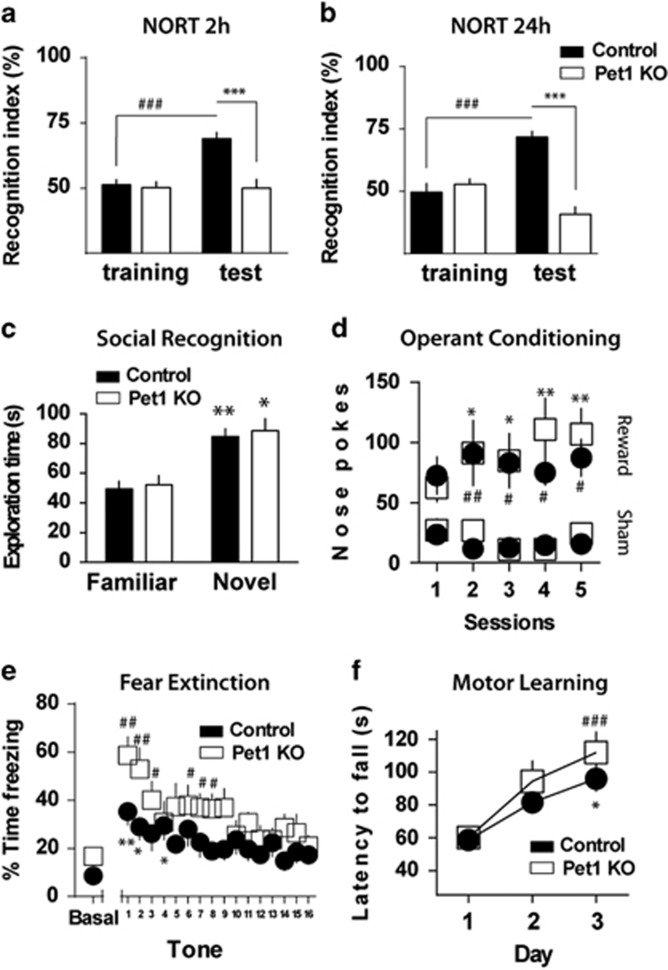
Figure 1
Figure 1
Object recognition memory, but not other forms of memory, is impaired in mice with low levels of brain 5-HT. (a) NORT was conducted with a 2 h delay between the training and test sessions. Recognition index is close to 50% during training sessions, indicating no bias toward any of the objects and/or locations. During the test session, control mice showed a significant preference for exploring the novel object (F1,48=9.925, ###P<0.001 training vs test and F1,48=14.92, ***P<0.001 control vs Pet1KO mice, Bonferroni posttest, after two-way ANOVA repeated measures), but Pet1KO failed to show this preference (n=27 and 23 for control and Pet1KO). (b) Similarly, when the intertrial interval was set to 24 h, control mice showed a significant preference for exploring the novel object (F1,22=3.717, ###P<0.001 training vs test, two-way ANOVA repeated-measures and Bonferroni's multiple comparisons test). Instead, Pet1KO did not show any significant differences in exploration of objects (F1,22=16.41, ***P<0.001 control vs Pet1KO mice; F1,22=3.717 training vs test, P>0.05, two-way ANOVA repeated-measures and Bonferroni's multiple comparisons test, n=13 control and 11 Pet1KO mice). (c) To test conspecific recognition, mice placed in a three-chamber box; the graph shows the total time spent exploring the familiar and novel mice. Control and Pet1KO mice spent significantly more time with the novel mouse compared with the familiar one (F1,80=29.60, *P<0.05, **P<0.01 novel vs familiar, and F1,80=0.2622, P=0.6100 control vs Pet1KO, n=21/group). (d) Performance of control and Pet1KO mice in operant conditioning. Nose pokes on the cued hole are rewarded with sugar pellet delivery (at a fixed ratio of five pokes for one sugar pellet), while pokes on sham hole has no response. Number of nose pokes on each hole is measured across five sessions during 5 consecutive days. The increase in the number of nose pokes in the reinforced hole vs the non-reinforced one is a criterion for validating the learning of the task. Both control and Pet1KO showed normal learning (F1, 18=24.29, #P<0.05, ##P<0.01 rewarded vs sham holes in control mice, n=10. F1, 18=12.36, *P<0.05, **P<0.01 rewarded vs sham holes in Pet1KO mice, n=10. Two-way ANOVA followed by Bonferroni's multiple comparison test). (e) Control and Pet1KO mice were submitted to an auditory fear conditioning and extinction protocol. Four hours after conditioning with 5 tone–footshock pairs, animals were placed in a different context and a total of 16 tones (conditioned stimulus) were presented and freezing behavior (conditioned response) quantified. Pet1KO mice showed higher levels of freezing to the presentation of the tone alone in a new context. However, extinction learning was not altered as repeated tone presentations produced a significant decrease in freezing behavior (extinction learning) in both control and Pet1KO mice (F16, 256=5.369, *P<0.05, **P<0.01 vs basal freezing response in control mice, n=9; #P<0.05, ##P<0.01 vs basal freezing response in Pet1KO mice, n=9. Two-way ANOVA followed by Bonferroni's multiple comparison test). (f) Control and Pet1KO mice showed similar motor learning on the rotarod test. Latency to fall (in seconds) is shown across daily sessions. A significant increment in the latency confirms the learning of the task (F2, 16=19.46, *P<0.05 day 1 vs day 3 in control mice, n=5; ###P<0.001 day 1 vs day 3 in Pet1KO mice, n=5. Two-way ANOVA followed by Bonferroni's multiple comparison test). All plots depict mean±SEM.
Figure 2
Figure 2
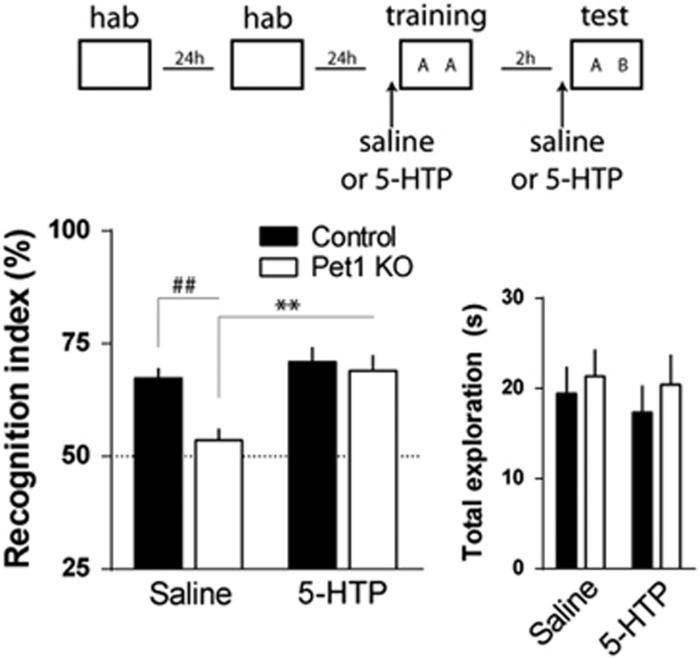
Increasing 5-HT levels in the brain rescues memory impairment in Pet1KO mice. Animals were injected i.p. with saline or a combination of 5-HTP (10 mg/kg) and benserazide (20 mg/kg) 30 min before the training and test sessions. Control mice did not show changes in object recognition after drug treatment (F1, 48=10.25, P>0.05, saline vs 5-HTP two-way ANOVA and Bonferroni's multiple comparison test). Pet1KO treated with saline showed object memory impairment (F1, 48=6.919, ##P<0.01, control vs Pet1KO mice), which was reversed by treatment with 5-HTP (F1, 48=10.25, **P<0.01, saline vs 5-HTP two-way ANOVA and Bonferroni's multiple comparison test). Drug treatment did not affect the total amount of time exploring the objects. Mice per group were as follows: control: 16 for saline and 10 for 5-HTP; Pet1KO: 11 for saline and 15 for 5-HTP. All plots depict mean±SEM.
Figure 3
Figure 3
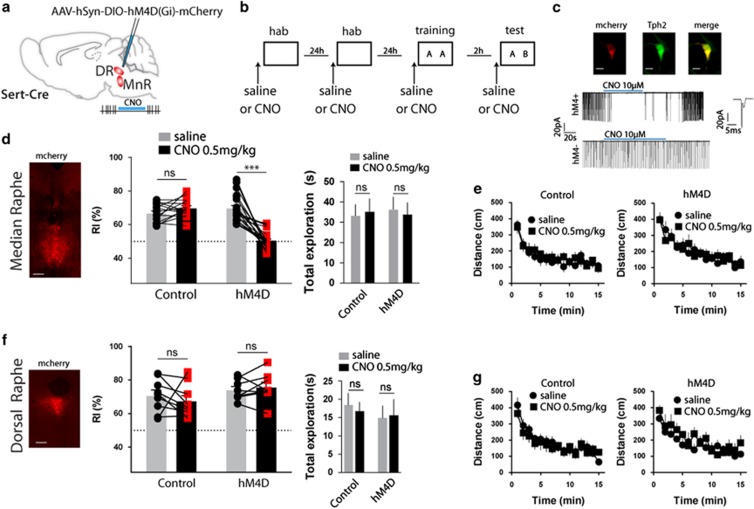
Chemogenetic inhibition of MnR 5-HT cells is sufficient to induce object recognition deficits in mice. (a) Injection of SertCre mice with AAV8-hSyn-DIO-hM4D(Gi)-mCherry into the MnR or the DR. (b) Protocol to remotely control the activity of 5-HT neurons during object recognition. CNO (0.5 mg/kg) or saline were administered i.p. on each habituation day and 30 min before the training and test sessions. (c) The ability of the hM4D/CNO system to inhibit the firing of 5-HT neurons was asserted using in vitro cell-attached recordings in brain slices from stereotaxically injected mice. In 5-HT neurons (green) expressing hM4D-mCherry (red), bath application of CNO (10 μM) completely abolished cell discharge of action potential currents, while hM4D-negative cells do not respond to CNO (representative current traces are shown at the bottom of the panel). (d) Control and hM4D-expressing mice injected in the MnR were subjected to NORT. A representative image shows the expression of mCherry in the MnR of SertCre mice (scale bar=200 μm). CNO treatment significantly reduced preference for exploring the novel object in hM4D mice (F1, 35=22.84, ***P<0.001 saline vs CNO hM4D mice n=23 Bonferroni posttest, after two-way ANOVA). Control mice did not show any changes in response to either saline or CNO treatments and performed normally (P>0.05, saline vs CNO control mice n=14). The total amount of time exploring the objects did not change between groups. (e) Silencing of MnR 5-HT neurons with the hM4D/CNO system did not affect locomotor activity. (f) Control and hM4D-expressing mice injected in the DR were subjected to NORT. A representative image shows the expression of mCherry in the DR of SertCre mice after AAV injection (scale bar=250 μm). Inhibition of DR serotonergic neurons did not affect object memory performance (F1, 15=0.1209, P=0.7329, for treatment after two-way ANOVA, n=9 and 8 mice for control and hM4D, respectively) or total amount of time exploring the objects. (g) No effect on locomotor activity was observed after inhibition of 5-HT cells in the DR with the hM4D/CNO system.
Figure 4
Figure 4
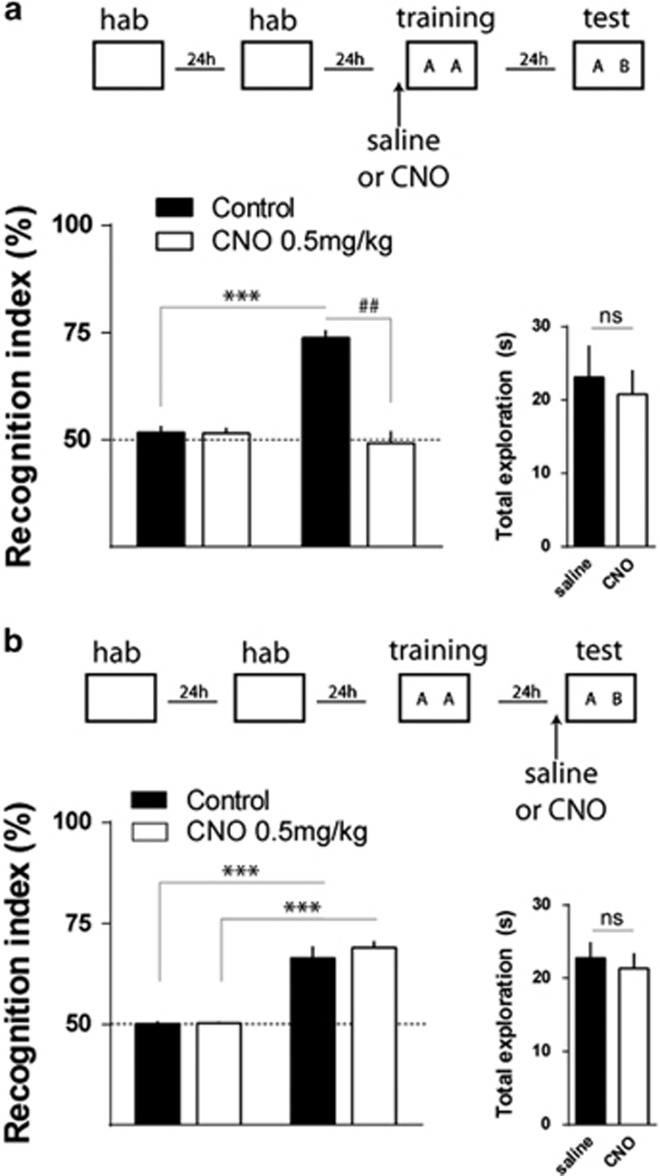
Chemogenetic inhibition of MnR 5-HT cells affects encoding/consolidation but not retrieval of object memory. (a) SertCre mice stereotaxically injected with AAV-hSyn-DIO-hM4D-mCherry in the MnR were used for NORT. CNO or saline were given i.p. before the training session, and a test session was conducted 24 h later. Saline-treated mice showed a significant preference for exploring the novel object (F1, 21=26.37, ***P<0.001 two-way ANOVA training × test, n=11). Injection of CNO did not affect exploration of objects on the training phase, but it completely blocked preference for the novel object during the test phase (F1, 21=39.95, ##P<0.001 two-way ANOVA saline × CNO, n=11 and 12 for saline and CNO, respectively). (b) In a second experiment, mice were given saline or CNO before the test session only. Both the saline and CNO-treated groups showed a significant preference for exploring the novel object during the test session (Figure 4B, F1, 20=137.3, ***P<0.001 two-way ANOVA training × test, n=11/group). In both cases, total time exploring the objects were not changed. All plots depict mean±SEM.
Figure 5
Figure 5
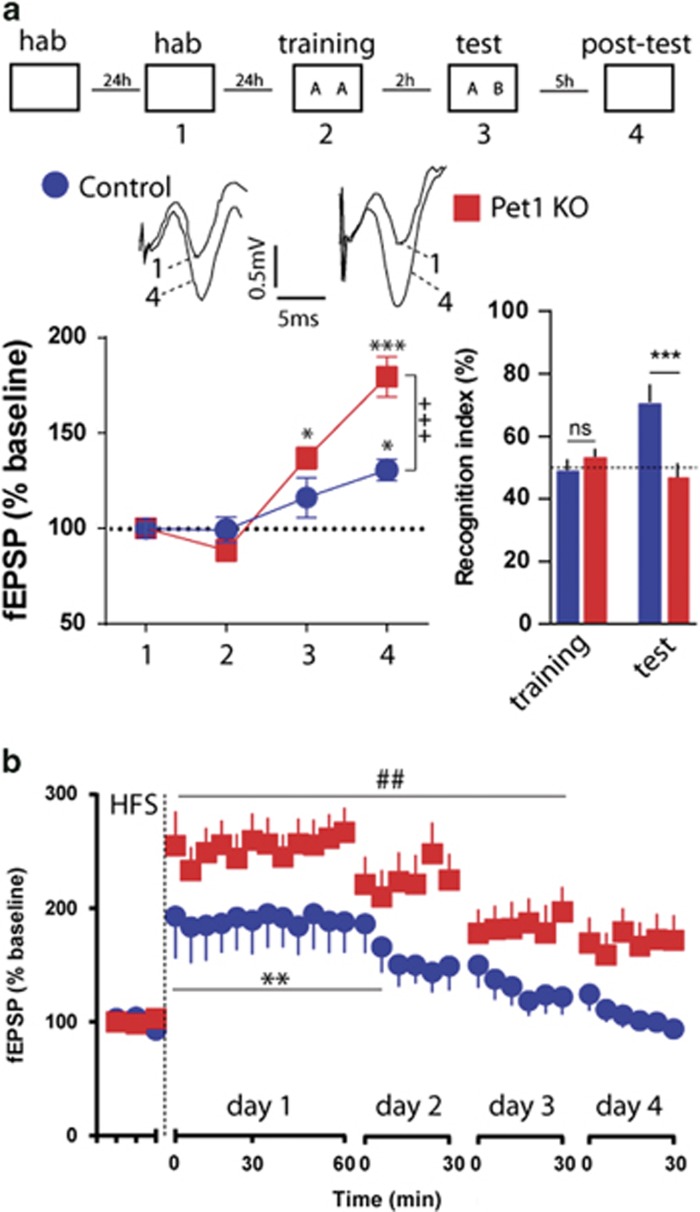
5-HT brain deficiency leads to exaggerated synaptic potentiation of the CA3→CA1 pathway in the hippocampus. (a) Electrode-implanted control and Pet1KO mice were submitted to the NORT as depicted. fEPSPs were recorded after stimulation of Schaffer collaterals throughout the entire behavioral experiments. Baseline recordings were obtained during the last habituation session (1), and changes in synaptic strength were scored during object memory training (2), retention test (3), and 5 h after completing the task (4). Representative fEPSP traces are shown depicting baseline and posttest recordings for control and Pet1KO mice. No changes in fEPSP amplitude were observed during training (2). During the retention session conducted 2 h after (3), we observed a slight increase in control mice (116.2±10.4%, *P>0.05, vs baseline), and this effect was more pronounced in Pet1KO mice (136.8±5.8%, *P<0.05, vs baseline). Late changes in synaptic strength were evaluated 5 h after completing NORT (4). In control mice, LTP increased slightly (130.6±5.6%, P<0.05, vs baseline), while we observed a striking increase in LTP in Pet1KO mice (179.5±10.5%, F1,1263=3.357, ***P<0.01 vs baseline; F3,1263=12.18, +++P<0.001 vs control mice, n=10 control and 9 Pet1KO). (b) In a separate experiment, we followed the evolution of fEPSPs evoked in the CA1 area after applying HFS to induce LTP. After establishing a stable baseline, five 200- Hz, 100-ms trains of pulses at a rate of one per second were applied, and this protocol was presented six times, at intervals of 1 min. This protocol induced a long-lasting potentiation of fEPSPs in control mice, reaching significant higher values during day 1 and the start of day 2 (**P<0.01 compared with baseline in control mice, n=10). Pet1KO mice showed higher levels of potentiation throughout the experiment (##P<0.01 compared with baseline in Pet1KO mice, n=9). All plots depict mean±SEM.
Figure 6
Figure 6
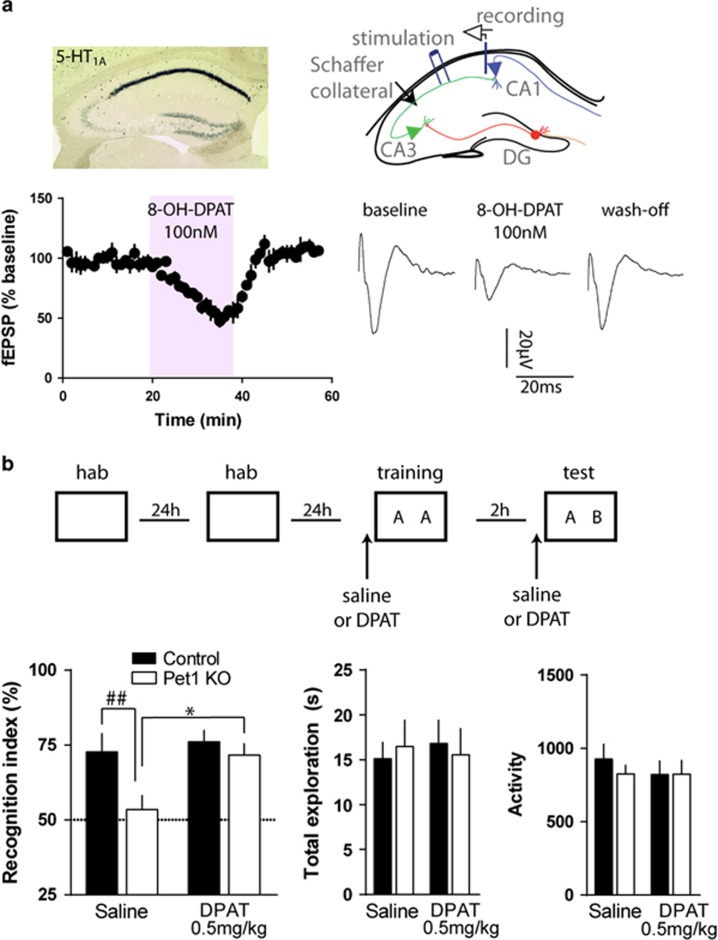
5-HT1A receptors exert inhibitory control over hippocampal CA3→CA1 synapse. (a) 5-HT1A mRNA expression was detected using in situ hybridization (blue signal is positive), showing strong expression in stratum pyramidale of the CA1 region, where pyramidal neuron cell bodies are located. The effect of the 5-HT1A agonist 8-OH-DPAT was tested on CA1-evoked EPSPs by stimulating CA3 fibers as depicted in the diagram. After a 20-min baseline, 8-OH-DPAT 100 nM was added to the perfusion bath and the amplitude of the EPSPs was recorded. 8-OH-DPAT exerted a strong inhibition of fEPSP amplitude. Representative EPSP traces are shown on the right side. Plot depicts mean±SEM (n=4). (b) 8-OH-DPAT (0.5 mg/kg) was injected to control and Pet1KO mice 30 min before training and retention sessions of NORT. Pet1KO injected with saline showed object recognition impairment as compared with control mice (F1,50=6.734, ##P<0.01 control vs Pet1KO in saline treated, Bonferroni posttest, after two-way ANOVA). Treatment with 8-OH-DPAT did not affect the performance of control mice, but it restored preference for the novel object in Pet1KO mice (F1,50=4.501, *P<0.05 saline vs 8-OH-DPAT in Pet1KO mice, Bonferroni posttest, after two-way ANOVA). Drug treatment did not affect the total amount of time exploring the objects or the locomotor activity during the test. Mice per group were as follows: control: 13 for saline and 13 for DPAT; Pet1KO: 14 for saline and 14 for DPAT. All plots depict mean±SEM.

References

    1. Adell A, Carceller A, Artigas F (1993). In vivo brain dialysis study of the somatodendritic release of serotonin in the Raphe nuclei of the rat: effects of 8-hydroxy-2-(di-n-propylamino)tetralin. J Neurochem 60: 1673–1681. - PubMed
    1. Babar E, Melik E, Ozgünen T, Polat S (2002). Effects of excitotoxic median raphe lesion on working memory deficits produced by the dorsal hippocampal muscarinic receptor blockade in the inhibitory avoidance in rats. Brain Res Bull 57: 683–688. - PubMed
    1. Balleine BW, Liljeholm M, Ostlund SB (2009). The integrative function of the basal ganglia in instrumental conditioning. Behav Brain Res 199: 43–52. - PubMed
    1. Barnes NM, Sharp T (1999). A review of central 5-HT receptors and their function. Neuropharmacology 38: 1083–1152. - PubMed
    1. Bielsky IF, Young LJ (2004). Oxytocin, vasopressin, and social recognition in mammals. Peptides 25: 1565–1574. - PubMed