


Altered aortic shape in bicuspid aortic valve relatives influences blood flow patterns
- PMID: 27461208
- PMCID: PMC5095691
- DOI: 10.1093/ehjci/jew149
Altered aortic shape in bicuspid aortic valve relatives influences blood flow patterns
Abstract
Aims: Bicuspid aortic valve (BAV) is known to exhibit familial inheritance and is associated with aortopathy and altered aortic haemodynamics. However, it remains unclear whether BAV-related aortopathy can be inherited independently of valve morphology.
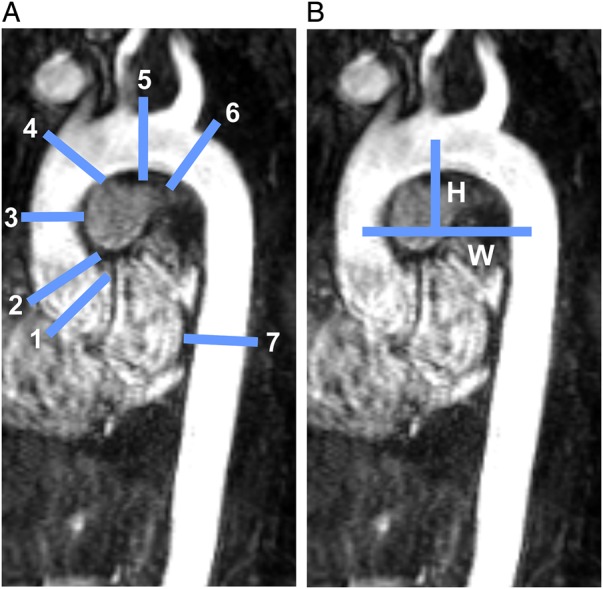
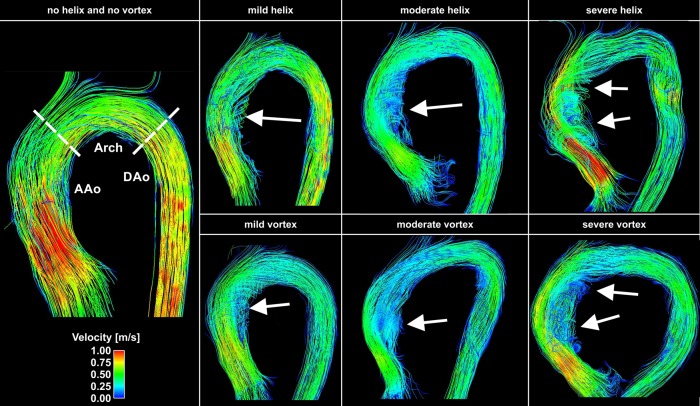
Methods and results: Four-dimensional flow magnetic resonance imaging for the in vivo assessment of thoracic aortic 3D blood flow was performed in 24 BAV relatives with trileaflet aortic valves (age = 40 ± 14 years) and 15 healthy controls (age = 37 ± 10 years). Data analysis included aortic dimensions, shape (round/gothic/cubic), and 3D blood flow characteristics (semi-quantitative vortex/helix grading and peak velocities). Cubic and gothic aortic shapes were markedly more prevalent in BAV relatives compared with controls (38 vs. 7%). Ascending aorta (AAo) vortex flow in BAV relatives was significantly increased compared with controls (grading = 1.5 ± 1.0 vs. 0.6 ± 0.9, P = 0.015). Aortic haemodynamics were influenced by aortic shape: peak velocities were reduced for gothic aortas vs. round aortas (P = 0.003); vortex flow was increased for cubic aortas in the AAo (P < 0.001) and aortic arch (P = 0.004); vortex and helix flows were elevated for gothic aortas in the AAo and descending aorta (P = 0.003, P = 0.029). Logistic regression demonstrated significant associations of shape with severity of vortex flow in AAo (P < 0.001) and aortic arch (P = 0.016) in BAV relatives.
Conclusion: BAV relatives expressed altered aortic shape and increased vortex flow despite the absence of valvular disease or aortic dilatation. These data suggest a heritable component of BAV-related aortopathy affecting aortic shape and aberrant blood flow, independent of valve morphology.
Keywords: 4D flow MRI; bicuspid aortic valve; haemodynamics; relatives.
Published on behalf of the European Society of Cardiology. All rights reserved. © The Author 2016. For permissions please email: journals.permissions@oup.com.
Figures



Comment in
-
Another piece in the puzzle of bicuspid aortic valve syndrome.Eur Heart J Cardiovasc Imaging. 2016 Nov;17(11):1248-1249. doi: 10.1093/ehjci/jew169. Epub 2016 Aug 7. Eur Heart J Cardiovasc Imaging. 2016. PMID: 27502291 Free PMC article. No abstract available.
References
-
- Gray GW, Salisbury DA, Gulino AM. Echocardiographic and color flow Doppler findings in military pilot applicants. Aviat Space Environ Med 1995;66:32–4. - PubMed
-
- Nistri S, Basso C, Marzari C, Mormino P, Thiene G. Frequency of bicuspid aortic valve in young male conscripts by echocardiogram. Am J Cardiol 2005;96:718–21. - PubMed
-
- Michelena HI, Khanna AD, Mahoney D, Margaryan E, Topilsky Y, Suri RM et al. Incidence of aortic complications in patients with bicuspid aortic valves. JAMA 2011;306:1104–12. - PubMed
-
- Tzemos N, Therrien J, Yip J, Thanassoulis G, Tremblay S, Jamorski MT et al. Outcomes in adults with bicuspid aortic valves. JAMA 2008;300:1317–25. - PubMed
Publication types
MeSH terms
Grants and funding
LinkOut - more resources
Full Text Sources
Other Literature Sources
Medical
