


Endocannabinoids control vesicle release mode at midbrain periaqueductal grey inhibitory synapses
- PMID: 27461371
- PMCID: PMC5199746
- DOI: 10.1113/JP272292
Endocannabinoids control vesicle release mode at midbrain periaqueductal grey inhibitory synapses
Abstract
Key points: The midbrain periaqueductal grey (PAG) forms part of an endogenous analgesic system which is tightly regulated by the neurotransmitter GABA. The role of endocannabinoids in regulating GABAergic control of this system was examined in rat PAG slices. Under basal conditions GABAergic neurotransmission onto PAG output neurons was multivesicular. Activation of the endocannabinoid system reduced GABAergic inhibition by reducing the probability of release and by shifting release to a univesicular mode. Blockade of endocannabinoid system unmasked a tonic control over the probability and mode of GABA release. These findings provides a mechanistic foundation for the control of the PAG analgesic system by disinhibition.
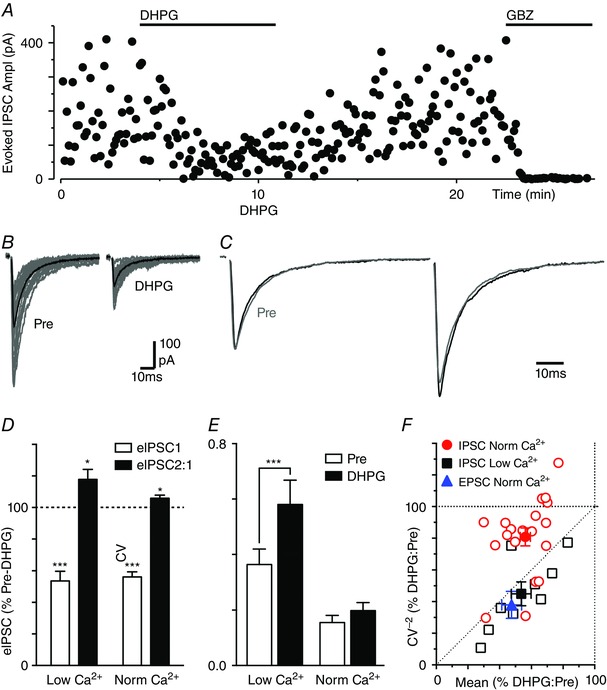
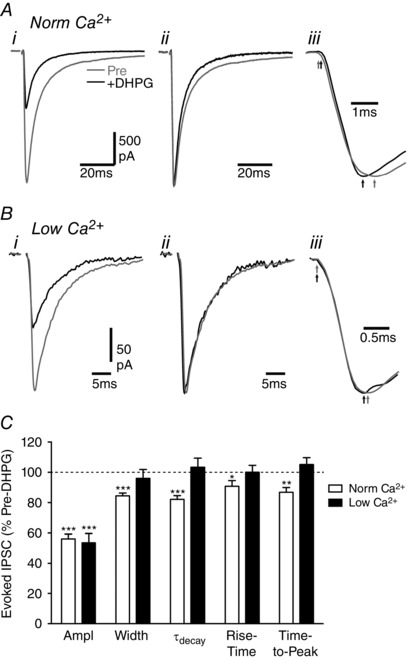
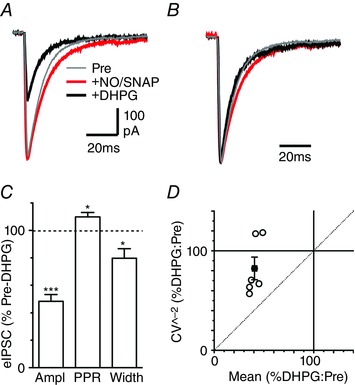
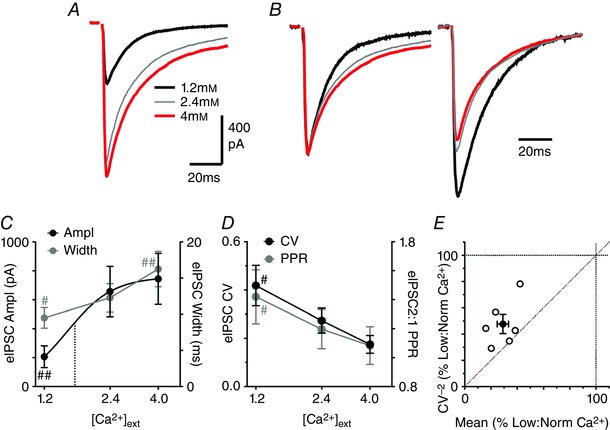
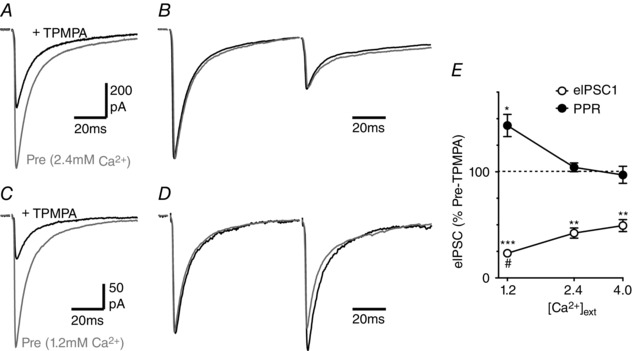
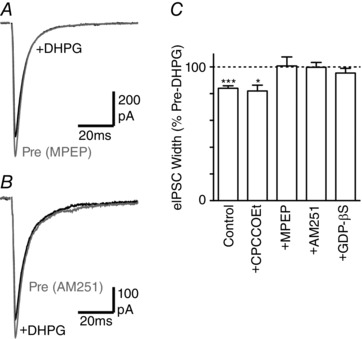
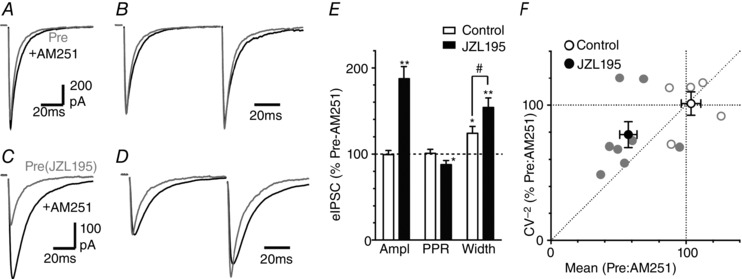
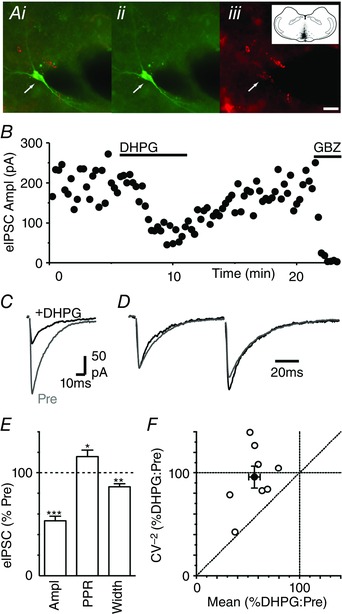
Abstract: The midbrain periaqueductal grey (PAG) has a crucial role in coordinating endogenous analgesic responses to physiological and psychological stressors. Endocannabinoids are thought to mediate a form of stress-induced analgesia within the PAG by relieving GABAergic inhibition of output neurons, a process known as disinhibition. This disinhibition is thought to be achieved by a presynaptic reduction in GABA release probability. We examined whether other mechanisms have a role in endocannabinoid modulation of GABAergic synaptic transmission within the rat PAG. The group I mGluR agonist DHPG ((R,S)-3,5-dihydroxyphenylglycine) inhibited evoked IPSCs and increased their paired pulse ratio in normal external Ca2+ , and when release probability was reduced by lowering Ca2+ . However, the effect of DHPG on the coefficient of variation and kinetics of evoked IPSCs differed between normal and low Ca2+ . Lowering external Ca2+ had a similar effect on evoked IPSCs to that observed for DHPG in normal external Ca2+ . The low affinity GABAA receptor antagonist TPMPA ((1,2,5,6-tetrahydropyridin-4-yl)methylphosphinic acid) inhibited evoked IPSCs to a greater extent in low than in normal Ca2+ . Together these findings indicate that the normal mode of GABA release is multivesicular within the PAG, and that DHPG and lowering external Ca2+ switch this to a univesicular mode. The effects of DHPG were mediated by mGlu5 receptor engagement of the retrograde endocannabinoid system. Blockade of endocannabinoid breakdown produced a similar shift in the mode of release. We conclude that endocannabinoids control both the mode and the probability of GABA release within the PAG.
Keywords: endocannabinoid; gaba; multivesicular; pain; synaptic transmission.
© 2016 The Authors. The Journal of Physiology © 2016 The Physiological Society.
Figures
References
-
- Anderson WB, Gould MJ, Torres RD, Mitchell VA & Vaughan CW (2014). Actions of the dual FAAH/MAGL inhibitor JZL195 in a murine inflammatory pain model. Neuropharmacology 81, 224–230. - PubMed
-
- Bagley EE, Hacker J, Chefer VI, Mallet C, McNally GP, Chieng BC, Perroud J, Shippenberg TS & Christie MJ (2011). Drug‐induced GABA transporter currents enhance GABA release to induce opioid withdrawal behaviours. Nat Neurosci 14, 1548–1554. - PubMed
MeSH terms
Substances
LinkOut - more resources
Full Text Sources
Other Literature Sources
Miscellaneous
