


Variation in leaf wettability traits along a tropical montane elevation gradient
- PMID: 27463359
- PMCID: PMC5412938
- DOI: 10.1111/nph.14121
Variation in leaf wettability traits along a tropical montane elevation gradient
Abstract
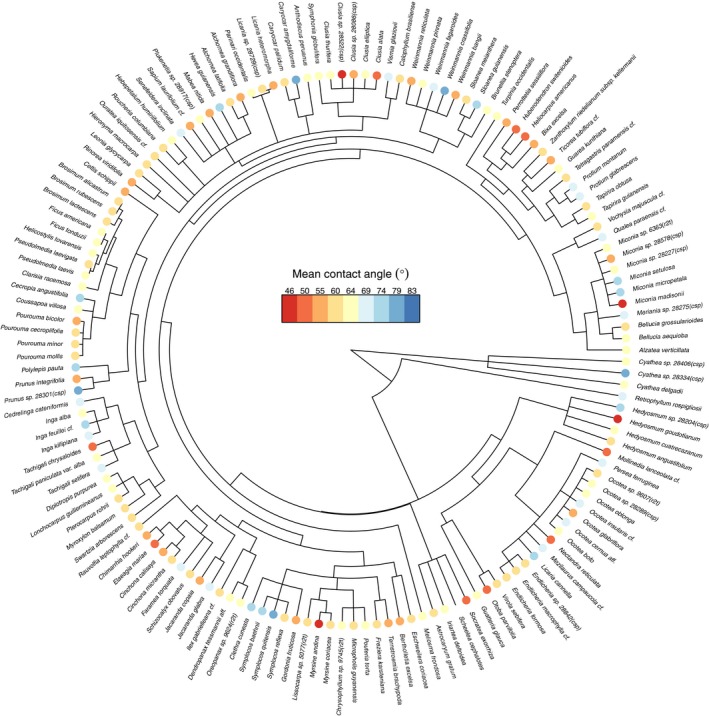
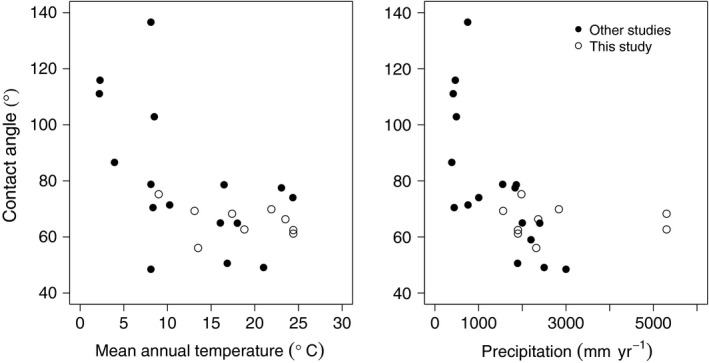
Leaf wetting is often considered to have negative effects on plant function, such that wet environments may select for leaves with certain leaf surface, morphological, and architectural traits that reduce leaf wettability. However, there is growing recognition that leaf wetting can have positive effects. We measured variation in two traits, leaf drip tips and leaf water repellency, in a series of nine tropical forest communities occurring along a 3300-m elevation gradient in southern Peru. To extend this climatic gradient, we also assembled published leaf water repellency values from 17 additional sites. We then tested hypotheses for how these traits should vary as a function of climate. Contrary to expectations, we found that the proportion of species with drip tips did not increase with increasing precipitation. Instead, drip tips increased with increasing temperature. Moreover, leaf water repellency was very low in our sites and the global analysis indicated high repellency only in sites with low precipitation and temperatures. Our findings suggest that drip tips and repellency may not solely reflect the negative effects of wetting on plant function. Understanding the drivers of leaf wettability traits can provide insight into the effects of leaf wetting on plant, community, and ecosystem function.
Keywords: cloud forest; contact angle; drip tips; ecohydrology; foliar water uptake; functional traits; leaf hydrophobicity; leaf water repellency.
© 2016 The Authors. New Phytologist © 2016 New Phytologist Trust.
Figures
Comment in
-
Using traits to uncover tropical forest function.New Phytol. 2017 May;214(3):903-904. doi: 10.1111/nph.14576. New Phytol. 2017. PMID: 28397361 No abstract available.
References
-
- Aryal B, Neuner G. 2010. Leaf wettability decreases along an extreme altitudinal gradient. Oecologia 162: 1–9. - PubMed
-
- Asner GP, Martin RE, Carranza‐Jiménez L, Sinca F, Tupayachi R, Anderson CB, Martinez P. 2014. Functional and biological diversity of foliar spectra in tree canopies throughout the Andes to Amazon region. New Phytologist 204: 127–139. - PubMed
-
- Baker‐Brosh KF, Peet RK. 1997. The ecological significance of lobed and toothed leaves in temperate forest trees. Ecology 78: 1250–1255.
-
- Bell CD, Soltis DE, Soltis PS. 2010. The age and diversification of the angiosperms re‐revisited. American Journal of Botany 97: 1296–1303. - PubMed
-
- Bradley DJ, Gilbert GS, Parker IM. 2003. Susceptibility of clover species to fungal infection: the interaction of leaf surface traits and environment. American Journal of Botany 90: 857–864. - PubMed
MeSH terms
Substances
LinkOut - more resources
Full Text Sources
Other Literature Sources
