


King-Devick and Pre-season Visual Function in Adolescent Athletes
- PMID: 27464573
- PMCID: PMC5182104
- DOI: 10.1097/OPX.0000000000000938
King-Devick and Pre-season Visual Function in Adolescent Athletes
Abstract
Purpose: The King-Devick test (KD) has been studied as a remove-from-play sideline test in college-age athletes and older; however, studies in younger athletes are limited. A cross-sectional study of the KD and other vision correlates was completed on school-aged athletes during pre-season physicals for a variety of sports to determine the repeatability of the KD. The study also evaluated how convergence, alignment, or pupil function contributed to a slower King-Devick baseline reading.
Methods: Seven hundred eighty-five athletes underwent vision screenings in a hospital or school setting by trained/certified staff as part of pre-season physicals. Six hundred nineteen had KD testing completed per the manufacturer's suggested protocol and repeated. Other baseline vision testing included visual acuity, Modified Thorington testing for alignment, convergence testing, and pupil function using the NeurOptics (NPI-200) NPi.
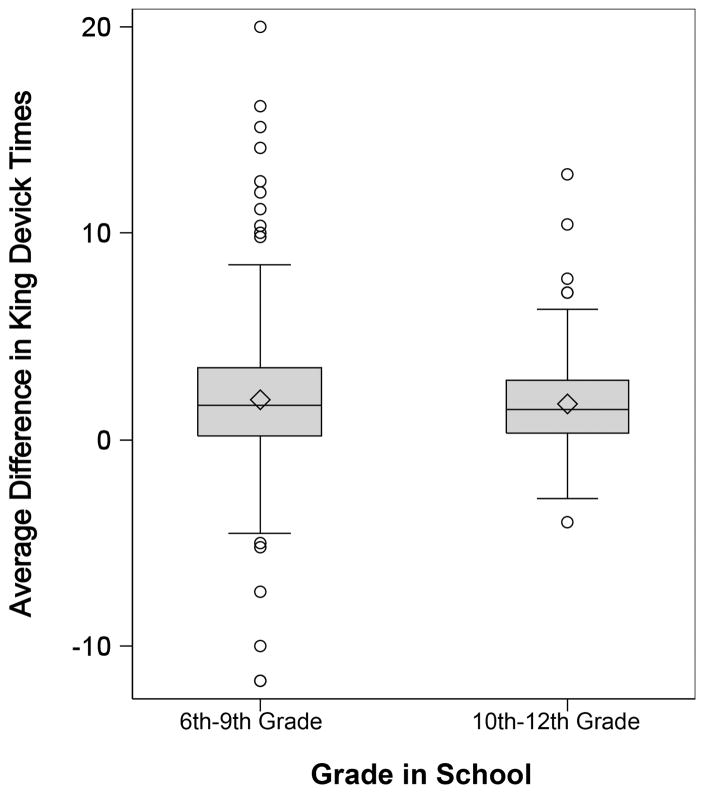
Results: The mean fastest, error-minimized KD time for all participants was 43.9 seconds(s) (SD ± 11.6, range 24-120). Median KD time got faster (+) with age (p < 0.0001). The inter-class correlation coefficient for all scores was 0.92. The absolute mean time difference for any two tests was 3.5 s (SD ± 2.5, range 0-23). There was no association between the best KD time and reduced NPC (p = 0.63), Modified Thorington measure of alignment (p = 0.55), or NPi pupil function (p = 0.79). The Bland Altman repeated measure limits of agreement was ±6.5 seconds for those in the 10th to12th grades, and ±10.2 seconds for those in the 6th to 9th grades.
Conclusions: King-Devick score in junior high and high school athletes is variable but gets faster and more repeatable with increasing age. The KD does not correlate significantly with reduced convergence, alignment, or pupil function. Based on grouped data, a slowing of 10 seconds for younger athletes and 6 seconds for older athletes on a second administration represents a true difference in testing speed. Within-player variability should be considered when removal-from-play decisions are influenced by KD results.
Figures
References
-
- Centers for Disease Control and Prevention, Morbidity and Mortality Weekly Report (MMWR) Nonfatal Traumatic Brain Injuries Related to Sports and Recreation Activities among Persons Aged ≤19 Years — United States, 2001–2009. [Accessed January 14, 2016];MMWR. 2011 60:1337–42. Available at: http://www.cdc.gov/mmwr/preview/mmwrhtml/mm6039a1.htm. - PubMed
-
- McCrory P, Meeuwisse W, Aubry M, Cantu B, Dvořák J, Echemendia R, Engebretsen L, Johnston K, Kutcher J, Raftery M, Sills A, Benson B, et al. Consensus statement on Concussion in Sport - The 4th International Conference on Concussion in Sport held in Zurich, November 2012. Phys Ther Sport. 2013;14:e1–e13. - PubMed
-
- Master CL, Scheiman M, Gallaway M, Goodman A, Robinson RL, Master SR, Grady MF. Vision diagnoses are common after concussion in adolescents. Clin Pediatr (Phila) 2016;55:260–7. - PubMed
-
- Stelmack JA, Frith T, Van Koevering D, Rinne S, Stelmack TR. Visual function in patients followed at a Veterans Affairs polytrauma network site: an electronic medical record review. Optometry. 2009;80:419–24. - PubMed
-
- Brahm KD, Wilgenburg HM, Kirby J, Ingalla S, Chang CY, Goodrich GL. Visual impairment and dysfunction in combat-injured service members with traumatic brain injury. Optom Vis Sci. 2009;86:817–25. - PubMed
MeSH terms
Grants and funding
LinkOut - more resources
Full Text Sources
Other Literature Sources
Medical
