


Cognitive Effects of Adenotonsillectomy for Obstructive Sleep Apnea
- PMID: 27464674
- PMCID: PMC4960728
- DOI: 10.1542/peds.2015-4458
Cognitive Effects of Adenotonsillectomy for Obstructive Sleep Apnea
Abstract
Objective: Research reveals mixed evidence for the effects of adenotonsillectomy (AT) on cognitive tests in children with obstructive sleep apnea syndrome (OSAS). The primary aim of the study was to investigate effects of AT on cognitive test scores in the randomized Childhood Adenotonsillectomy Trial.
Methods: Children ages 5 to 9 years with OSAS without prolonged oxyhemoglobin desaturation were randomly assigned to watchful waiting with supportive care (n = 227) or early AT (eAT, n = 226). Neuropsychological tests were administered before the intervention and 7 months after the intervention. Mixed model analysis compared the groups on changes in test scores across follow-up, and regression analysis examined associations of these changes in the eAT group with changes in sleep measures.
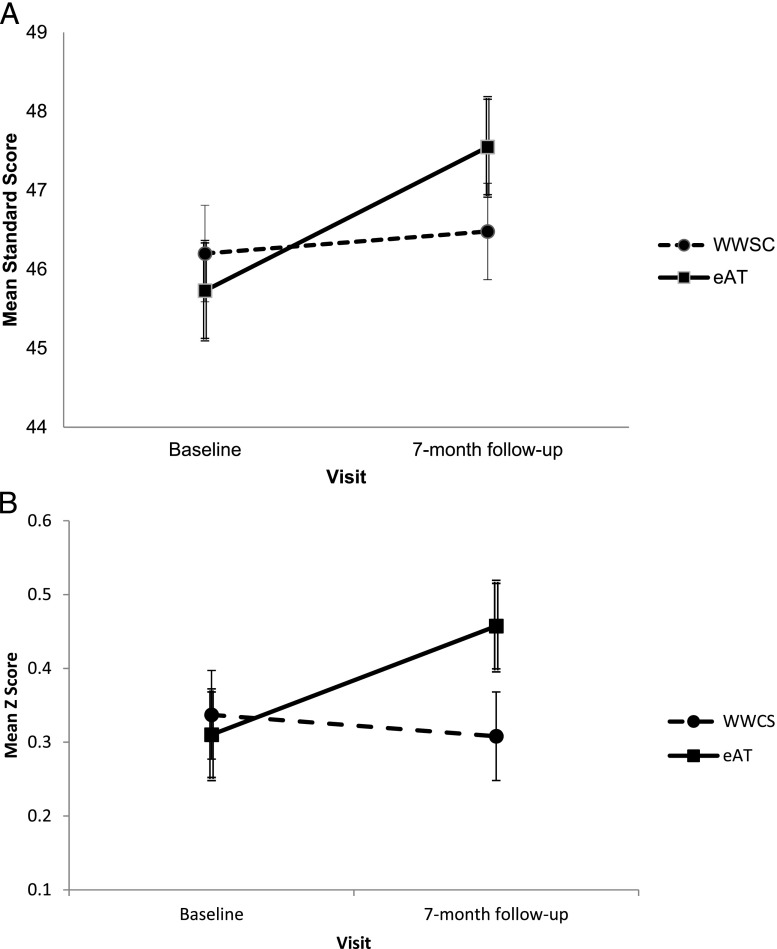
Results: Mean test scores were within the average range for both groups. Scores improved significantly (P < .05) more across follow-up for the eAT group than for the watchful waiting group. These differences were found only on measures of nonverbal reasoning, fine motor skills, and selective attention and had small effects sizes (Cohen's d, 0.20-0.24). As additional evidence for AT-related effects on scores, gains in test scores for the eAT group were associated with improvements in sleep measures.
Conclusions: Small and selective effects of AT were observed on cognitive tests in children with OSAS without prolonged desaturation. Relative to evidence from Childhood Adenotonsillectomy Trial for larger effects of surgery on sleep, behavior, and quality of life, AT may have limited benefits in reversing any cognitive effects of OSAS, or these benefits may require more extended follow-up to become manifest.
Trial registration: ClinicalTrials.gov NCT00560859.
Copyright © 2016 by the American Academy of Pediatrics.
Conflict of interest statement
Figures
References
-
- American Thoracic Society Standard and indications for cardiopulmonary sleep studies in children. Am J Respir Crit Care Med. 1996;153:866–878 - PubMed
-
- Garetz SL. Behavior, cognition, and quality of life after adenotonsillectomy for pediatric sleep-disordered breathing: summary of the literature. Otolaryngol Head Neck Surg. 2008;138(1 suppl):S19–S26 - PubMed
-
- Marcus CL, Brooks LJ, Draper KA, et al. ; American Academy of Pediatrics . Diagnosis and management of childhood obstructive sleep apnea syndrome. Pediatrics. 2012;130(3):576–584 - PubMed
-
- Amin R, Somers VK, McConnell K, et al. Activity-adjusted 24-hour ambulatory blood pressure and cardiac remodeling in children with sleep disordered breathing. Hypertension. 2008;51(1):84–91 - PubMed
Publication types
MeSH terms
Associated data
Grants and funding
LinkOut - more resources
Full Text Sources
Other Literature Sources
Medical
