


A Mobile Ecological Momentary Assessment Tool (devilSPARC) for Nutrition and Physical Activity Behaviors in College Students: A Validation Study
- PMID: 27465701
- PMCID: PMC4980553
- DOI: 10.2196/jmir.5969
A Mobile Ecological Momentary Assessment Tool (devilSPARC) for Nutrition and Physical Activity Behaviors in College Students: A Validation Study
Abstract
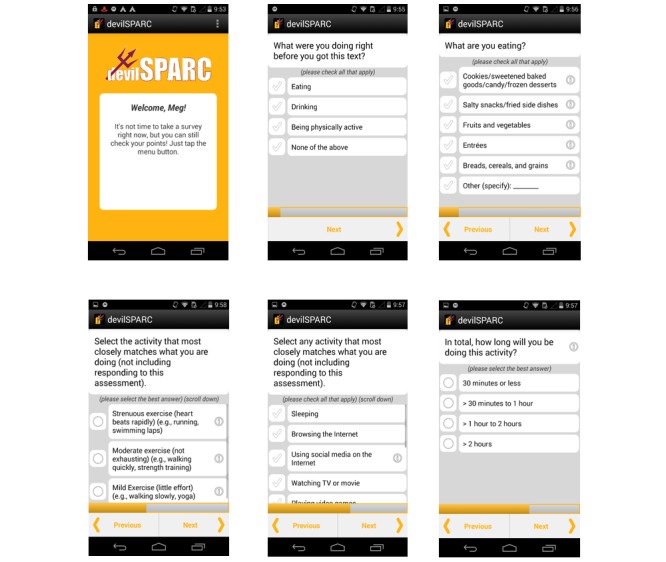
Background: The majority of nutrition and physical activity assessments methods commonly used in scientific research are subject to recall and social desirability biases, which result in over- or under-reporting of behaviors. Real-time mobile-based ecological momentary assessments (mEMAs) may result in decreased measurement biases and minimize participant burden.
Objective: The aim was to examine the validity of a mEMA methodology to assess dietary and physical activity levels compared to 24-hour dietary recalls and accelerometers.
Methods: This study was a pilot test of the SPARC (Social impact of Physical Activity and nutRition in College) study, which aimed to determine the mechanism by which friendship networks impact weight-related behaviors among young people. An mEMA app, devilSPARC, was developed to assess weight-related behaviors in real time. A diverse sample of 109 freshmen and community mentors attending a large southwestern university downloaded the devilSPARC mEMA app onto their personal mobile phones. Participants were prompted randomly eight times per day over the course of 4 days to complete mEMAs. During the same 4-day period, participants completed up to three 24-hour dietary recalls and/or 4 days of accelerometry. Self-reported mEMA responses were compared to 24-hour dietary recalls and accelerometry measures using comparison statistics, such as match rate, sensitivity and specificity, and mixed model odds ratios, adjusted for within-person correlation among repeated measurements.
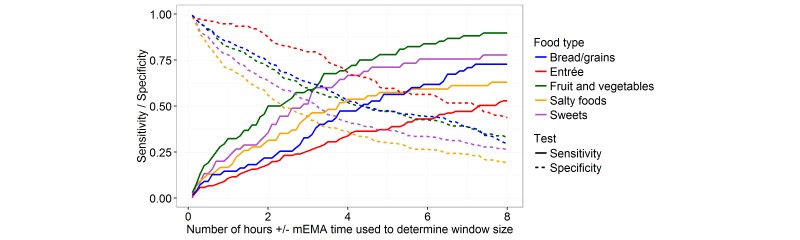
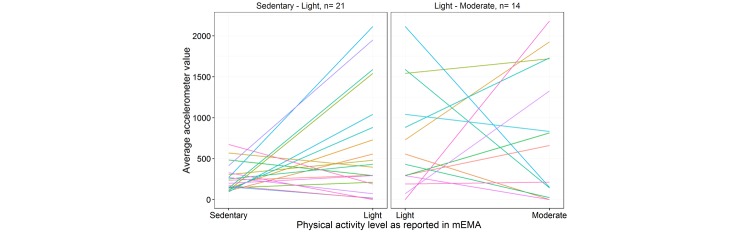
Results: At the day level, total dietary intake data reported through the mEMA app reflected eating choices also captured by the 24-hour recall. Entrées had the lowest match rate, and fruits and vegetables had the highest match rate. Widening the window of aggregation of 24-hour dietary recall data on either side of the mEMA response resulted in increased specificity and decreased sensitivity. For physical activity behaviors, levels of activity reported through mEMA differed for sedentary versus non-sedentary activity at the day level as measured by accelerometers.
Conclusions: The devilSPARC mEMA app is valid for assessing eating behaviors and the presence of sedentary activity at the day level. This mEMA may be useful in studies examining real-time weight-related behaviors.
Keywords: ecological momentary assessment; emerging adults; nutritional status; physical activity; sedentary activity; validation study.
Conflict of interest statement
Conflicts of Interest: None declared.
Figures
References
-
- Brenner PS, DeLamater JD. Social desirability bias in self-reports of physical activity: is an exercise identity the culprit? Soc Indic Res. 2014;117(2):489–504. doi: 10.1007/s11205-013-0359-y. - DOI
-
- Spook JE, Paulussen T, Kok G, Van Empelen P. Monitoring dietary intake and physical activity electronically: feasibility, usability, and ecological validity of a mobile-based ecological momentary assessment tool. J Med Internet Res. 2013 Sep 24;15(9):e214. doi: 10.2196/jmir.2617. http://www.jmir.org/2013/9/e214/ - DOI - PMC - PubMed
-
- Livingstone MB, Robson PJ, Wallace JM. Issues in dietary intake assessment of children and adolescents. Br J Nutr. 2004 Oct;92 Suppl 2:S213–S222. - PubMed
Publication types
MeSH terms
Grants and funding
LinkOut - more resources
Full Text Sources
Other Literature Sources
Medical
Miscellaneous
