


Late Acute Rejection After Allograft Limbal Stem Cell Transplantation: Evidence for Long-Term Donor Survival
- PMID: 27467047
- PMCID: PMC5138087
- DOI: 10.1097/ICO.0000000000000970
Late Acute Rejection After Allograft Limbal Stem Cell Transplantation: Evidence for Long-Term Donor Survival
Abstract
Purpose: To describe the clinical presentation and management of late (>3.0 years) acute graft rejection in keratolimbal allograft (KLAL) recipients.
Methods: This was a multicenter, retrospective observational case series. Six eyes of 6 patients with ocular surface transplant at a mean age of 36.2 years were seen at 3 tertiary referral centers for acute graft rejection between 2007 and 2013. Main outcome measures included strength of systemic immunosuppression (SI) at the time of rejection, time to rejection, and clinical presentation of rejection.
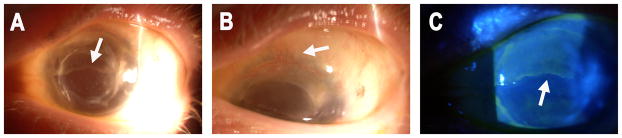
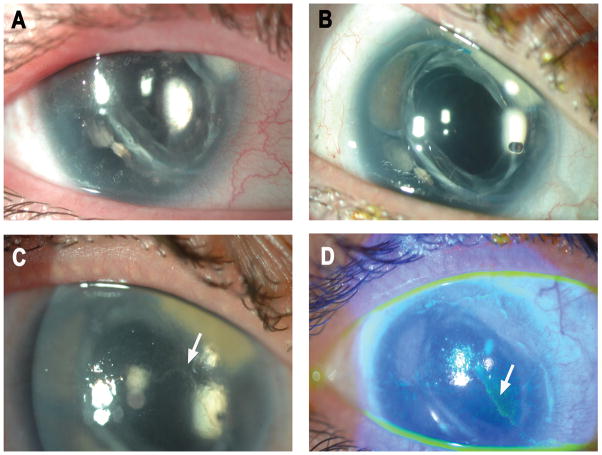
Results: Preoperative diagnoses included total limbal stem cell deficiency because of aniridia (n = 2) or chemical injury (n = 4). After an initially successful outcome, patients experienced late acute graft rejection at a mean time of 67.8 ± 24.1 months (range: 41-98) after KLAL while receiving suboptimal levels of SI because of medication taper (n = 5) or noncompliance (n = 1). Objective findings included an epithelial rejection line (n = 6), edema (n = 2), corneal epithelial irregularities (n = 2), and neovascularization (n = 1). Antirejection management consisted of topical corticosteroids (n = 6) and augmentation of SI therapy (n = 5).
Conclusions: These cases of late acute graft rejection in KLAL patients support the notion that allodonor cells can persist over the long run and remain at risk for immunologic rejection. It further underscores the fact that long-term success with KLAL may require extension of SI beyond the first few years, albeit at lower levels individualized to each patient.
Conflict of interest statement
Edward J. Holland is a consultant for and receives lecture fees from Allergan; consultant for and receives lecture fees from Abbott Medical Optics; consultant and receives grant support from Alcon Laboratories; consults for Senju Pharmaceutical Co, Ltd; consults for TearScience; consults for TearLab. For the remaining authors none were declared.
Figures
References
-
- Davanger M, Evensen A. Role of the pericorneal papillary structure in renewal of corneal epithelium. Nature. 1971;229:560–1. - PubMed
-
- Thoft RA, Friend J. The X, Y, Z hypothesis of corneal epithelial maintenance. Invest Ophthalmol Vis Sci. 1983;24:1442–3. - PubMed
-
- Lavker RM, Tseng SC, Sun TT. Corneal epithelial stem cells at the limbus: looking at some old problems from a new angle. Exp Eye Res. 2004;78:433–46. - PubMed
-
- Ang AY, Chan CC, Biber JM, et al. Ocular surface stem cell transplantation rejection: incidence, characteristics, and outcomes. Cornea. 2013;32:229–36. - PubMed
-
- Holland EJ, Djalilian AR, Schwartz GS. Management of aniridic keratopathy with keratolimbal allograft: a limbal stem cell transplantation technique. Ophthalmology. 2003;110:125–30. - PubMed
Publication types
MeSH terms
Substances
Grants and funding
LinkOut - more resources
Full Text Sources
Other Literature Sources
Medical
