


Establishing normative foot posture index values for the paediatric population: a cross-sectional study
- PMID: 27468312
- PMCID: PMC4962378
- DOI: 10.1186/s13047-016-0156-3
Establishing normative foot posture index values for the paediatric population: a cross-sectional study
Abstract
Background: The Foot Posture Index (FPI) is an observational tool designed to measure the position of the foot. Its reliability is well established, and it provides normative reference values for the general population. However, this is not so for the paediatric population. The aim of this study is to determine FPI reference values in childhood, taking into account age and gender.
Methods: This cross-sectional study included 1,762 school children (863 boys and 899 girls) aged 6-11 years, from Málaga, Granada and Plasencia (Spain). In every case, FPI measurements were obtained for both feet by two experienced podiatrists. A descriptive analysis was then conducted and the percentiles of the variables determined, with a significance level of P < 0.05.
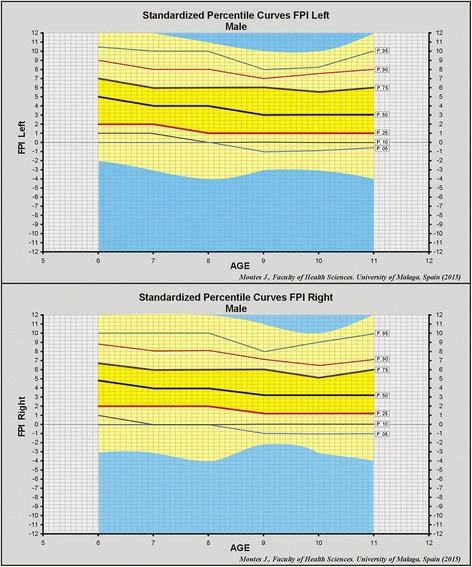
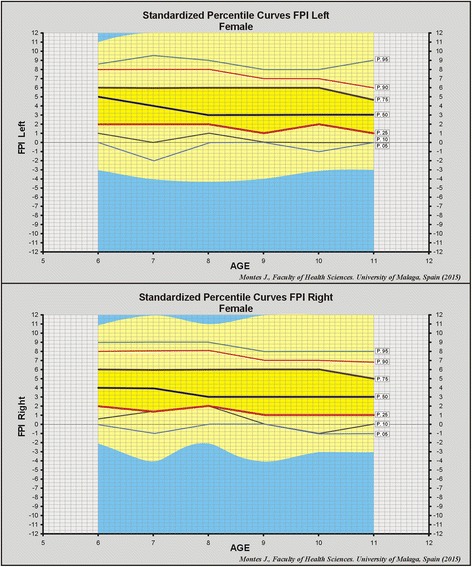
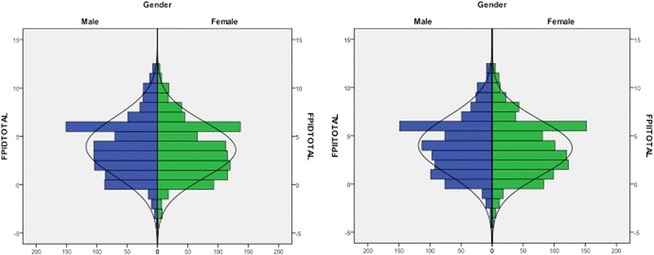
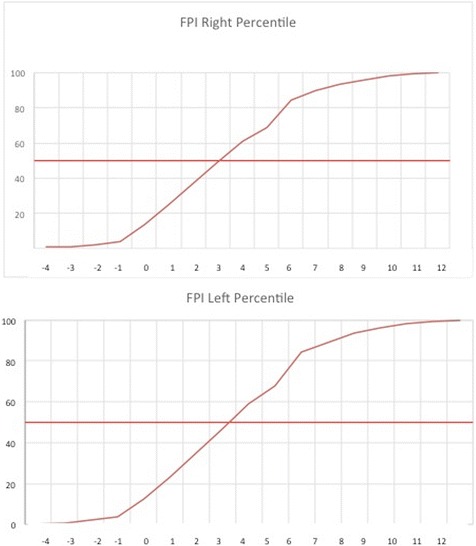
Results: The consolidated FPI results for the sample population produced mean values of 3.74 (SD 2.93) points for the right foot and 3.83 (SD 2.92) for the left. The 50th percentile was 4 points for both genders and for both feet, except for the right foot among the girls, which was slightly lower, at 3 points. The 85th percentile, which is considered to represent the boundary between the normal and the pronated foot among children, was 6 points, uniformly among the subjects.
Conclusions: As a normative FPI value for the paediatric population, we recommend the 50th percentile, i.e. 4 points, for children, of both genders, aged 6 years. This value progressively falls with age, to 3 FPI points for children aged 11 years. The 85th percentile for the pronated foot and the 4th percentile for the supinated foot can be considered the pathological boundary.
Figures
References
-
- Bordelon RL. Hypermobile flatfoot in children. Comprehension, evaluation, and treatment. Clin Orthop. 1983;181:7–14. - PubMed
-
- McCarthy DJ. The developmental anatomy of pes valgo planus. Clin Podiatr Med Surg. 1989;6(3):491–509. - PubMed
-
- Onodera AN, Sacco ICN, Morioka EH, Souza PS, de Sá MR, Amadio AC. What is the best method for child longitudinal plantar arch assessment and when does arch maturation occur? Foot Edinb Scotl. 2008;18(3):142–9. - PubMed
MeSH terms
LinkOut - more resources
Full Text Sources
Other Literature Sources
Medical
Research Materials
