


Heterogeneity of the HIV epidemic in agrarian, trading, and fishing communities in Rakai, Uganda: an observational epidemiological study
- PMID: 27470029
- PMCID: PMC4973864
- DOI: 10.1016/S2352-3018(16)30034-0
Heterogeneity of the HIV epidemic in agrarian, trading, and fishing communities in Rakai, Uganda: an observational epidemiological study
Abstract
Background: Understanding the extent to which HIV burden differs across communities and the drivers of local disparities is crucial for an effective and targeted HIV response. We assessed community-level variations in HIV prevalence, risk factors, and treatment and prevention service uptake in Rakai, Uganda.
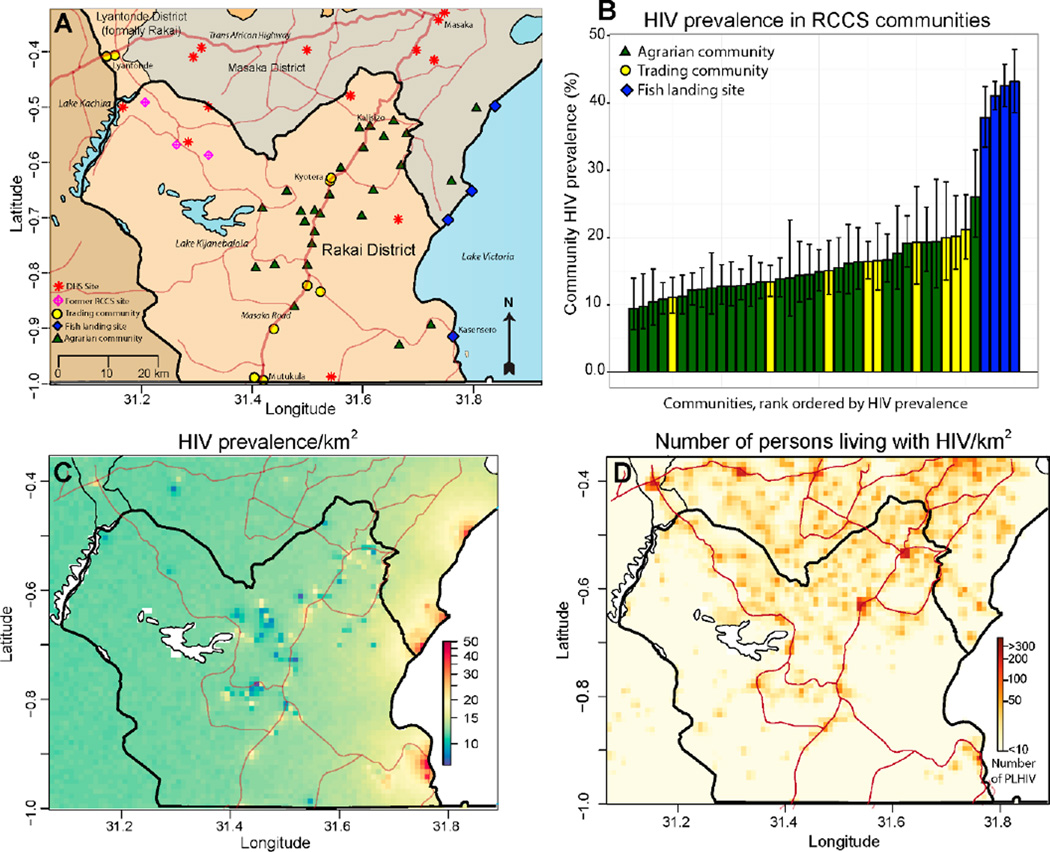
Methods: The Rakai Community Cohort Study (RCCS) is an open, population-based cohort of people aged 15-49 years in 40 communities. Participants are HIV tested and interviewed to obtain sociodemographic, behavioural, and health information. RCCS data from Aug 10, 2011, to May 30, 2013, were used to classify communities as agrarian (n=27), trading (n=9), or lakeside fishing sites (n=4). We mapped HIV prevalence with Bayesian methods, and characterised variability across and within community classifications. We also assessed differences in HIV risk factors and uptake of antiretroviral therapy and male circumcision between community types.
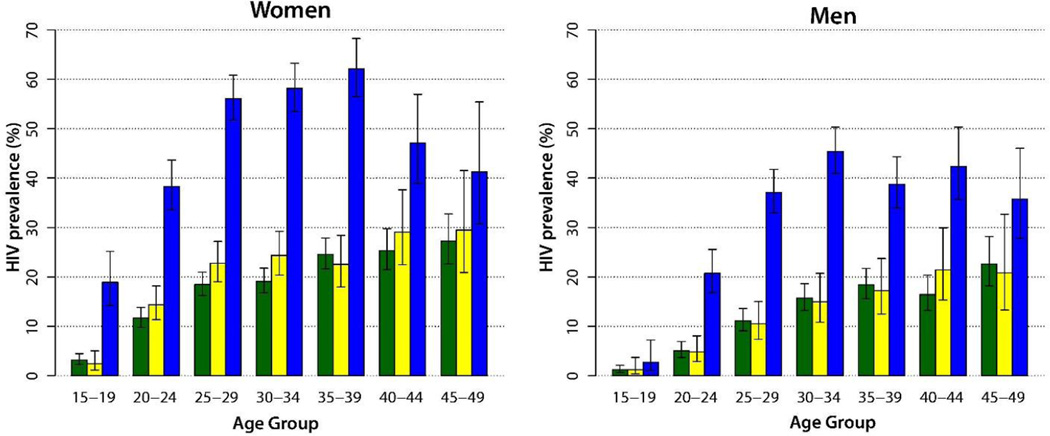
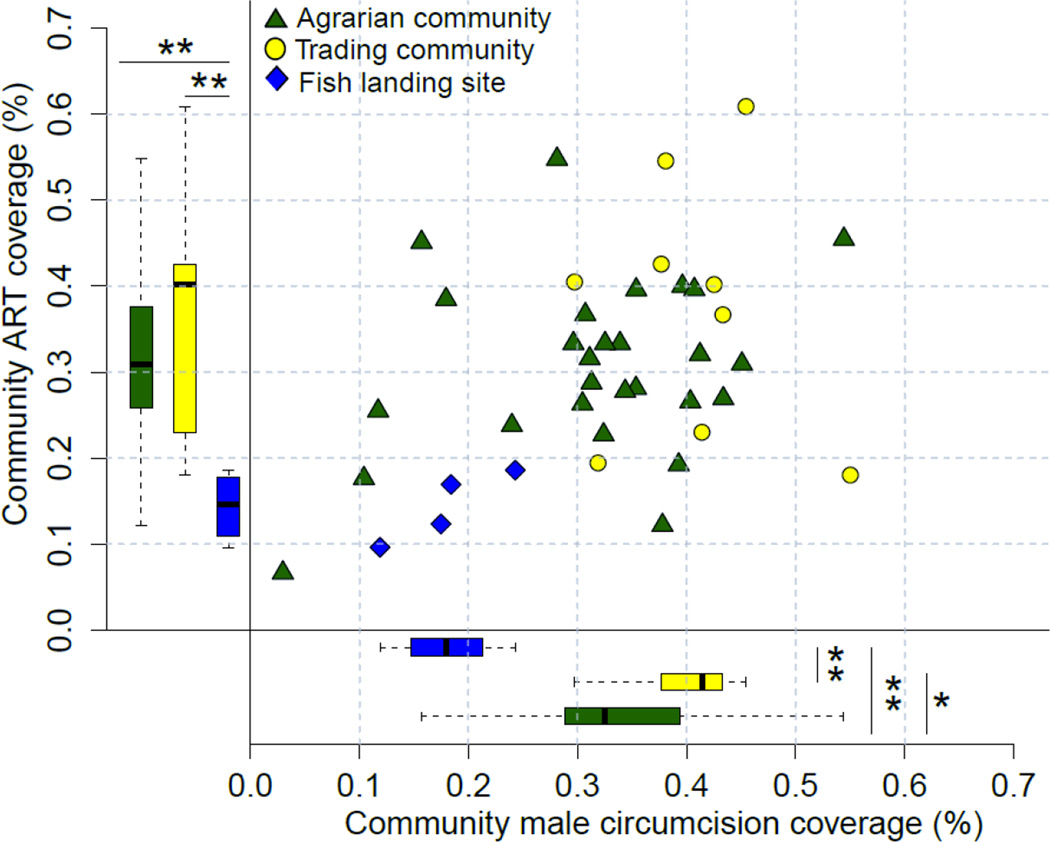
Findings: 17 119 individuals were included, 9215 (54%) of whom were female. 9931 participants resided in agrarian, 3318 in trading, and 3870 in fishing communities. Median HIV prevalence was higher in fishing communities (42%, range 38-43) than in trading (17%, 11-21) and agrarian communities (14%, 9-26). Antiretroviral therapy use was significantly lower in both men and women in fishing communities than in trading (age-adjusted prevalence risk ratio in men 0·64, 95% CI 0·44-0·97; women 0·53, 0·42-0·66) and agrarian communities (men 0·55, 0·42-0·72; women 0·65, 0·54-0·79), as was circumcision coverage among men (vs trading 0·48, 0·42-0·55; vs agrarian 0·64, 0·56-0·72). Self-reported risk behaviours were significantly higher in men than in women and in fishing communities than in other community types.
Interpretation: Substantial heterogeneity in HIV prevalence, risk factors, and service uptake in Rakai, Uganda, emphasises the need for local surveillance and the design of targeted HIV responses. High HIV burden, risk behaviours, and low use of combination HIV prevention in fishing communities make these populations a priority for intervention.
Funding: National Institute of Mental Health, the National Institute of Allergy and Infectious Diseases, the National Institute of Child Health and Development, and the National Institute for Allergy and Infectious Diseases Division of Intramural Research, National Institutes of Health; the Bill & Melinda Gates Foundation; and the Johns Hopkins University Center for AIDS Research.
Copyright © 2016 Elsevier Ltd. All rights reserved.
Conflict of interest statement
We declare that we have no conflicts of interest.
Figures
Comment in
-
Geographical mobility and heterogeneity of the HIV epidemic.Lancet HIV. 2016 Aug;3(8):e339-e341. doi: 10.1016/S2352-3018(16)30048-0. Epub 2016 Jul 9. Lancet HIV. 2016. PMID: 27470023 Free PMC article. No abstract available.
References
-
- PEPFAR 3.0. [accessed August 18, 2015]; http://www.pepfar.gov/documents/organization/234744.pdf.
-
- Puskas C, Hogg RS, Ferrand R, et al. Fast track to 2030: granularity at a global scale. The Lancet. 2015;2(1):e1–e32. - PubMed
-
- World AIDS Day 2015 Report. Focus on location and population. UNAIDS. 2015
-
- Anderson SJ, Cherutich P, Kilonzo N, et al. Maximising the effect of combination HIV prevention through prioritisation of the people and places in greatest need: a modelling study. Lancet. 2014;384(9939):249–256. - PubMed
-
- Kerr CC, Stuart RM, Gray RT, et al. Optima: A Model for HIV Epidemic Analysis, Program Prioritization, and Resource Optimization. J Acquir Immune Defic Syndr. 2015;69(3):365–376. - PubMed
Publication types
MeSH terms
Substances
Grants and funding
LinkOut - more resources
Full Text Sources
Other Literature Sources
Medical
