


Investigating the association between allergen-specific immunoglobulin E, cancer risk and survival
- PMID: 27471625
- PMCID: PMC4938379
- DOI: 10.1080/2162402X.2016.1154250
Investigating the association between allergen-specific immunoglobulin E, cancer risk and survival
Abstract
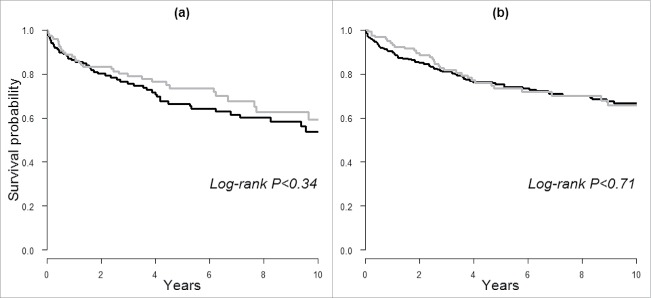
Prior findings linking allergy and cancer have been inconsistent, which may be driven by diverse assessment methods. We used serum specific immunoglobulin E (IgE) against common inhalant allergens that was assessed prior to cancer diagnosis in studying this association. We selected 8,727 Swedish men and women who had measurements of serum allergen-specific IgE and total IgE between 1992 and 1996. Multivariable Cox regression using age as a timescale was performed to assess the associations of IgE sensitization, defined by any levels of serum specific IgE ≥35 kU/L, with risk of overall and specific cancers. A test for trend was performed by assigning scores derived from allergen-specific IgE levels at baseline as an ordinal scale. Kaplan-Meier curves and log-rank test were used to assess cancer survival by IgE sensitization status. During a mean follow-up of 16 year, 689 persons were diagnosed with cancer. We found an inverse association between IgE sensitization and cancer risk, with a hazard ratio (HR) of 0.83 and 95% confidence intervals (CI) of 0.70-0.99. A similar trend was seen with specific IgE scores overall (Ptrend = 0.007) and in women (Ptrend = 0.01). Although IgE sensitization was not associated with risk of common site-specific cancers, serum specific IgE scores were inversely associated with melanoma risk in men and women combined, and with risk of female breast and gynecological cancers combined. No association with survival was observed. The association between circulating IgE levels and incident cancer may point toward a role of T-helper 2 (TH2)-biased response in development of some cancers.
Keywords: Allergy; atopy; cancer; cohort; immunoglobulin E.
Figures
References
-
- Johansson SGO, Bieber T, Dahl R, Friedmann PS, Lanier BQ, Lockey RF, Motala C, Ortega Martell JA, Platts-Mills TAE, Ring J et al.. Revised nomenclature for allergy for global use: Report of the Nomenclature Review Committee of the World Allergy Organization, October 2003. J Allergy Clin Immunol 2004; 113:832-6; PMID:15131563; http://dx.doi.org/ 10.1016/j.jaci.2003.12.591 - DOI - PubMed
-
- Rittmeyer D, Lorentz A. Relationship between allergy and cancer: an overview. Int Arch Allergy Immunol 2012; 159:216-25; PMID:22722389; http://dx.doi.org/ 10.1159/000338994 - DOI - PubMed
-
- Sherman PW, Holland E, Sherman JS. Allergies: their role in cancer prevention. Q Rev Biol 2008; 83:339-62; PMID:19143335; http://dx.doi.org/ 10.1086/592850 - DOI - PubMed
-
- Simpson CR, Anderson WJA, Helms PJ, Taylor MW, Watson L, Prescott GJ, Godden DJ, Barker RN. Coincidence of immune-mediated diseases driven by Th1 and Th2 subsets suggests a common aetiology. A population-based study using computerized general practice data. Clin Exp Allergy [Internet] 2002; 32:37-42. Available from: http://www.ncbi.nlm.nih.gov/pubmed/12002734; PMID:12002734; http://dx.doi.org/ 10.1046/j.0022-0477.2001.01250.x - DOI - PubMed
-
- Schäfer M, Werner S. Cancer as an overhealing wound: an old hypothesis revisited. Nat Rev Mol Cell Biol [Internet] 2008. [cited 2015May15]; 9:628-38. Available from: http://www.ncbi.nlm.nih.gov/pubmed/18628784; PMID:18628784; http://dx.doi.org/24074329 10.1038/nrm2455 - DOI - PubMed
Publication types
Grants and funding
LinkOut - more resources
Full Text Sources
Other Literature Sources
