


Insulin Resistance and Obesity Affect Lipid Profile in the Salivary Glands
- PMID: 27471733
- PMCID: PMC4951584
- DOI: 10.1155/2016/8163474
Insulin Resistance and Obesity Affect Lipid Profile in the Salivary Glands
Abstract
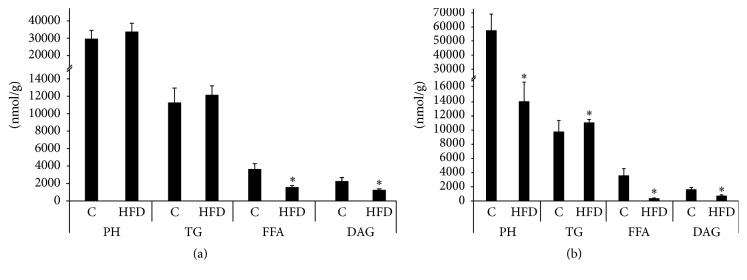
In today's world wrong nutritional habits together with a low level of physical activity have given rise to the development of obesity and its comorbidity, insulin resistance. More specifically, many researches indicate that lipids are vitally involved in the onset of a peripheral tissue (e.g., skeletal muscle, heart, and liver) insulin resistance. Moreover, it seems that diabetes can also induce changes in respect of lipid composition of both the salivary glands and saliva. However, judging by the number of research articles, the salivary glands lipid profile still has not been sufficiently explored. In the current study we aim to assess the changes in the main lipid fractions, namely, triacylglycerols, phospholipids, free fatty acids, and diacylglycerols, in the parotid and the submandibular salivary glands of rats exposed to a 5-week high fat diet regimen. We observed that the high caloric fat diet caused a significant change in the salivary glands lipid composition, especially with respect to PH and TG, but not DAG or FFAs, classes. The observed reduction in PH concentration is an interesting phenomenon frequently signifying the atrophy and malfunctions in the saliva secreting organs. On the other hand, the increased accumulation of TG in the glands may be an important clinical manifestation of metabolic syndrome and type 2 diabetes mellitus.
Figures
References
-
- Zhang L., Keung W., Samokhvalov V., Wang W., Lopaschuk G. D. Role of fatty acid uptake and fatty acid β-oxidation in mediating insulin resistance in heart and skeletal muscle. Biochimica et Biophysica Acta (BBA)—Molecular and Cell Biology of Lipids. 2010;1801(1):1–22. doi: 10.1016/j.bbalip.2009.09.014. - DOI - PubMed
-
- Bonen A., Tandon N. N., Glatz J. F. C., Luiken J. J. F. P., Heigenhauser G. J. F. The fatty acid transporter FAT/CD36 is upregulated in subcutaneous and visceral adipose tissues in human obesity and type 2 diabetes. International Journal of Obesity. 2006;30(6):877–883. doi: 10.1038/sj.ijo.0803212. - DOI - PubMed
MeSH terms
Substances
LinkOut - more resources
Full Text Sources
Other Literature Sources
Medical
Miscellaneous
