


Recruiting faith- and non-faith-based schools, adolescents and parents to a cluster randomised sexual-health trial: experiences, challenges and lessons from the mixed-methods Jack Feasibility Trial
- PMID: 27473584
- PMCID: PMC4966702
- DOI: 10.1186/s13063-016-1506-y
Recruiting faith- and non-faith-based schools, adolescents and parents to a cluster randomised sexual-health trial: experiences, challenges and lessons from the mixed-methods Jack Feasibility Trial
Abstract
Background: The move toward evidence-based education has led to increasing numbers of randomised trials in schools. However, the literature on recruitment to non-clinical trials is relatively underdeveloped, when compared to that of clinical trials. Recruitment to school-based randomised trials is, however, challenging, even more so when the focus of the study is a sensitive issue such as sexual health. This article reflects on the challenges of recruiting post-primary schools, adolescent pupils and parents to a cluster randomised feasibility trial of a sexual-health intervention, and the strategies employed to address them.
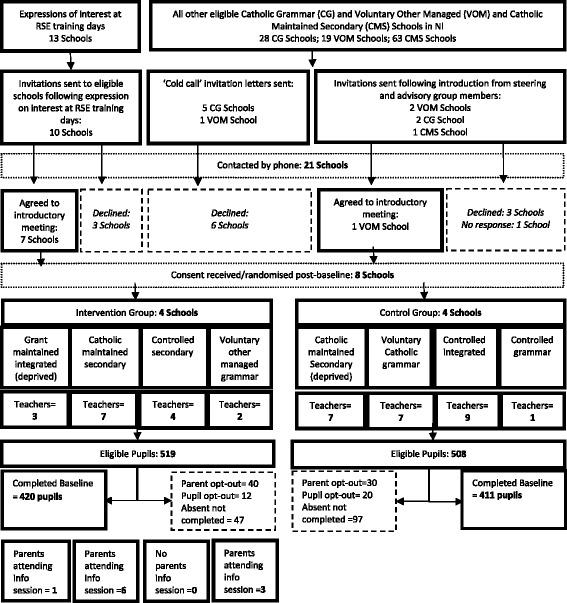
Methods: The Jack Trial was funded by the UK National Institute for Health Research. It comprised a feasibility study of an interactive film-based sexual-health intervention entitled If I Were Jack, recruiting over 800 adolescents from eight socio-demographically diverse post-primary schools in Northern Ireland. It aimed to determine the facilitators and barriers to recruitment and retention to a school-based sexual-health trial and identify optimal multi-level strategies for an effectiveness study. As part of an embedded process evaluation, we conducted semi-structured interviews and focus groups with principals, vice-principals, teachers, pupils and parents recruited to the study as well as classroom observations and a parents' survey.
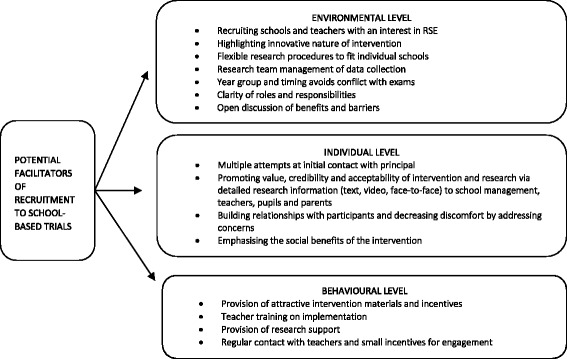
Results: With reference to social learning theory, we identified a number of individual-, behavioural- and environmental-level factors that influenced recruitment. Commonly identified facilitators included perceptions of the relevance and potential benefit of the intervention to adolescents, the credibility of the organisation and individuals running the study, support offered by trial staff, and financial incentives. Key barriers were prior commitment to other research, lack of time and resources, and perceptions that the intervention was incompatible with pupil or parent needs or the school ethos.
Conclusions: Reflecting on the methodological challenges of recruiting to a school-based sexual-health feasibility trial, this study highlights pertinent general and trial-specific facilitators and barriers to recruitment, which will prove useful for future trials with schools, adolescent pupils and parents.
Trial registration: ISRCTN 11632300 . Registered on 19 December 2014.
Keywords: Barriers and facilitators; Cluster randomised controlled trial; Complex interventions; Randomised controlled trial; Recruitment; Schools; Sexual health.
Figures
References
Publication types
MeSH terms
Associated data
Grants and funding
LinkOut - more resources
Full Text Sources
Other Literature Sources
Medical
