


Does the vaginal microbiota play a role in the development of cervical cancer?
- PMID: 27477083
- PMCID: PMC5164950
- DOI: 10.1016/j.trsl.2016.07.004
Does the vaginal microbiota play a role in the development of cervical cancer?
Abstract
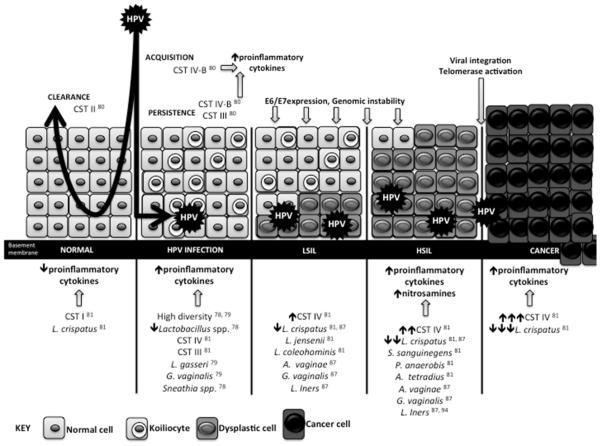
Persistent infection with oncogenic human papillomavirus (HPV) is necessary but not sufficient for the development of cervical cancer. The factors promoting persistence as well those triggering carcinogenetic pathways are incompletely understood. Rapidly evolving evidence indicates that the vaginal microbiome (VM) may play a functional role (both protective and harmful) in the acquisition and persistence of HPV, and subsequent development of cervical cancer. The first studies examining the VM and the presence of an HPV infection using next-generation sequencing techniques identified higher microbial diversity in HPV-positive as opposed to HPV-negative women. Furthermore, there appears to be a temporal relationship between the VM and HPV infection in that specific community state types may be correlated with a higher chance of progression or regression of the infection. Studies describing the VM in women with preinvasive disease (squamous intraepithelial neoplasia [SIL]) consistently demonstrate a dysbiosis in women with the more severe disease. Although it is plausible that the composition of the VM may influence the host's innate immune response, susceptibility to infection, and the development of cervical disease, the studies to date do not prove causality. Future studies should explore the causal link between the VM and the clinical outcome in longitudinal samples from existing biobanks.
Copyright © 2016 Elsevier Inc. All rights reserved.
Figures
References
-
- Ferlay J, Soerjomataram I, Dikshit R, et al. Cancer incidence and mortality worldwide: sources, methods and major patterns in GLOBOCAN 2012. International journal of cancer Journal international du cancer. 2015;136(5):E359–86. - PubMed
-
- Cervical Cancer . International Agency for Research on Cancer. World Health Organization: 2012. Estimated Incidence, Mortality and Prevalence Worldwide in 2012. GLOBOCAN 2012.
-
- Peto J, Gilham C, Fletcher O, et al. The cervical cancer epidemic that screening has prevented in the U. Lancet. 2004;364(9430):249–56. - PubMed
-
- Walboomers JM, Jacobs MV, Manos MM, et al. Human papillomavirus is a necessary cause of invasive cervical cancer worldwide. The Journal of pathology. 1999;189(1):12–9. - PubMed
-
- Dunne EF, Unger ER, Sternberg M, et al. Prevalence of HPV infection among females in the United States. JAMA. 2007;297(8):813–9. - PubMed
Publication types
MeSH terms
Grants and funding
LinkOut - more resources
Full Text Sources
Other Literature Sources
Medical
