


Cellular tagging as a neural network mechanism for behavioural tagging
- PMID: 27477539
- PMCID: PMC4974651
- DOI: 10.1038/ncomms12319
Cellular tagging as a neural network mechanism for behavioural tagging
Abstract
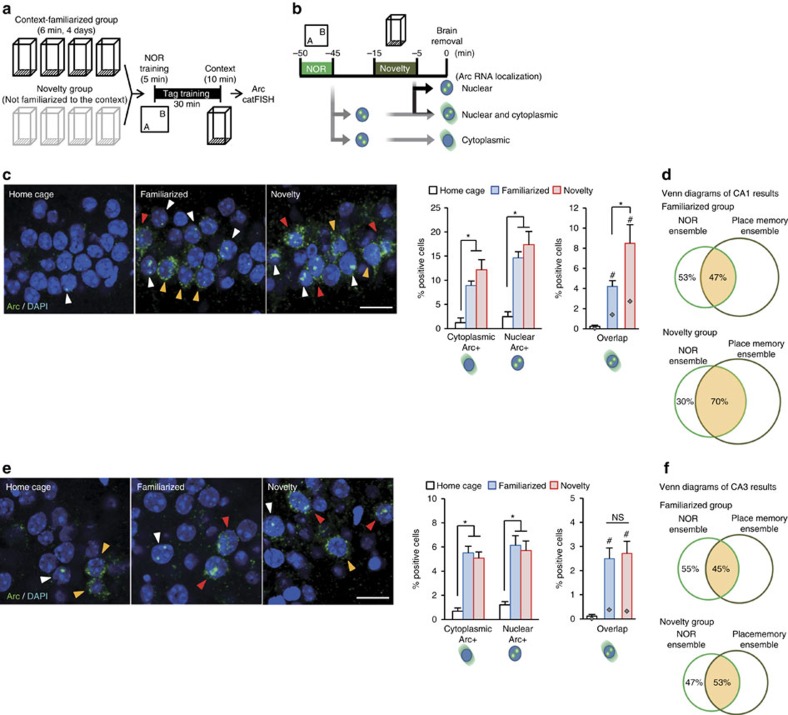
Behavioural tagging is the transformation of a short-term memory, induced by a weak experience, into a long-term memory (LTM) due to the temporal association with a novel experience. The mechanism by which neuronal ensembles, each carrying a memory engram of one of the experiences, interact to achieve behavioural tagging is unknown. Here we show that retrieval of a LTM formed by behavioural tagging of a weak experience depends on the degree of overlap with the neuronal ensemble corresponding to a novel experience. The numbers of neurons activated by weak training in a novel object recognition (NOR) task and by a novel context exploration (NCE) task, denoted as overlapping neurons, increases in the hippocampal CA1 when behavioural tagging is successfully achieved. Optical silencing of an NCE-related ensemble suppresses NOR-LTM retrieval. Thus, a population of cells recruited by NOR is tagged and then preferentially incorporated into the memory trace for NCE to achieve behavioural tagging.
Figures




References
-
- Bear M. F. How do memories leave their mark? Nature 385, 481–482 (1997). - PubMed
Publication types
MeSH terms
Substances
LinkOut - more resources
Full Text Sources
Other Literature Sources
Molecular Biology Databases
Miscellaneous
