


Access-related hand ischemia and the Hemodialysis Fistula Maturation Study
- PMID: 27478007
- PMCID: PMC5036979
- DOI: 10.1016/j.jvs.2016.03.449
Access-related hand ischemia and the Hemodialysis Fistula Maturation Study
Abstract
Objective: Access-related hand ischemia (ARHI) is a major complication after hemodialysis access construction. This study was designed to prospectively describe its incidence, predictors, interventions, and associated access maturation.
Methods: The Hemodialysis Fistula Maturation Study is a multicenter prospective cohort study designed to identify predictors of autogenous arteriovenous access (arteriovenous fistula [AVF]) maturation. Symptoms and interventions for ARHI were documented, and participants who received interventions for ARHI were compared with other participants using a nested case-control design. Associations of ARHI with clinical, ultrasound, vascular function, and vein histologic variables were each individually evaluated using conditional logistic regression; the association with maturation was assessed by relative risk, Pearson χ(2) test, and multiple logistic regression.
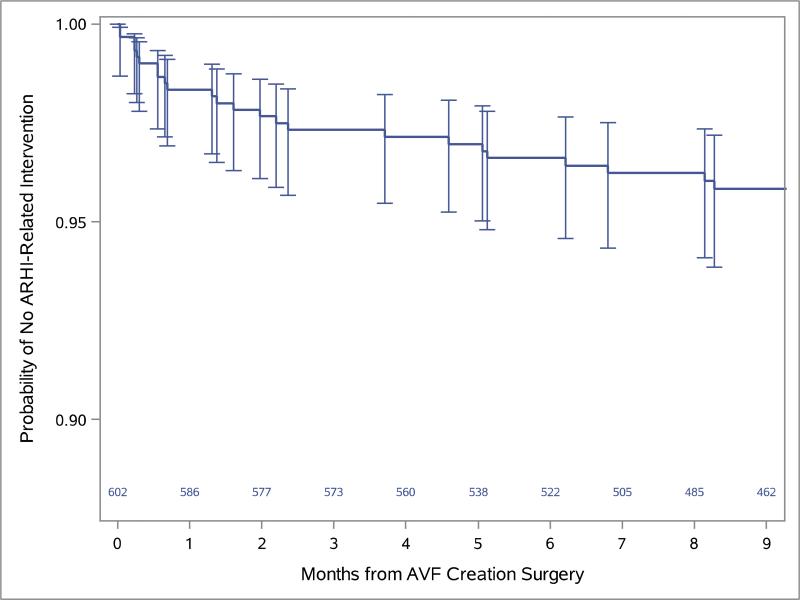
Results: The study cohort included 602 participants with median follow-up of 2.1 years (10th-90th percentiles, 0.7-3.5 years). Mean age was 55.1 ± 13.4 (standard deviation) years; the majority were male (70%), white (47%), diabetic (59%), smokers (55%), and on dialysis (64%) and underwent an upper arm AVF (76%). Symptoms of ARHI occurred in 45 (7%) participants, and intervention was required in 26 (4%). Interventions included distal revascularization with interval ligation (13), ligation (7), banding (4), revision using distal inflow (1), and proximalization of arterial inflow (1). Interventions were performed ≤7 days after AVF creation in 4 participants (15%), between 8 and 30 days in 6 (23%), and >30 days in 16 (63%). Female gender (odds ratio, 3.17; 95% confidence interval, 1.27-7.91; P = .013), diabetes (13.62 [1.81-102.4]; P = .011), coronary artery disease (2.60 [1.03-6.58]; P = .044), higher preoperative venous capacitance (per %/10 mm Hg, 2.76 [1.07-6.52]; P = .021), and maximum venous outflow slope (per [mL/100 mL/min]/10 mm Hg, 1.13 [1.03-1.25]; P = .011) were significantly associated with interventions; a lower carotid-femoral pulse wave velocity and the outflow vein diameter in the early postoperative period (days 0-3) approached significance (P < .10). Intervention for ARHI was not associated with AVF maturation failure (unadjusted risk ratio, 1.18 [0.69-2.04], P = .56; adjusted odds ratio, 0.97 [0.41-2.31], P = .95).
Conclusions: Remedial intervention for ARHI after AVF construction is uncommon. Diabetes, female gender, capacitant outflow veins, and coronary artery disease are all associated with an increased risk of intervention. These higher risk patients should be counseled preoperatively, their operative plans should be designed to reduce the risk of hand ischemia, and they should be observed closely.
Copyright © 2016 Society for Vascular Surgery. All rights reserved.
Figures
Comment in
-
Discussion.J Vasc Surg. 2016 Oct;64(4):1057-8. doi: 10.1016/j.jvs.2016.03.471. Epub 2016 Jul 29. J Vasc Surg. 2016. PMID: 27478008 No abstract available.
References
-
- Huber TS, Ozaki CK, Flynn TC, Lee WA, Berceli SA, Hirneise CM, et al. Prospective validation of an algorithm to maximize native arteriovenous fistulae for chronic hemodialysis access. J Vasc Surg. 2002 Sep;36(3):452–9. - PubMed
-
- Keuter XH, Kessels AG, de Haan MH, Van Der Sande FM, Tordoir JH. Prospective evaluation of ischemia in brachial-basilic and forearm prosthetic arteriovenous fistulas for hemodialysis. Eur J Vasc Endovasc Surg. 2008 May;35(5):619–24. - PubMed
-
- Lazarides MK, Staramos DN, Kopadis G, Maltezos C, Tzilalis VD, Georgiadis GS. Onset of arterial 'steal' following proximal angioaccess: immediate and delayed types. Nephrol Dial Transplant. 2003 Nov;18(11):2387–90. - PubMed
-
- Morsy AH, Kulbaski M, Chen C, Isiklar H, Lumsden AB. Incidence and characteristics of patients with hand ischemia after a hemodialysis access procedure. J Surg Res. 1998 Jan;74(1):8–10. - PubMed
Publication types
MeSH terms
Grants and funding
LinkOut - more resources
Full Text Sources
Other Literature Sources
Medical
