. 2016 Aug 1;11(8):e0160079.
doi: 10.1371/journal.pone.0160079. eCollection 2016.

Characterization of the Sweet Taste Receptor Tas1r2 from an Old World Monkey Species Rhesus Monkey and Species-Dependent Activation of the Monomeric Receptor by an Intense Sweetener Perillartine

Affiliations

Characterization of the Sweet Taste Receptor Tas1r2 from an Old World Monkey Species Rhesus Monkey and Species-Dependent Activation of the Monomeric Receptor by an Intense Sweetener Perillartine

Chenggu Cai et al. PLoS One. .

Abstract

Sweet state is a basic physiological sensation of humans and other mammals which is mediated by the broadly acting sweet taste receptor-the heterodimer of Tas1r2 (taste receptor type 1 member 2) and Tas1r3 (taste receptor type 1 member 3). Various sweeteners interact with either Tas1r2 or Tas1r3 and then activate the receptor. In this study, we cloned, expressed and functionally characterized the taste receptor Tas1r2 from a species of Old World monkeys, the rhesus monkey. Paired with the human TAS1R3, it was shown that the rhesus monkey Tas1r2 could respond to natural sugars, amino acids and their derivates. Furthermore, similar to human TAS1R2, rhesus monkey Tas1r2 could respond to artificial sweeteners and sweet-tasting proteins. However, the responses induced by rhesus monkey Tas1r2 could not be inhibited by the sweet inhibitor amiloride. Moreover, we found a species-dependent activation of the Tas1r2 monomeric receptors of human, rhesus monkey and squirrel monkey but not mouse by an intense sweetener perillartine. Molecular modeling and sequence analysis indicate that the receptor has the conserved domains and ligand-specific interactive residues, which have been identified in the characterized sweet taste receptors up to now. This is the first report of the functional characterization of sweet taste receptors from an Old World monkey species.


Conflict of interest statement

Competing Interests: The authors have declared that no competing interests exist.

Figures

Fig 1
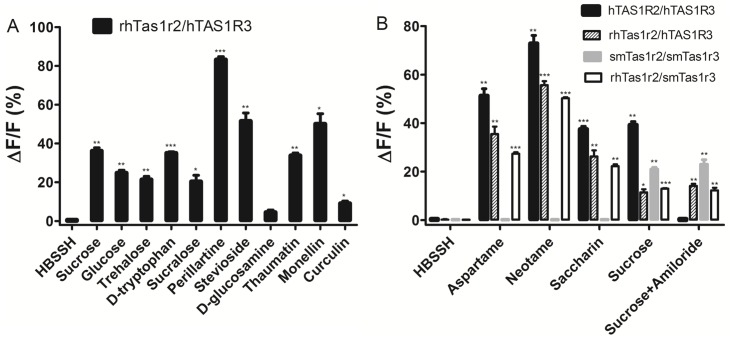
Fig 1. Rhesus monkey Tas1r2 responds to natural sugars, amino acids, artificial sweeteners and sweet-tasting proteins but not sweet taste inhibitor amiloride.
(A) The responses of rhTas1r2/hTAS1R3 towards HBSSH (buffer solution), sucrose (300 mM), glucose (300 mM), trehalose (250 mM), D-tryptophan (5 mM), sucralose (1 mM), perillartine (300 μM), stevioside (1 mM), D-glucosamine (500 mM), monellin (45 μM), thaumatin (4.4 μM) and curculin (10 μM). (B) The responses towards HBSSH, aspartame (5 mM), neotame (0.25 mM), saccharin (1 mM) and amiloride (3 mM). The asterisks indicate significant levels of the receptor responses to various sweeteners determined by the two-sided unpaired t test (*: p<0.05; **: p<0.01; ***: p<0.001) compared with the receptor responses to HBSSH buffer (S1 and S2 Appendices).
Fig 2
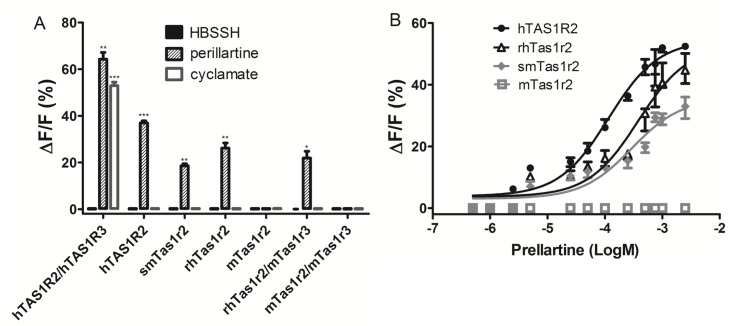
Fig 2. Perillartine activates the Tas1r2 subunit in a species-dependent manner.
(A) Responses of the Tas1r2 subunits of human, rhesus monkey, squirrel monkey and mouse, rhTas1r2/mTas1r3 and mTas1r2/mTas1r3 towards HBSSH (buffer solution), perillartine (300 μM) and cyclamate (50 mM). The asterisks indicate significant levels of the receptor responses to the sweeteners determined by the two-sided unpaired t test (*: p<0.05; **: p<0.01; ***: p<0.001) compared with the receptor responses to HBSSH buffer (S3 Appendix). (B) Dose-response curve of the Tas1r2 subunits of human, rhesus monkey, squirrel monkey and mouse towards perillartine.
Fig 3
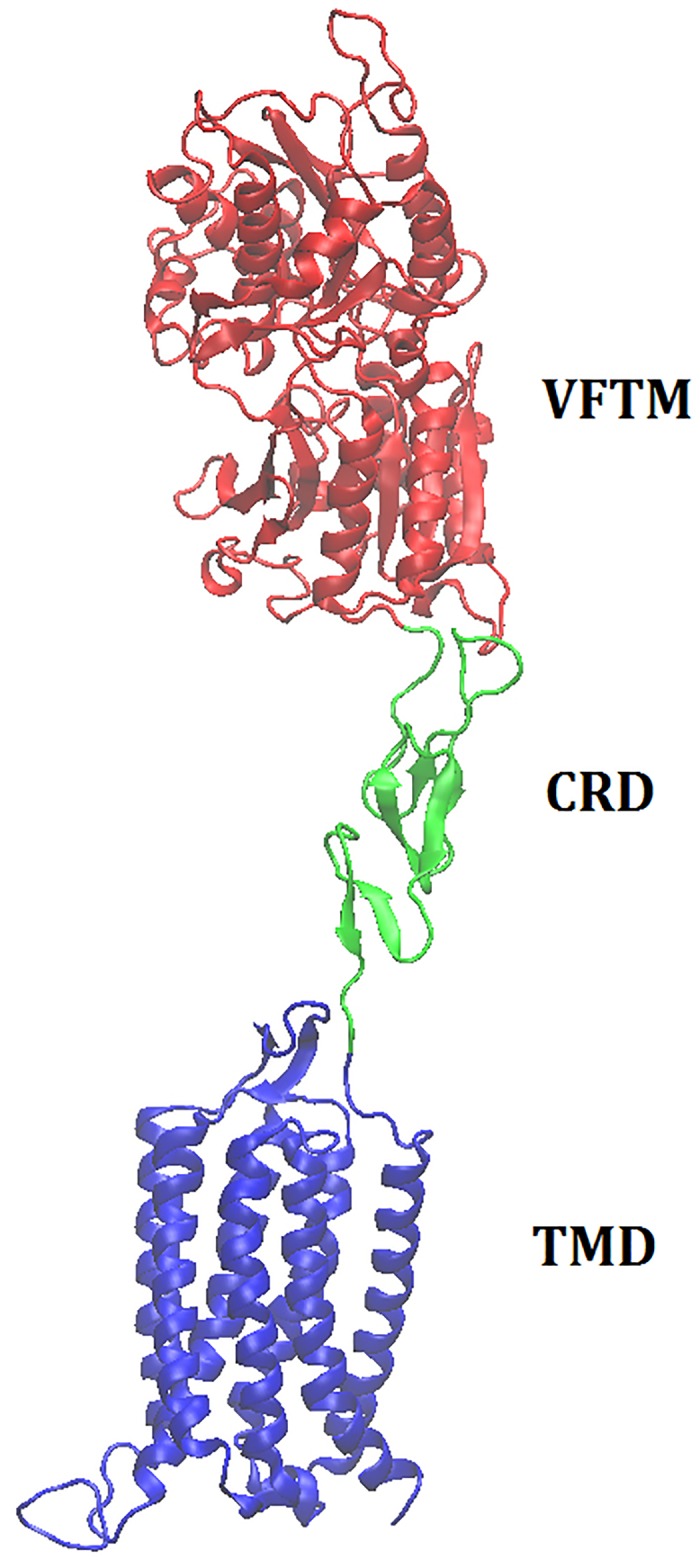
Fig 3. Homology modeling of the full length rhesus monkey Tas1r2.
The conserved VFTM, CRD and TMD are colored in red, aqua and blue, respectively.
Fig 4
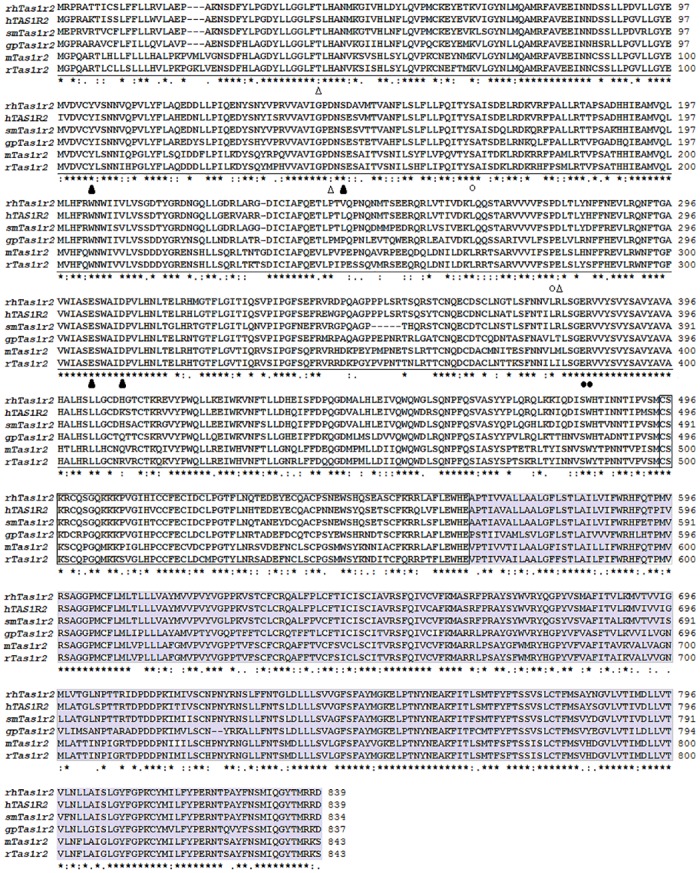
Fig 4. Sequence alignment of rhesus monkey Tas1r2 with the functionally characterized Tas1r2s from other species.
Conserved residues are indicated by asterisk above the alignment, single and double dots represent amino acids with semi-conservative and conservative characteristics. Gaps introduced during the alignment process are indicated as dashes. The conserved VFTM, CRD and TMD regions are underlined, boxed and grey color shaded respectively. The conserved aspartame and D-tryptophan interactive residues Y103, S144, E302 and D307 (numbering based on the rhTas1r2 sequence) are denoted as black triangles, and residues T40, D142 and D278 responsible for the species-dependent taste to aspartame are denoted as white triangles. Saccharin-specific residues E382 and R383 are denoted as black cycles, and residues S165 and P277 specific for D-tryptophan or sucralose reception are denoted as white cycles [3, 12, 15]. rhTas1r2: rhesus monkey Tas1r2 (GenBank: ABD37678); hTAS1R2: human TAS1R2 (Q8TE23); smTas1r2: squirrel monkey Tas1r2 (A3QP08); gpTas1r2: giant panda Tas1r2 (XP_002926877); mTas1r2: mouse Tas1r2 (Q925I4); rTas1r2: rat Tas1r2 (Q9Z0R7).

References

    1. Kim UK, Breslin PA, Reed D, Drayna D. Genetics of human taste perception. J Dent Res. 2004; 83(6):448–53. - PubMed
    1. Nelson G, Hoon MA, Chandrashekar J, Zhang Y, Ryba NJ, Zuker CS. Mammalian sweet taste receptors. Cell. 2001; 106(3):381–90. - PubMed
    1. Xu H, Staszewski L, Tang H, Adler E, Zoller M, Li X. Different functional roles of T1R subunits in the heteromeric taste receptors. Proc Natl Acad Sci USA. 2004; 101(39) 14258–63. - PMC - PubMed
    1. Nie Y, Vigues S, Hobbs JR, Conn GL, Munger SD. Distinct contributions of Tas1R2 and Tas1R3 taste receptor subunits to the detection of sweet stimuli. Curr Biol. 2005; 15 (21):1948–52. - PubMed
    1. Masuda T, Taguchi W, Sano A, Ohta K, Kitabatake N, Tani F. Five amino acid residues in cysteine-rich domain of human Tas1R3 were involved in the response for sweet-tasting protein, thaumatin. Biochimie. 2013; 95(7):1502–5. 10.1016/j.biochi.2013.01.010 - DOI - PubMed

MeSH terms

LinkOut - more resources