


Catalytic enantioselective 1,6-conjugate additions of propargyl and allyl groups
- PMID: 27479320
- PMCID: PMC5161616
- DOI: 10.1038/nature19063
Catalytic enantioselective 1,6-conjugate additions of propargyl and allyl groups
Abstract
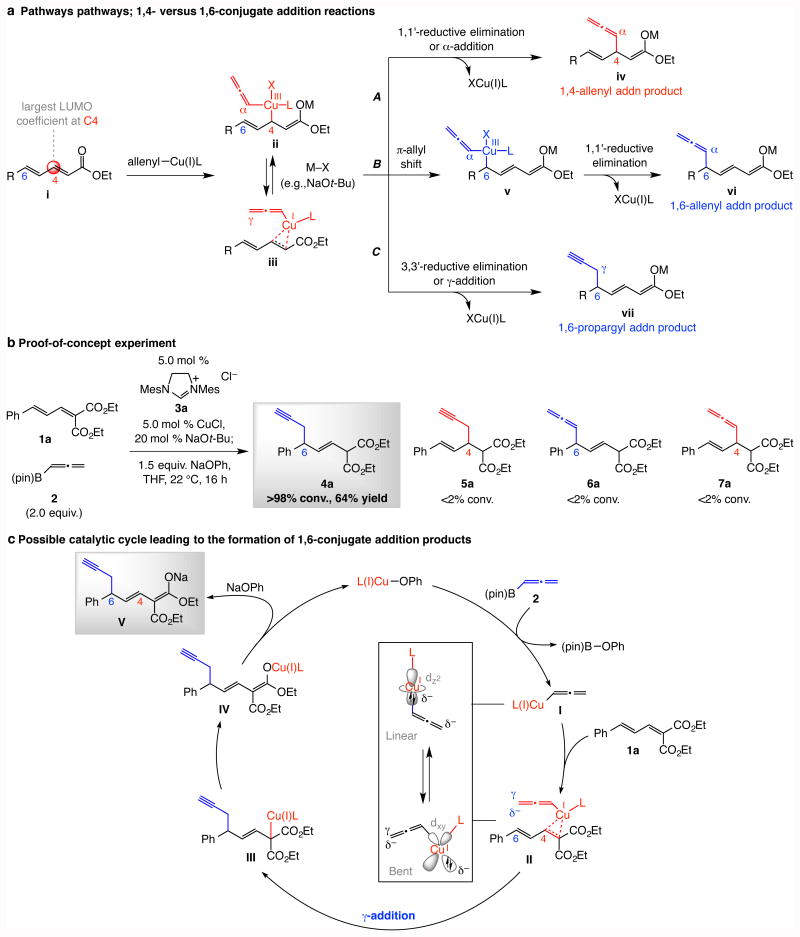
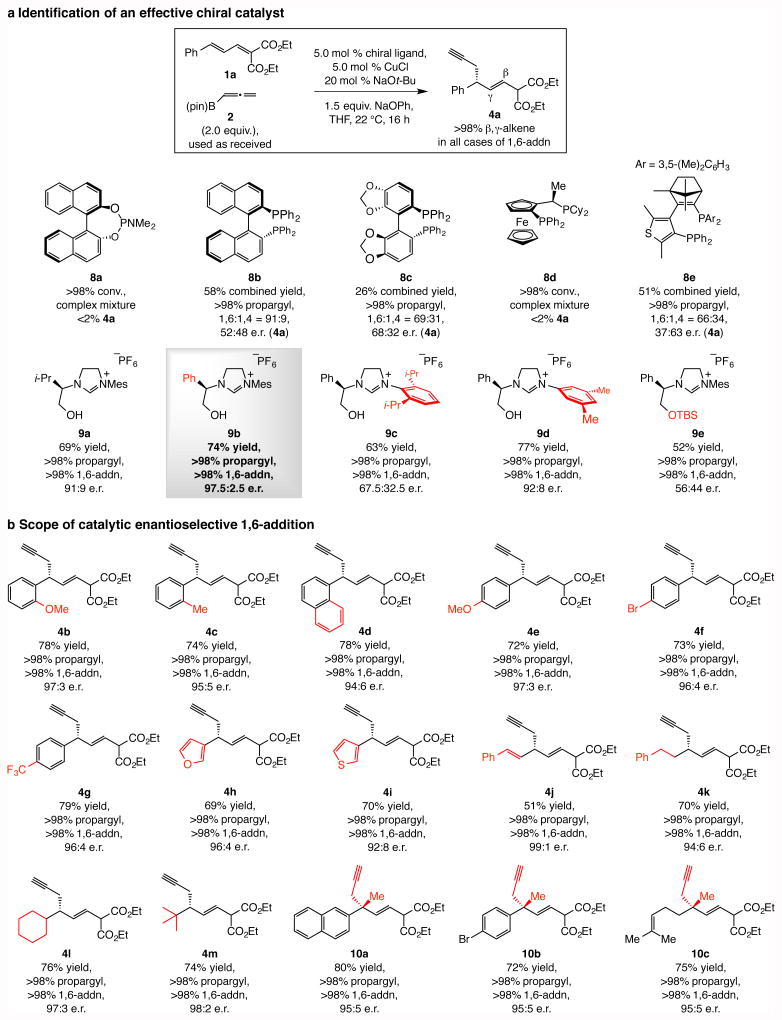
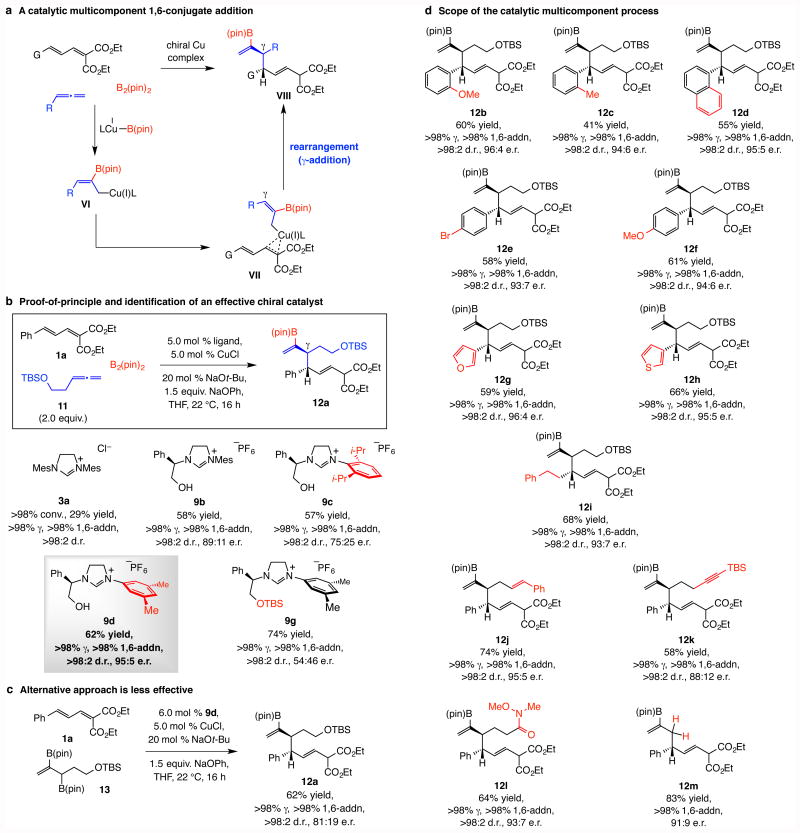
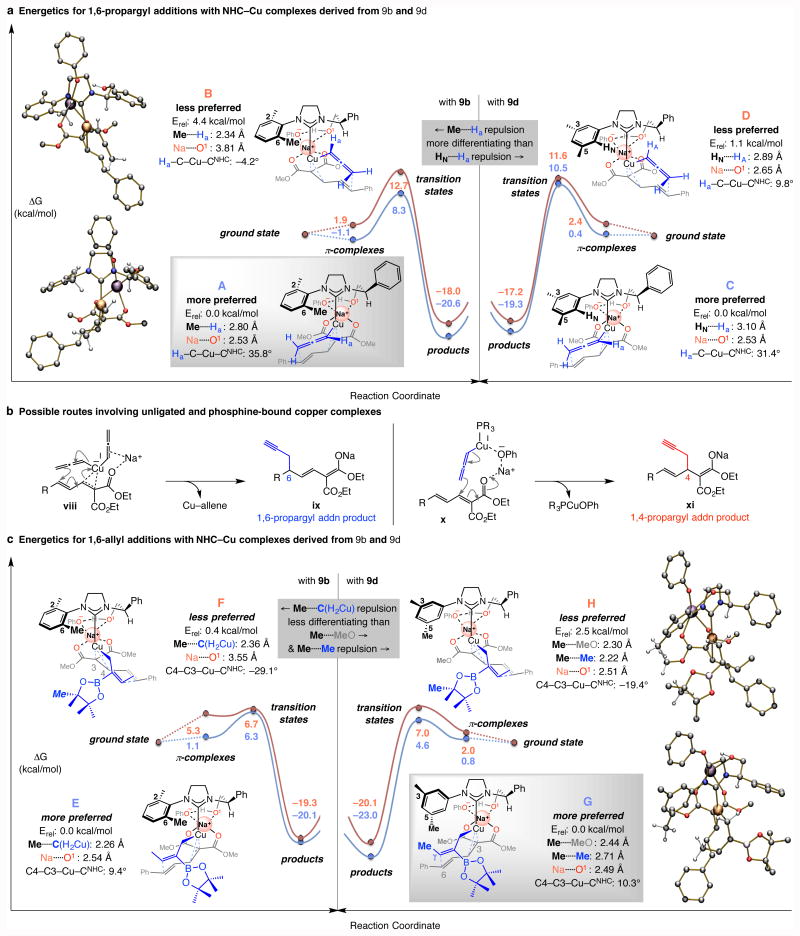
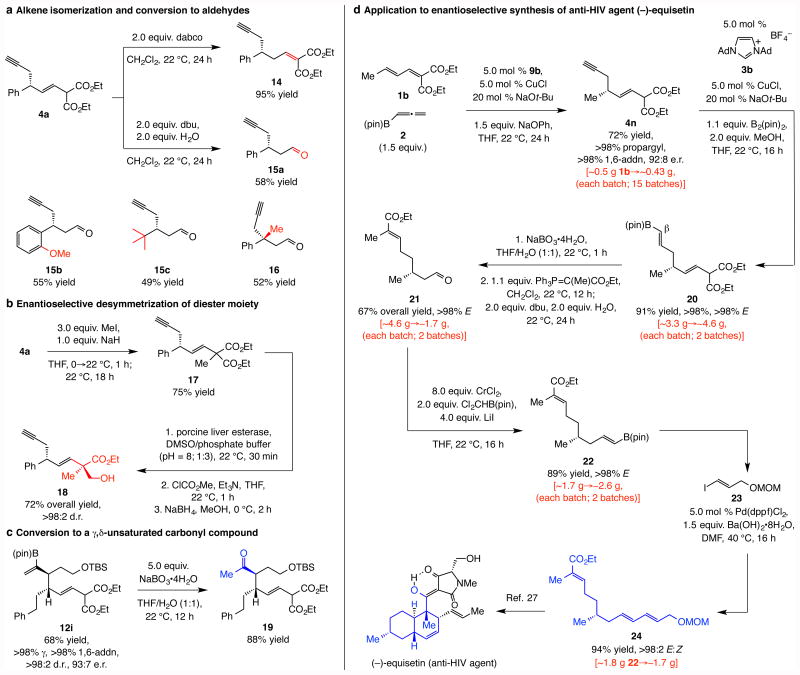
Conjugate (or 1,4-) additions of carbanionic species to α,β-unsaturated carbonyl compounds are vital to research in organic and medicinal chemistry, and there are several chiral catalysts that facilitate the catalytic enantioselective additions of nucleophiles to enoates. Nonetheless, catalytic enantioselective 1,6-conjugate additions are uncommon, and ones that incorporate readily functionalizable moieties, such as propargyl or allyl groups, into acyclic α,β,γ,δ-doubly unsaturated acceptors are unknown. Chemical transformations that could generate a new bond at the C6 position of a dienoate are particularly desirable because the resulting products could then be subjected to further modifications. However, such reactions, especially when dienoates contain two equally substituted olefins, are scarce and are confined to reactions promoted by a phosphine-copper catalyst (with an alkyl Grignard reagent, dialkylzinc or trialkylaluminium compounds), a diene-iridium catalyst (with arylboroxines), or a bisphosphine-cobalt catalyst (with monosilyl-acetylenes). 1,6-Conjugate additions are otherwise limited to substrates where there is full substitution at the C4 position. It is unclear why certain catalysts favour bond formation at C6, and-although there are a small number of catalytic enantioselective conjugate allyl additions-related 1,6-additions and processes involving a propargyl unit are non-existent. Here we show that an easily accessible organocopper catalyst can promote 1,6-conjugate additions of propargyl and 2-boryl-substituted allyl groups to acyclic dienoates with high selectivity. A commercially available allenyl-boron compound or a monosubstituted allene may be used. Products can be obtained in up to 83 per cent yield, >98:2 diastereomeric ratio (for allyl additions) and 99:1 enantiomeric ratio. We elucidate the mechanistic details, including the origins of high site selectivity (1,6- versus 1,4-) and enantioselectivity as a function of the catalyst structure and reaction type, by means of density functional theory calculations. The utility of the approach is highlighted by an application towards enantioselective synthesis of the anti-HIV agent (-)-equisetin.
Figures
References
-
- Alexakis A, Krause N, Woodward S. In: Copper-Catalyzed Asymmetric Synthesis. Alexakis A, Krause N, Woodward S, editors. VCH–Wiley; 2014. pp. 33–68.
-
- Silva EMP, Silva AMS. 1,6-Conjugate addition of nucleophiles to α,β,γ,δ-diunsaturated systems. Synthesis. 2012;44:3109–3128.
-
- Tissot M, Li H, Alexakis A. In: Copper-Catalyzed Asymmetric Synthesis. Alexakis A, Krause N, Woodward S, editors. VCH–Wiley; 2014. pp. 69–84.
-
- den Hartog T, Harutyunyan SR, Font D, Minnaard AJ, Feringa BL. Catalytic enantioselective 1,6-conjugate addition of Grignard reagents to linear dienoates. Angew Chem Int Edn. 2008;47:398–401. - PubMed
-
- den Hartog T, van Dijken DJ, Minnaard AJ, Feringa BL. An enantioselective approach to syn deoxypropionate units combining Cu-catalyzed 1,6- and 1,4-conjugate addition. Tetrahedron:Asymmetry. 2010;21:1574–1584.
Publication types
MeSH terms
Substances
Grants and funding
LinkOut - more resources
Full Text Sources
Other Literature Sources
Medical
Miscellaneous
