


Regional Systems of Care Demonstration Project: American Heart Association Mission: Lifeline STEMI Systems Accelerator
- PMID: 27482000
- PMCID: PMC4975540
- DOI: 10.1161/CIRCULATIONAHA.115.019474
Regional Systems of Care Demonstration Project: American Heart Association Mission: Lifeline STEMI Systems Accelerator
Abstract
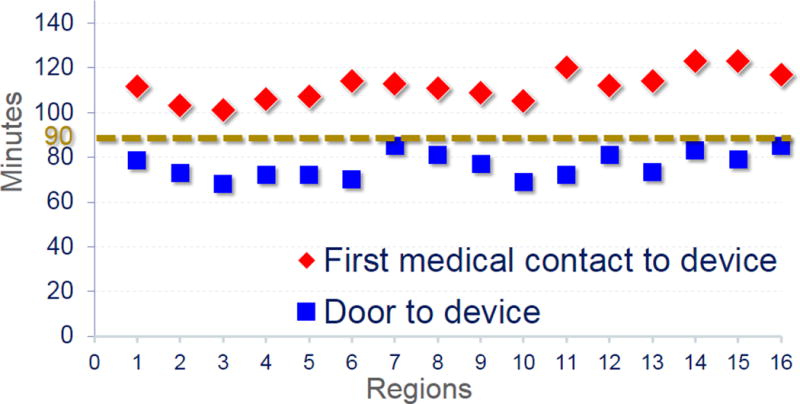
Background: Up to 50% of patients fail to meet ST-segment-elevation myocardial infarction (STEMI) guideline goals recommending a first medical contact-to-device time of <90 minutes for patients directly presenting to percutaneous coronary intervention-capable hospitals and <120 minutes for transferred patients. We sought to increase the proportion of patients treated within guideline goals by organizing coordinated regional reperfusion plans.
Methods: We established leadership teams, coordinated protocols, and provided regular feedback for 484 hospitals and 1253 emergency medical services (EMS) agencies in 16 regions across the United States.
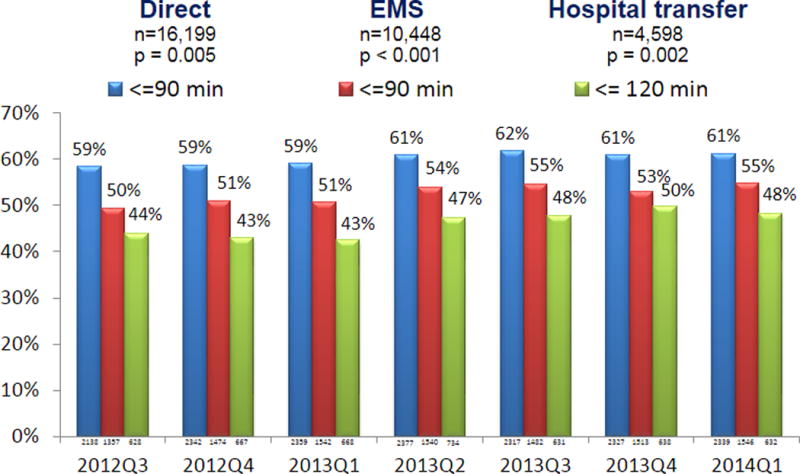
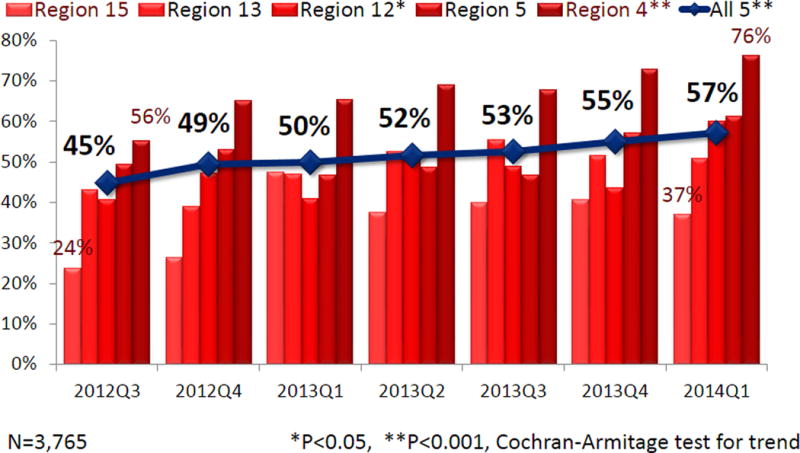
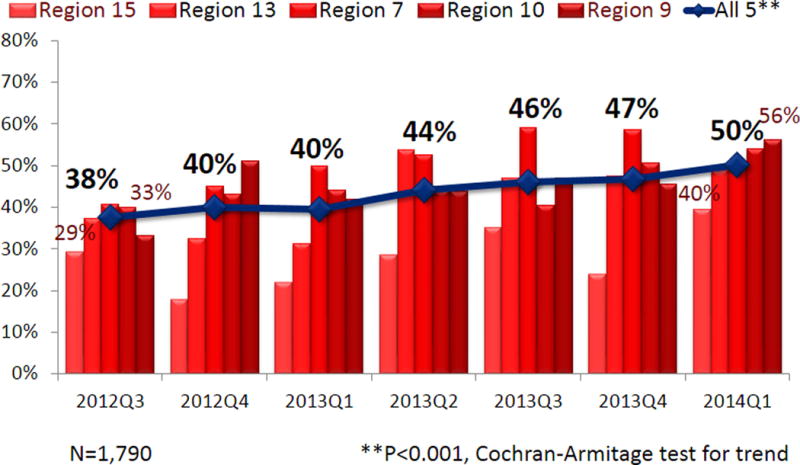
Results: Between July 2012 and December 2013, 23 809 patients presented with acute STEMI (direct to percutaneous coronary intervention hospital: 11 765 EMS transported and 6502 self-transported; 5542 transferred). EMS-transported patients differed from self-transported patients in symptom onset to first medical contact time (median, 47 versus 114 minutes), incidence of cardiac arrest (10% versus 3%), shock on admission (11% versus 3%), and in-hospital mortality (8% versus 3%; P<0.001 for all comparisons). There was a significant increase in the proportion of patients meeting guideline goals of first medical contact-to-device time, including those directly presenting via EMS (50% to 55%; P<0.001) and transferred patients (44%-48%; P=0.002). Despite regional variability, the greatest gains occurred among patients in the 5 most improved regions, increasing from 45% to 57% (direct EMS; P<0.001) and 38% to 50% (transfers; P<0.001).
Conclusions: This Mission: Lifeline STEMI Systems Accelerator demonstration project represents the largest national effort to organize regional STEMI care. By focusing on first medical contact-to-device time, coordinated treatment protocols, and regional data collection and reporting, we were able to increase significantly the proportion of patients treated within guideline goals.
Keywords: catheterization; myocardial infarction; reperfusion; survival.
© 2016 American Heart Association, Inc.
Figures
Comment in
-
The Challenge to Implement Systems of Care for ST-Segment-Elevation Myocardial Infarction.Circulation. 2016 Aug 2;134(5):375-7. doi: 10.1161/CIRCULATIONAHA.116.023834. Circulation. 2016. PMID: 27482001 No abstract available.
-
Letter by Cordero et al Regarding Article, "Regional Systems of Care Demonstration Project: American Heart Association Mission: Lifeline STEMI Systems Accelerator".Circulation. 2016 Dec 13;134(24):e700-e701. doi: 10.1161/CIRCULATIONAHA.116.025304. Circulation. 2016. PMID: 27956406 No abstract available.
References
-
- O’Gara PT, Kushner FG, Ascheim DD, Casey DE, Jr, Chung MK, de Lemos JA, Ettinger SM, Fang JC, Fesmire FM, Franklin BA, Granger CB, Krumholz HM, Linderbaum JA, Morrow DA, Newby LK, Ornato JP, Ou N, Radford MJ, Tamis-Holland JE, Tommaso JE, Tracy CM, Woo YJ, Zhao DX. 2013 ACCF/AHA guideline for the management of ST-elevation myocardial infarction: a report of the American College of Cardiology Foundation/American Heart Association Task Force on Practice Guidelines: developed in collaboration with the American College of Emergency Physicians and Society for Cardiovascular Angiography and Interventions. Circulation. 2013;127:529–555. - PubMed
-
- Antman EM, Hand M, Armstrong PW, Bates ER, Green LA, Halasyamani LK, Hochman JS, Krumholz HM, Lamas GA, Mullany CJ, Pearle DL, Sloan MA, Smith SC, Jr, 2004 Writing Committee Members. Anbe DT, Kushner FG, Ornato JP, Jacobs AK, Adams CD, Anderson JL, Buller CE, Creager MA, Ettinger SM, Halperin JL, Hunt SA, Lytle BW, Nishimura R, Page RL, Riegel B, Tarkington LG, Yancy CW. 2007 Focused Update of the ACC/AHA 2004 Guidelines for the Management of Patients With ST-Elevation Myocardial Infarction: a report of the American College of Cardiology/American Heart Association Task Force on Practice Guidelines: developed in collaboration With the Canadian Cardiovascular Society endorsed by the American Academy of Family Physicians: 2007 Writing Group to Review New Evidence and Update the ACC/AHA 2004 Guidelines for the Management of Patients With ST-Elevation Myocardial Infarction, Writing on Behalf of the 2004 Writing Committee. Circulation. 2008;117:296–329. - PubMed
-
- Dauerman HL, Bates ER, Kontos MC, Li S, Garvey JL, Manoukian SV, Roe MT. Nationwide Analysis of Patients With ST-Segment-Elevation Myocardial Infarction Transferred for Primary Percutaneous Intervention: Findings From the American Heart Association Mission: Lifeline Program. Circ Cardiovasc Interv. 2015;8:pii:e002450. - PubMed
-
- Bagai A, Al-Khalidi HR, Muñoz D, Monk L, Roettig ML, Corbett CC, Garvey JL, Wilson BH, Granger CB, Jollis JG. Bypassing the emergency department and time to reperfusion in patients with prehospital ST-segment-elevation: findings from the reperfusion in acute myocardial infarction in Carolina Emergency Departments project. Circ Cardiovasc Interv. 2013;6:399–406. - PubMed
-
- Bagai A, Jollis JG, Dauerman HL, Peng SA, Rokos IC, Bates ER, French WJ, Granger CB, Roe MT. Emergency department bypass for ST-segment-elevation myocardial infarction patients identified with a prehospital electrocardiogram: a report from the American Heart Association Mission: Lifeline program. Circulation. 2013;128:352–359. - PubMed
Publication types
MeSH terms
Grants and funding
LinkOut - more resources
Full Text Sources
Other Literature Sources
Medical
