. 2016 Aug 16;113(33):E4895-903.
doi: 10.1073/pnas.1605216113. Epub 2016 Aug 1.

Leaky RyR2 channels unleash a brainstem spreading depolarization mechanism of sudden cardiac death

Affiliations

Leaky RyR2 channels unleash a brainstem spreading depolarization mechanism of sudden cardiac death

Isamu Aiba et al. Proc Natl Acad Sci U S A. .

Abstract

Cardiorespiratory failure is the most common cause of sudden unexplained death in epilepsy (SUDEP). Genetic autopsies have detected "leaky" gain-of-function mutations in the ryanodine receptor-2 (RyR2) gene in both SUDEP and sudden cardiac death cases linked to catecholaminergic polymorphic ventricular tachycardia that feature lethal cardiac arrhythmias without structural abnormality. Here we find that a human leaky RyR2 mutation, R176Q (RQ), alters neurotransmitter release probability in mice and significantly lowers the threshold for spreading depolarization (SD) in dorsal medulla, leading to cardiorespiratory collapse. Rare episodes of sinus bradycardia, spontaneous seizure, and sudden death were detected in RQ/+ mutant mice in vivo; however, when provoked, cortical seizures frequently led to apneas, brainstem SD, cardiorespiratory failure, and death. In vitro studies revealed that the RQ mutation selectively strengthened excitatory, but not inhibitory, synapses and facilitated SD in both the neocortex as well as brainstem dorsal medulla autonomic microcircuits. These data link defects in neuronal intracellular calcium homeostasis to the vulnerability of central autonomic brainstem pathways to hypoxic stress and implicate brainstem SD as a previously unrecognized site and mechanism contributing to premature death in individuals with leaky RYR2 mutations.

Keywords: CPVT; SUDEP; catecholaminergic polymorphic ventricular tachycardia; ryanodine receptor; sudden unexpected death in epilepsy.


Conflict of interest statement

The authors declare no conflict of interest.

Figures
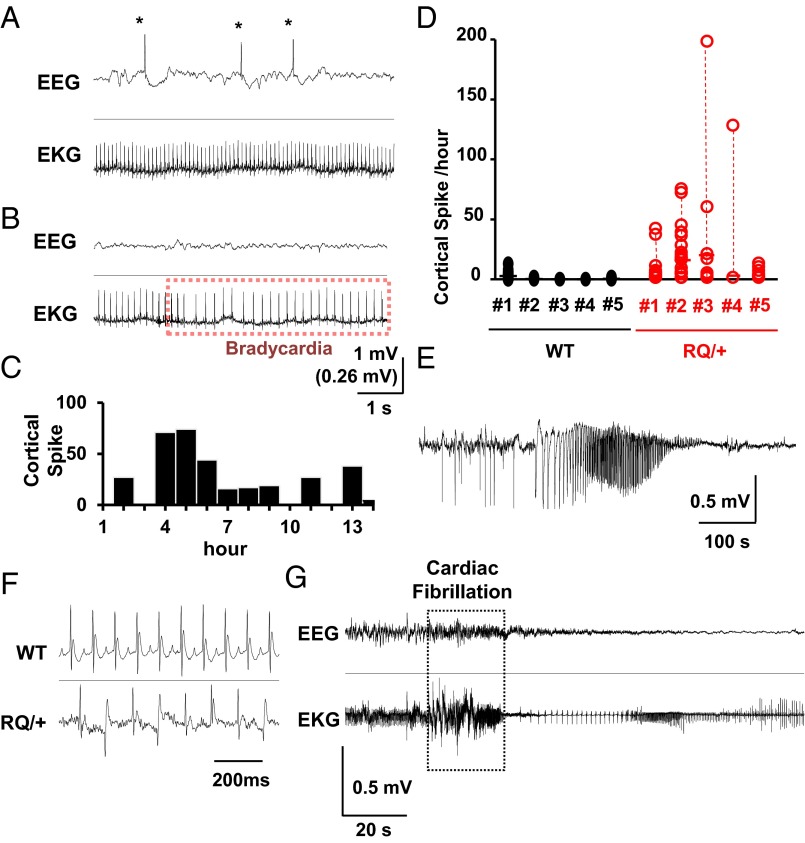
Fig. 1.
Fig. 1.
In vivo simultaneous EEG and EKG monitoring of awake RQ (R176Q/+) mutant and WT male mice (P30–50, n = 5 each) revealed resting abnormalities in brain and cardiac rhythms. (A and B) Representative traces of cortical spikes (*) with normal EKG (A) and a brief episode of bradycardia with normal EEG activity (B). (C) Histogram of spike distribution from a RQ mouse showing the large variability in EEG spike occurrence. (D) Summary of spike frequency from five RQ mutant and WT animals. Each data point shows numbers of spikes in 1-h bins. (E) EEG tracing showing an example of a spontaneous convulsive seizure in a RQ mutant mouse. (F) EKG recordings from WT (Top) and RQ mutant mice (Bottom) 10 min after caffeine injection (100 mg/kg, i.p.). Cardiac arrhythmias were seen in RQ mutant but not WT mice. (G) Caffeine injection led to cardiac fibrillation and arrest in RQ mutant mice. No abnormal EEG discharges were seen during caffeine-induced lethal cardiac arrhythmias.
Fig. 2.
Fig. 2.
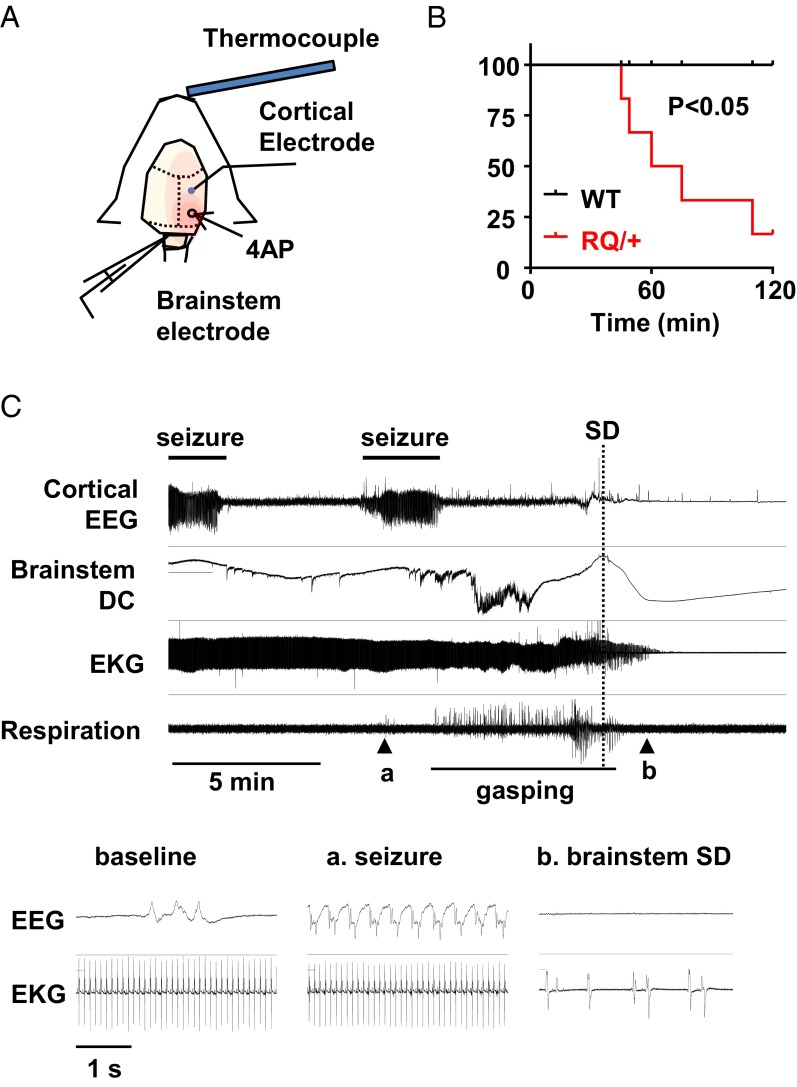
Seizure monitoring in vivo. (A) Experimental procedure. Juvenile mice (P18–25) were lightly anesthetized with urethane, and body temperature was maintained at 37 °C. Cortical EEG was recorded from an Ag/AgCl electrode implanted on the skull over the somatosensory cortex. Seizures were evoked by topical application of 4AP (100 mM). Heart rate was monitored with s.c. electrodes implanted on the thoracic wall. (B) Plot of survival rate following 4AP application. Seventy-one percent of RQ mutant mice (5 of 7) died shortly after 4AP-induced seizure, whereas none (0 of 7) of the WT mice died. (C) Representative recording showing terminal brainstem SD and cardiac arrhythmias following recurrent cortical seizures. Insets show EEG/EKG activity during baseline, during seizure (a), and after brainstem SD (b).
Fig. 3.
Fig. 3.
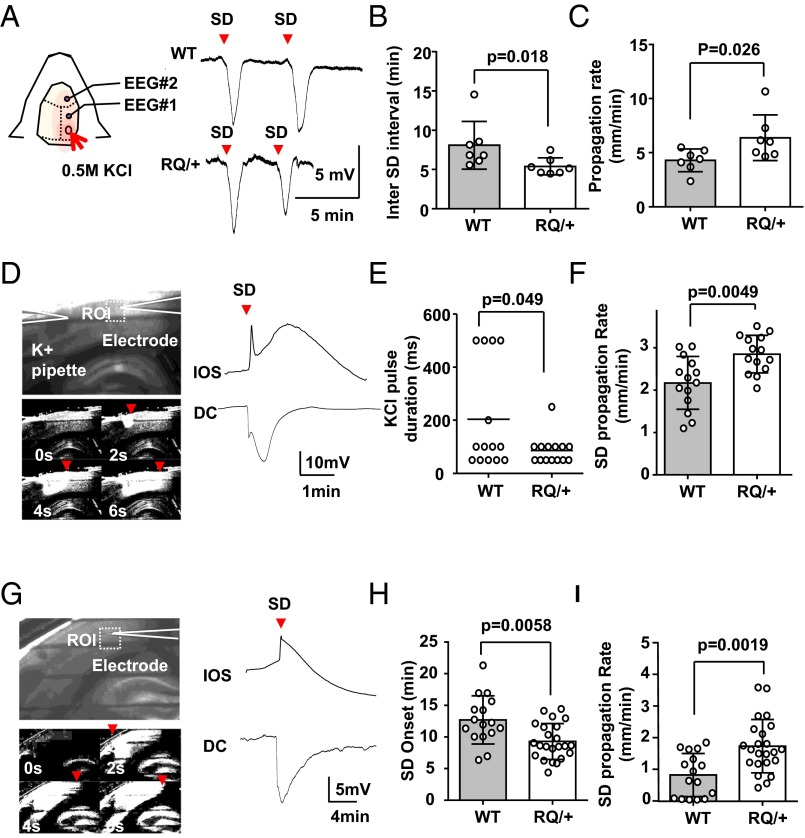
In vivo and in vitro characterization of SD thresholds. (A–C) Characterization of cortical SD frequency in vivo. SD was evoked by topical application of KCl-soaked gelfoam in the cranial window and was detected with a pair of Ag/AgCl electrodes. (A) Traces show representative DC recordings from WT (Top) and RQ mutant (Bottom). The inter-SD interval was significantly shorter (B) and the propagation rate was faster (C) in the RQ mutant cortex. (D–F) Characterization of KCl-evoked cortical SD in vitro. SD was evoked by local microinjection of 1 M KCl and detected by DC recording and IOS change (D). Raw image (Top) and a sequence of ratio images showing bright region of IOS change of SD (Bottom). The effective KCl pulse duration needed to trigger SD was shorter (E) and the SD propagation rate was faster (F) in cortical slices obtained from the RQ mouse. For each genotype, 14 slices from four adult mice were used. (G–I) Characterization of cortical SD evoked by OGD. SD was evoked by continuous exposure to OGD solution (0% O2 and 2 mM glucose). The latency to SD onset was shorter (H) and the propagation rate was faster (I) in slices from RQ mutant mice. WT, 16 slices from 4 mice; RQ, 23 slices from 5 mice. Bar graph, mean ± standard deviation.
Fig. 4.
Fig. 4.
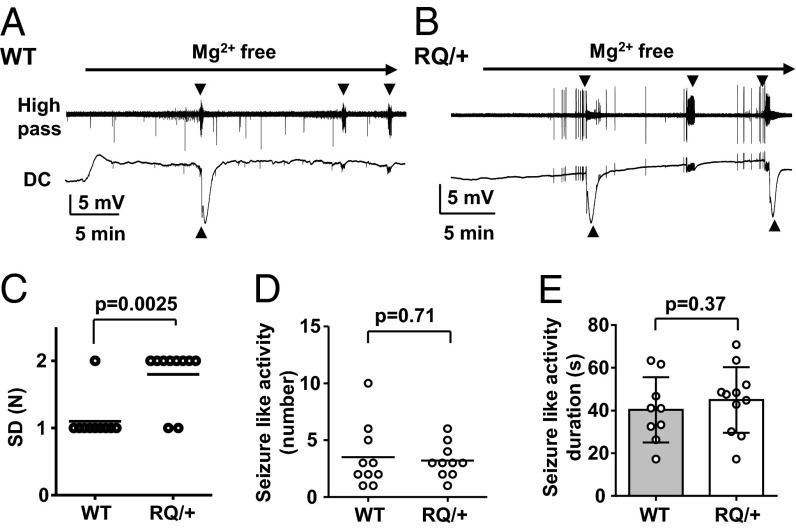
Characterization of seizure-like activities and SD in vitro. Representative traces from WT (A) and RQ mutant cortical slices (B) exposed to Mg2+-free ACSF solution. High pass-filtered recording (Top) and DC components (Bottom) from the same recordings are presented. Arrowheads indicate spontaneous seizure-like activity (Top) and SD (Bottom). The number of SD events was greater in RQ mutant than +/+ slices (C), whereas the numbers (D) and durations (E) of seizure events were not different. For each genotype, 10 slices from 3 mice were used. Bar graph, mean ± standard deviation.
Fig. 5.
Fig. 5.
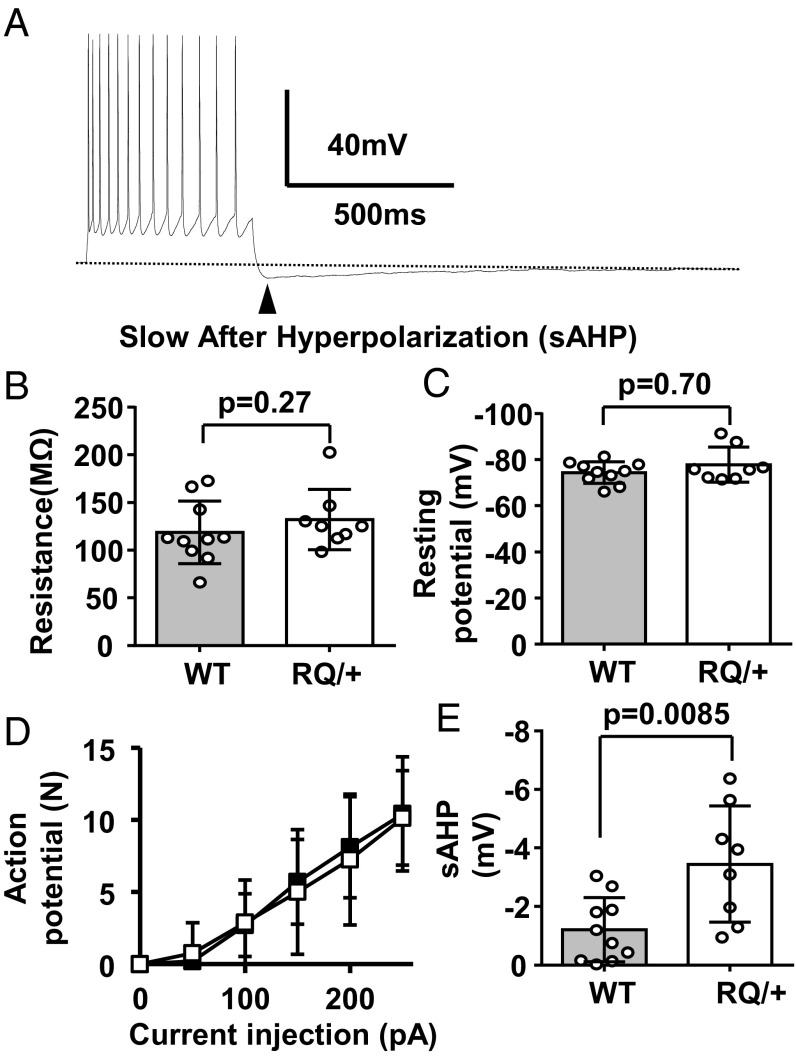
Intrinsic excitability of layer II/III pyramidal neurons from the somatosensory cortex was unchanged. (A) Representative trace showing action potentials evoked by a rectangular pulse (+200 pA, 500 ms) and consequently slow AHP. There were no differences in input resistance (B), resting potential (C), or the number of evoked action potentials by a series of current injections (50 pA increment) (D). The maximal amplitude of the slow phase of AHP (sAHP) was significantly larger in RQ mutant than +/+ neurons (E). Ten and eight slices from three WT and RQ mice were used. All graphs, mean ± standard deviation.
Fig. 6.
Fig. 6.
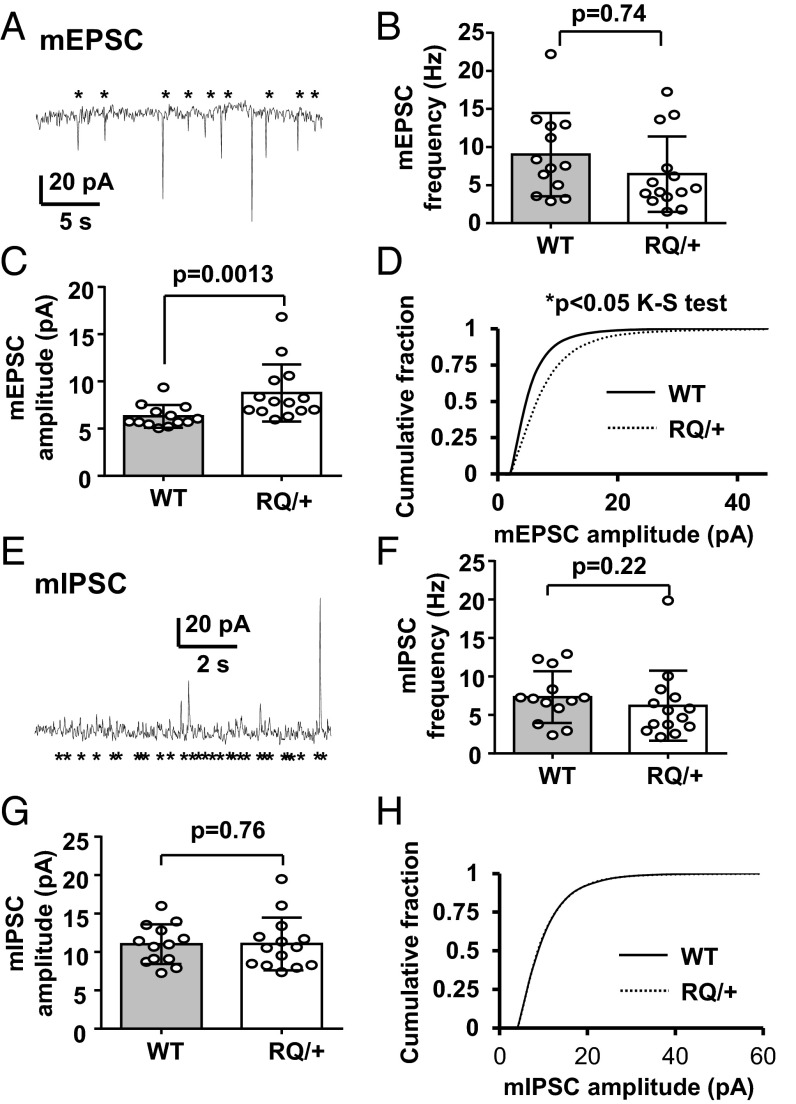
Characterization of mEPSCs and miniature IPSCs (mIPSCs) recorded in vitro from layer II/III pyramidal neurons in slices from the somatosensory cortex. (A) Representative trace of mEPSCs. An asterisk indicates a detected event. (B) There was no genotypic difference in mEPSC frequency, however in C the mean mEPSC amplitude was significantly larger in the RQ mutant. (D) Mean cumulative histogram of mEPSC amplitude distribution from WT and RQ mutant mice (P < 0.05, Kolmogorov–Smirnov test). (E) Representative trace of mIPSC recording. There were no differences in mean IPSC frequency (F) or amplitude (G). (H) Mean cumulative histogram of mIPSC amplitudes shows no difference in the distribution between genotypes. WT, 13 neurons from three mice; RQ, 14 neurons from three mice. Bar graph, mean ± standard deviation.
Fig. 7.
Fig. 7.
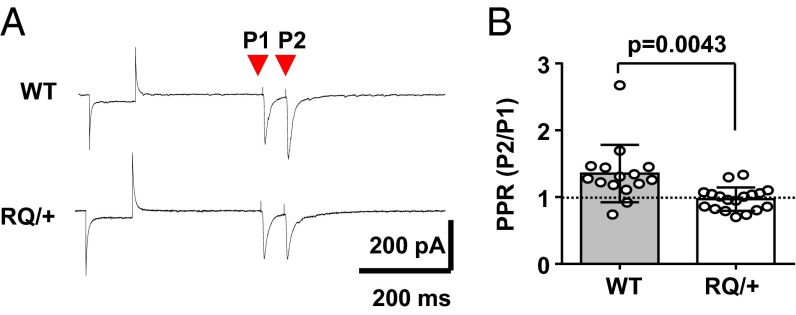
Enhanced evoked presynaptic release properties at RQ cortical synapses. Shown is the PPR of evoked EPSCs in layer II/III pyramidal neurons from the somatosensory cortex. Pairs of evoked EPSCs (100 ms interpulse interval) were triggered following a membrane seal test. Representative traces (A) and bar graphs are shown (B). PPR was significantly smaller in the RQ mutant than in WT control neurons, suggesting that presynaptic glutamate initial release probability is increased at RQ mutant synapses. WT, 14 neurons from 4 mice; RQ, 18 neurons from 5 mice. Bar graph, mean ± standard deviation.
Fig. 8.
Fig. 8.
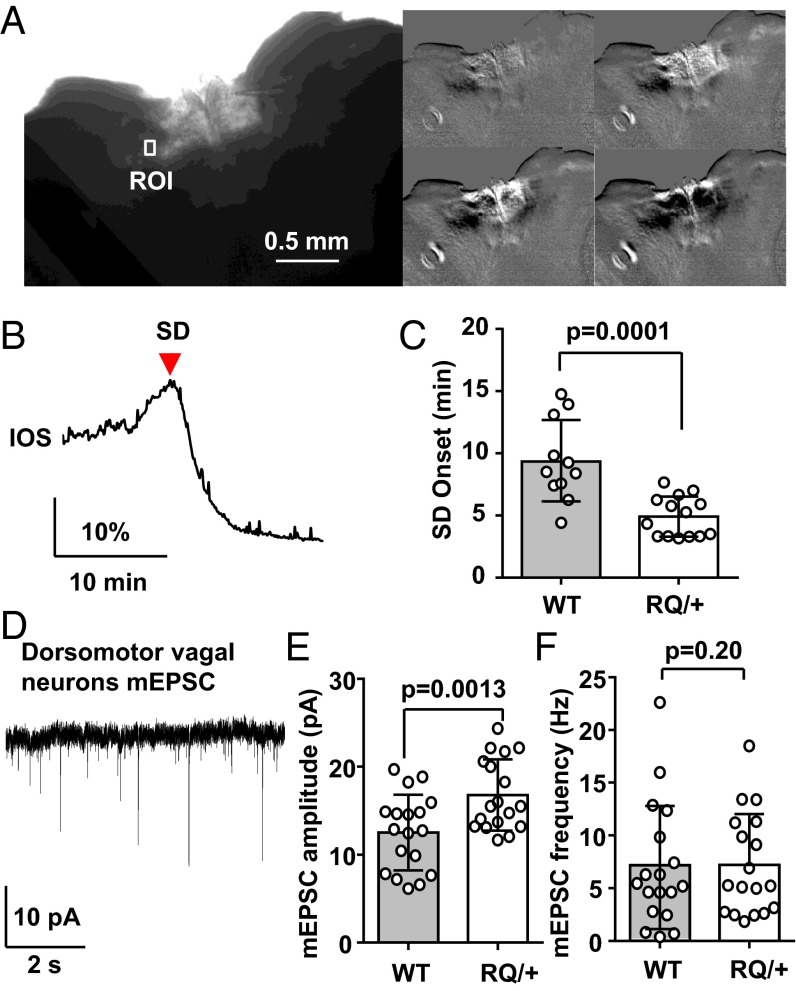
Lowered SD threshold in dorsal vagal complex of the RQ mutant brainstem. (A–C) Characterization of SD generated in dorsal medulla in vitro. Brainstem slices containing the dorsal vagal complex were exposed to OGD solution (0% O2, 5 mM glucose), and SD was detected by monitoring intrinsic light transmission signals in the region of interest (ROI) positioned in the lateral NTS (A and B). A raw image of an acute brainstem slice (Left large) and a sequence of ratio images showing spreading light transmission changes following OGD exposure (Right). The latency to SD onset was significantly shorter in the RQ mutant (C). WT, 11 slices from 4 mice; RQ, 15 slices from 5 mice. (D–F) Characterization of mEPSC in dorsomotor vagal (DMV) neurons. (D) Representative trace of mEPSCs recorded from a DMV neuron. The mean amplitude was significantly larger in RQ mutant neurons (E), whereas the mean frequency did not differ (F). WT, 18 neurons from 4 mice; RQ, 18 neurons from 4 mice. Bar graph, mean ± standard deviation.

Comment in

  • Leaks That Could Kill.
    Murphy GG. Murphy GG. Epilepsy Curr. 2017 Sep-Oct;17(5):301-302. doi: 10.5698/1535-7597.17.5.301. Epilepsy Curr. 2017. PMID: 29225546 Free PMC article. No abstract available.

References

    1. Thurman DJ, Hesdorffer DC, French JA. Sudden unexpected death in epilepsy: Assessing the public health burden. Epilepsia. 2014;55(10):1479–1485. - PubMed
    1. Ryvlin P, et al. Incidence and mechanisms of cardiorespiratory arrests in epilepsy monitoring units (MORTEMUS): A retrospective study. Lancet Neurol. 2013;12(10):966–977. - PubMed
    1. Cole AJ, et al. Case records of the Massachusetts General Hospital. Case 18-2013: A 32-year-old woman with recurrent episodes of altered consciousness. N Engl J Med. 2013;368(24):2304–2312. - PubMed
    1. Glasscock E, Yoo JW, Chen TT, Klassen TL, Noebels JL. Kv1.1 potassium channel deficiency reveals brain-driven cardiac dysfunction as a candidate mechanism for sudden unexplained death in epilepsy. J Neurosci. 2010;30(15):5167–5175. - PMC - PubMed
    1. Kalume F, et al. Sudden unexpected death in a mouse model of Dravet syndrome. J Clin Invest. 2013;123(4):1798–1808. - PMC - PubMed

Publication types

Substances

LinkOut - more resources