. 2016 Oct 1;9(10):1203-1210.
doi: 10.1242/dmm.024406. Epub 2016 Jul 13.

A rat model for hepatitis E virus

Affiliations

A rat model for hepatitis E virus

Yannick Debing et al. Dis Model Mech. .

Abstract

Hepatitis E virus (HEV) is one of the prime causes of acute viral hepatitis, and chronic hepatitis E is increasingly recognized as an important problem in the transplant setting. Nevertheless, the fundamental understanding of the biology of HEV replication is limited and there are few therapeutic options. The development of such therapies is partially hindered by the lack of a robust and convenient animal model. We propose the infection of athymic nude rats with the rat HEV strain LA-B350 as such a model. A cDNA clone, pLA-B350, was constructed and the infectivity of its capped RNA transcripts was confirmed in vitro and in vivo Furthermore, a subgenomic replicon, pLA-B350/luc, was constructed and validated for in vitro antiviral studies. Interestingly, rat HEV proved to be less sensitive to the antiviral activity of α-interferon, ribavirin and mycophenolic acid than genotype 3 HEV (a strain that infects humans). As a proof-of-concept, part of the C-terminal polymerase sequence of pLA-B350/luc was swapped with its genotype 3 HEV counterpart: the resulting chimeric replicon replicated with comparable efficiency as the wild-type construct, confirming that LA-B350 strain is amenable to humanization (replacement of certain sequences or motifs by their counterparts from human HEV strains). Finally, ribavirin effectively inhibited LA-B350 replication in athymic nude rats, confirming the suitability of the rat model for antiviral studies.

Keywords: Animal model; Antiviral; Hepatitis E virus; LA-B350; Rat; Ribavirin.


Conflict of interest statement

The authors declare no competing or financial interests.

Figures
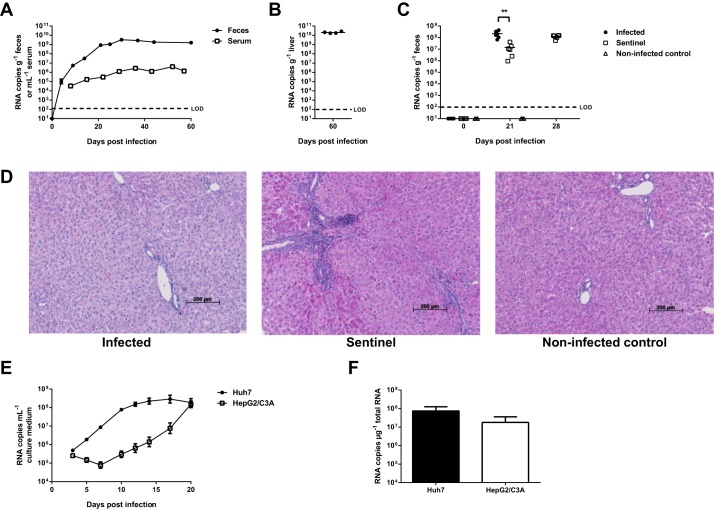
Fig. 1.
Fig. 1.
Rat HEV strain LA-B350 is infectious in vivo and in vitro. Four athymic nude rats were inoculated intravenously with LA-B350 and virus quantities in feces and serum (A) and liver (B) were determined by RT-qPCR, documenting robust infection. In a subsequent transmission experiment, LA-B350-infected rats were co-housed with non-infected sentinels. Sentinels displayed robust shedding of virus in stool after 21 and 28 days, indicating efficient transmission of rat HEV (C). Hematoxylin-eosin staining of liver sections showed only very limited infiltration of portal tracks with lymphocytes and polymorphonuclear leucocytes in infected animals (D). LA-B350 also proved infectious in vitro in Huh7 and HepG2/C3A cells: viral RNA released in the culture medium increased over time (E) and high amounts of RNA were detected intracellularly after 20 days (F). Values represent mean±s.e.m. for four animals (A) or from three independent experiments (E,F). The limit of detection for panels E and F is approximately 103 RNA copies ml−1 culture medium or µg−1 total RNA, respectively. LOD, limit of detection. **P<0.01 (two-tailed t-test).
Fig. 2.
Fig. 2.
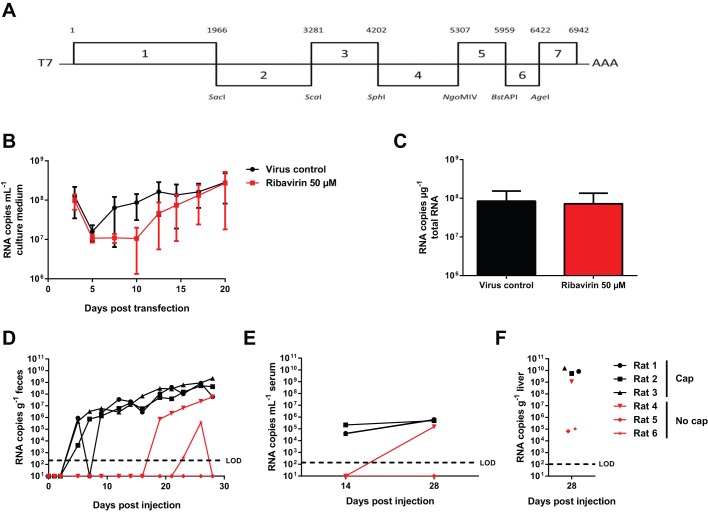
RNA transcripts from cDNA clone pLA-B350 induce robust infection in vitro and in vivo. A cDNA clone for LA-B350 was constructed based on the consensus sequence from seven overlapping fragments (A). Capped pLA-B350 transcripts were transfected into Huh7 cells and induced robust infection (B,C). Intrahepatic injection of capped pLA-B350 RNA in athymic nude rats resulted in robust shedding of rat HEV RNA in the feces (D) and serum (E), whereas high amounts of virus were detected in the liver after 28 days (F). Injection of non-capped RNA only induced successful infection in 1/3 rats. Values represent mean±s.e.m. from three independent experiments (B,C) or individual values for each rat (D-F). LOD, limit of detection.
Fig. 3.
Fig. 3.
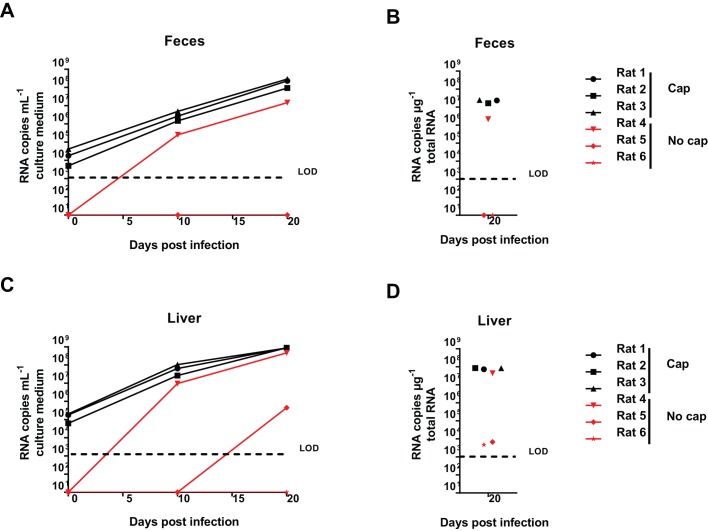
Virus progeny from pLA-B350 RNA-injected rats is infectious in cell culture. Huh7 cell cultures were inoculated with feces (A,B) or liver (C,D) suspensions from pLA-B350 RNA-injected rats (28 days post-infection). Robust viral replication was observed for cultures corresponding to rats 1-3 (capped) and rat 4 (non-capped). Values represent individual values for each culture/rat. LOD, limit of detection.
Fig. 4.
Fig. 4.
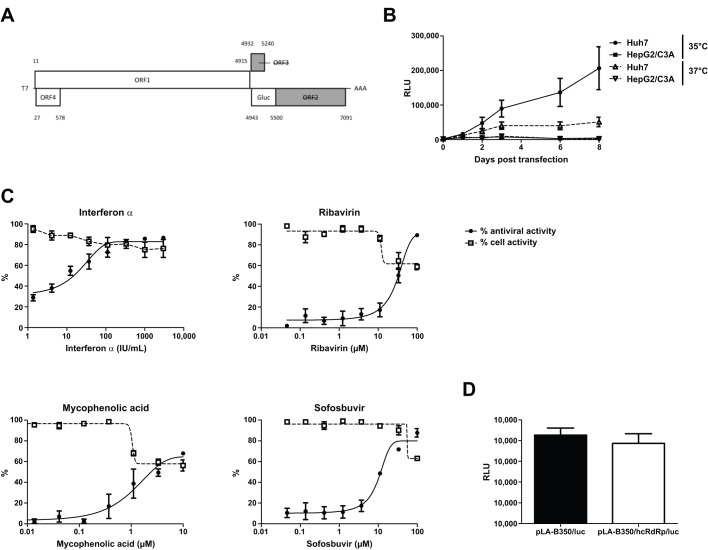
Subgenomic replicon pLA-B350/luc is suitable for antiviral testing and is amenable to humanization. The pLA-B350/luc subgenomic replicon was constructed by inserting a Gaussia luciferase reporter gene downstream of the ORF2 start codon (A). pLA-B350/luc displayed strong viral replication in Huh7 cells at 35°C, but less at 37°C, whereas HepG2/C3A yielded very low luminescence signals, probably due to transfection toxicity (B). Dose–response curves represent antiviral effects and cell viability for α-interferon, ribavirin, mycophenolic acid and sofosbuvir (C). Part of the C-terminal RdRp sequence of pLA-B350/luc was replaced with its genotype 3 HEV counterpart, without affecting viral replication (D). Values represent mean±s.e.m. from three independent experiments. RLU, relative light units.
Fig. 5.
Fig. 5.
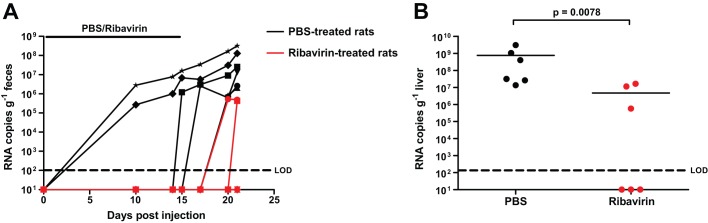
Ribavirin treatment of LA-B350-infected rats delays virus shedding and significantly reduces viral loads in the liver. Twelve rats were infected intravenously with rat HEV LA-B350. Afterwards, six of these rats were injected daily with ribavirin at 30 mg/kg body weight (red), whereas the other six were injected with PBS (black), for 14 days. Rat HEV was quantified in feces (A) and in liver 21 days after infection (B). Values represent individual values for each rat; significance was calculated through the Mann–Whitney U-test (B). LOD, limit of detection.

References

    1. Dalton H. R., Kamar N. and Izopet J. (2014). Hepatitis E in developed countries: current status and future perspectives. Future Microbiol. 9, 1361-1372. 10.2217/fmb.14.89 - DOI - PubMed
    1. Dao Thi V. L., Debing Y., Wu X., Rice C. M., Neyts J., Moradpour D. and Gouttenoire J. (2016). Sofosbuvir inhibits hepatitis E virus replication in vitro and results in an additive effect when combined with ribavirin. Gastroenterology 150, 82-85.e4. 10.1053/j.gastro.2015.09.011 - DOI - PubMed
    1. Debing Y. and Neyts J. (2014). Antiviral strategies for hepatitis E virus. Antivir. Res. 102, 106-118. 10.1016/j.antiviral.2013.12.005 - DOI - PMC - PubMed
    1. Debing Y., Emerson S. U., Purcell R. H., Neyts J. and Dallmeier K. (2014a). Complete genome sequence of a rat hepatitis e virus strain isolated in the United States. Genome Announc. 2, e01096-14 10.1128/genomeA.01096-14 - DOI - PMC - PubMed
    1. Debing Y., Emerson S. U., Wang Y., Pan Q., Balzarini J., Dallmeier K. and Neyts J. (2014b). Ribavirin inhibits in vitro hepatitis E virus replication through depletion of cellular GTP pools and is moderately synergistic with alpha interferon. Antimicrob. Agents Chemother. 58, 267-273. 10.1128/AAC.01795-13 - DOI - PMC - PubMed

MeSH terms