


Genetic and Environmental Determinants of Otitis Media in an Indigenous Filipino Population
- PMID: 27484237
- PMCID: PMC5093071
- DOI: 10.1177/0194599816661703
Genetic and Environmental Determinants of Otitis Media in an Indigenous Filipino Population
Abstract
Objective: To identify genetic and environmental risk factors for otitis media in an indigenous Filipino population.
Study design: Cross-sectional study.
Setting: Indigenous Filipino community.
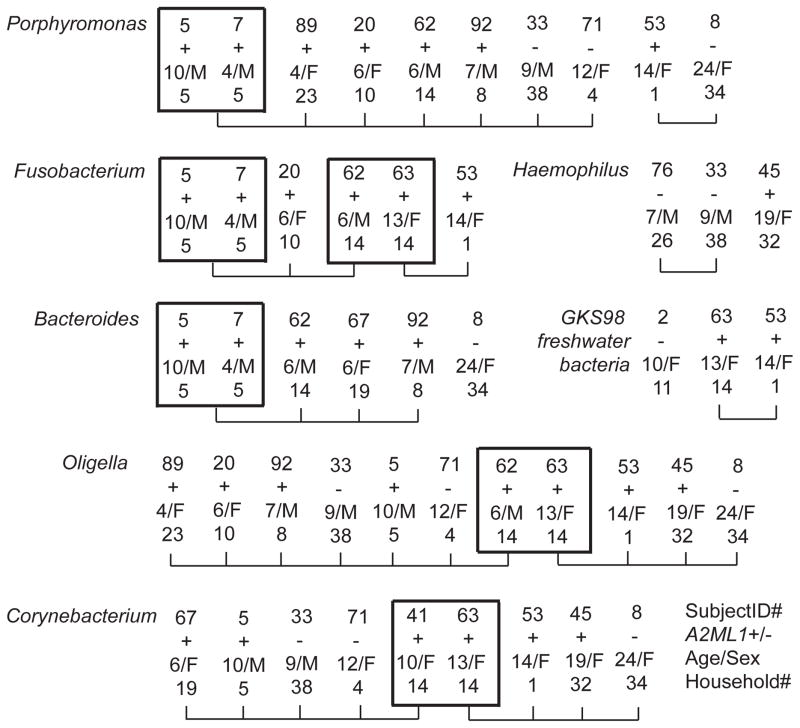
Subjects and methods: Clinical history and information on breastfeeding, tobacco smoke exposure, and swimming were obtained from community members. Heads of households were interviewed for family history and personal beliefs on ear health. Height and weight were measured. Otoscopic findings were described for the presence and character of perforation or discharge. An A2ML1 duplication variant that confers otitis media susceptibility was Sanger sequenced in all DNA samples. Co-occurrence of middle ear bacteria detected by 16S rRNA gene sequencing was determined according to A2ML1 genotype and social cluster.
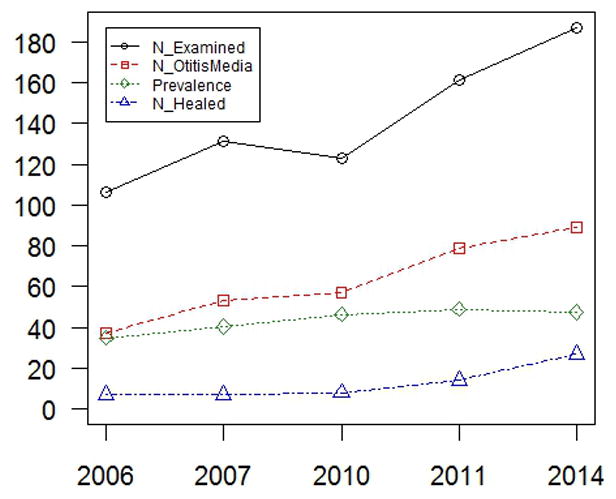
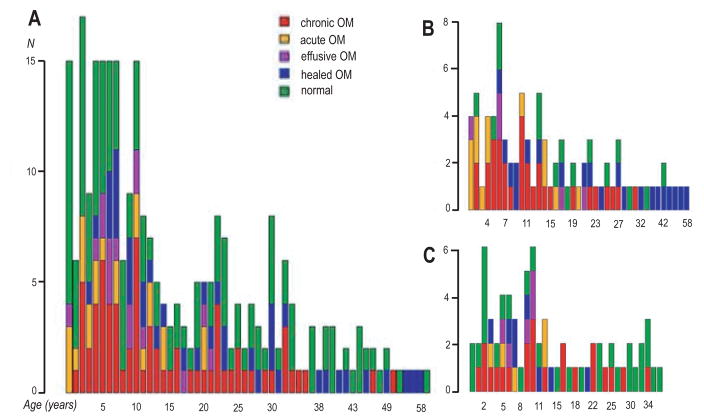
Results: The indigenous Filipino population has a ~50% prevalence of otitis media. Young age was associated with otitis media (4 age strata; P = .004); however, age was nonsignificant as a bistratal or continuous variable. There was no association between otitis media and sex, body mass index, breastfeeding, tobacco exposure, or deep swimming. In multivariate analyses, A2ML1 genotype is the strongest predictor of otitis media, with an odds ratio of 3.7 (95% confidence interval: 1.3-10.8; P = .005). When otitis media diagnoses were plotted across ages, otitis media was observed within the first year of life, and chronic otitis media persisted up to adulthood, particularly in A2ML1-variant carriers.
Conclusion: Among indigenous Filipinos, A2ML1 genotype is the primary risk factor for otitis media and main determinant of disease progression, although age, the middle ear microbiome, and social clusters might modulate the effect of the A2ML1 genotype.
Keywords: A2ML1; Philippines; indigenous population; microbiome; middle ear; otitis media.
© American Academy of Otolaryngology—Head and Neck Surgery Foundation 2016.
Conflict of interest statement
Competing interests: None. Sponsorships: None. Funding source: This study was funded by grants from the University of the Philippines Manila – National Institutes of Health (to G.T.A.); the Albert and Margaret Alkek Foundation (to J.F.P.); the National Institute on Deafness and Other Communication Disorders at the United States National Institutes of Health (grants R01 DC011651 and R01 DC003594 to S.M.L. and R01 DC015004 to R.L.P.S.C.); and the National Organization for Hearing Research, Action for Hearing Loss and the Hearing Health Foundation (to R.L.P.S.C.).
Figures
References
-
- Gidengil C, Mangione-Smith R, Bailey LC, et al. Using Medicaid and CHIP claims data to support pediatric quality measurement: lessons from 3 centers of excellence in measure development. Acad Pediatr. 2014;14:S76–81. - PubMed
-
- Jensen RG, Koch A, Homøe P. The risk of hearing loss in a population with a high prevalence of chronic suppurative otitis media. Int J Pediatr Otorhinolaryngol. 2013;77:1530–1535. - PubMed
Publication types
MeSH terms
Substances
Grants and funding
LinkOut - more resources
Full Text Sources
Other Literature Sources
Medical
Molecular Biology Databases
