


Strengthening health disaster risk management in Africa: multi-sectoral and people-centred approaches are required in the post-Hyogo Framework of Action era
- PMID: 27484354
- PMCID: PMC4970204
- DOI: 10.1186/s12889-016-3390-5
Strengthening health disaster risk management in Africa: multi-sectoral and people-centred approaches are required in the post-Hyogo Framework of Action era
Abstract
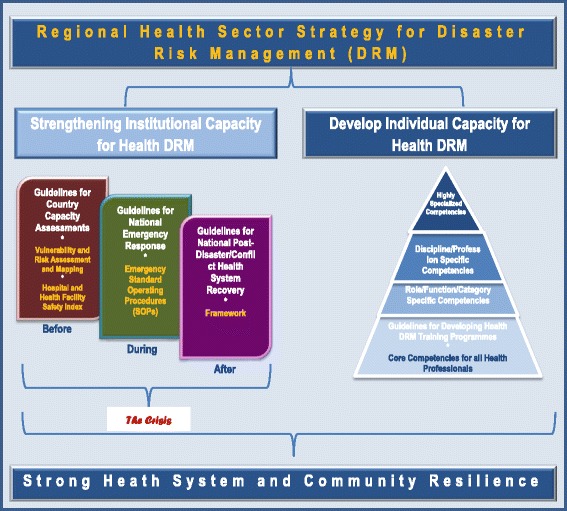
Background: In November 2012, the 62nd session of the Regional Committee for Africa adopted a comprehensive 10-year regional strategy for health disaster risk management (DRM). This was intended to operationalize the World Health Organization's core commitments to health DRM and the Hyogo Framework for Action 2005-2015 in the health sectors of the 47 African member states. This study reported the formative evaluation of the strategy, including evaluation of the progress in achieving nine targets (expected to be achieved incrementally by 2014, 2017, and 2022). We proposed recommendations for accelerating the strategy's implementation within the Sendai Framework for Disaster Risk Reduction.
Methods: This study used a mixed methods design. A cross-sectional quantitative survey was conducted along with a review of available reports and information on the implementation of the strategy. A review meeting to discuss and finalize the study findings was also conducted.
Results: In total, 58 % of the countries assessed had established DRM coordination units within their Ministry of Health (MOH). Most had dedicated MOH DRM staff (88 %) and national-level DRM committees (71 %). Only 14 (58 %) of the countries had health DRM subcommittees using a multi-sectoral disaster risk reduction platform. Less than 40 % had conducted surveys such as disaster risk analysis, hospital safety index, and mapping of health resources availability. Key challenges in implementing the strategy were inadequate political will and commitment resulting in poor funding for health DRM, weak health systems, and a dearth of scientific evidence on mainstreaming DRM and disaster risk reduction in longer-term health system development programs.
Conclusions: Implementation of the strategy was behind anticipated targets despite some positive outcomes, such as an increase in the number of countries with health DRM incorporated in their national health legislation, MOH DRM units, and functional health sub-committees within national DRM committees. Health system-based, multi-sectoral, and people-centred approaches are proposed to accelerate implementation of the strategy in the post-Hyogo Framework of Action era.
Keywords: Africa; Disaster risk management; Disaster risk reduction; Health; Health system; Hyogo Framework for Action; Sendai.
Figures
References
-
- UNISDR terminology on disaster reduction. 2009. http://www.unisdr.org/files/7817_UNISDRTerminologyEnglish.pdf. Accessed 13 Apr 2016.
-
- Global overview 2015. People internally displaced by conflict and violence. http://www.internal-displacement.org/assets/library/Media/201505-Global-.... Accessed 13 May 2015.
-
- Ebola situation report. 25 November 2015. http://apps.who.int/ebola/current-situation/ebola-situation-report-25-no.... Accessed 13 Apr 2016.
MeSH terms
Grants and funding
LinkOut - more resources
Full Text Sources
Other Literature Sources
Medical
