


Endocannabinoid system as a regulator of tumor cell malignancy - biological pathways and clinical significance
- PMID: 27486335
- PMCID: PMC4958360
- DOI: 10.2147/OTT.S106944
Endocannabinoid system as a regulator of tumor cell malignancy - biological pathways and clinical significance
Abstract
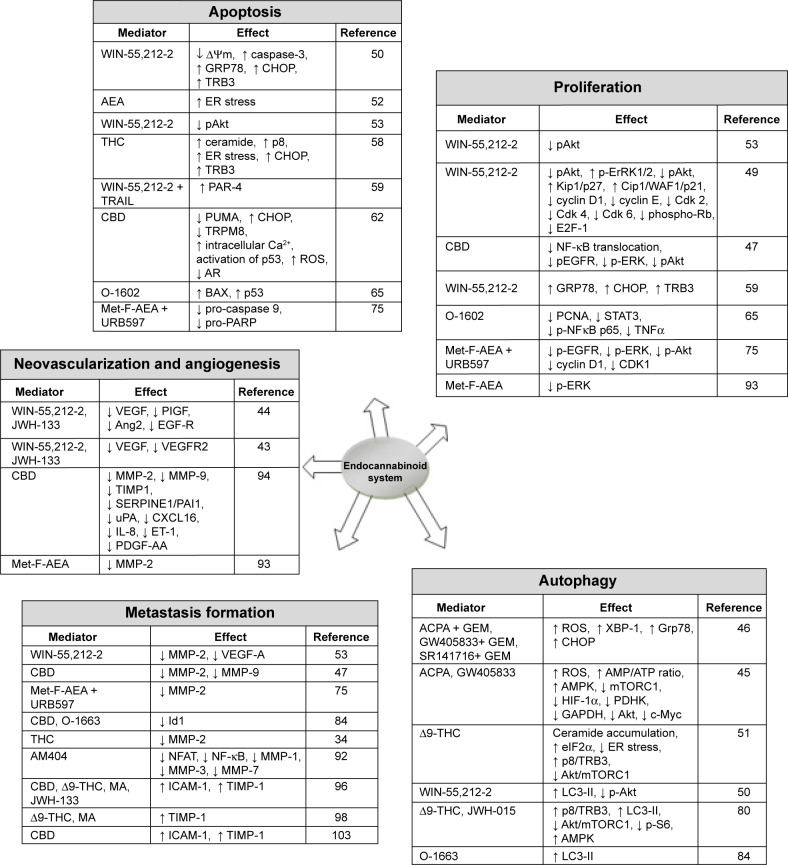
The endocannabinoid system (ECS) comprises cannabinoid receptors (CBs), endogenous cannabinoids, and enzymes responsible for their synthesis, transport, and degradation of (endo)cannabinoids. To date, two CBs, CB1 and CB2, have been characterized; however, orphan G-protein-coupled receptor GPR55 has been suggested to be the third putative CB. Several different types of cancer present abnormal expression of CBs, as well as other components of ECS, and this has been shown to correlate with the clinical outcome. Although most effects of (endo)cannabinoids are mediated through stimulation of classical CBs, they also interact with several molecules, either prosurvival or proapoptotic molecules. It should be noted that the mode of action of exogenous cannabinoids differs significantly from that of endocannabinoid and results from the studies on their activity both in vivo and in vitro could not be easily compared. This review highlights the main signaling pathways involved in the antitumor activity of cannabinoids and the influence of their activation on cancer cell biology. We also discuss changes in the expression pattern of the ECS in various cancer types that have an impact on disease progression and patient survival. A growing amount of experimental data imply possible exploitation of cannabinoids in cancer therapy.
Keywords: cancer; cannabinoid receptor; cannabinoids; cell signaling; delta-9-tetrahy-drocannabinol.
Figures
References
-
- Pisanti S, Picardi P, D’Alessandro A, Laezza C, Bifulco M. The endocannabinoid signaling system in cancer. Trends Pharmacol Sci. 2013;34:273–282. - PubMed
-
- Devane WA, Dysarz FA, Johnson MR, Melvin LS, Howlett AC. Determination and characterization of a cannabinoid receptor in rat brain. Mol Pharmacol. 1988;34(5):605–613. - PubMed
-
- Munro S, Thomas KL, Abu-Shaar M. Molecular characterization of a peripheral receptor for cannabinoids. Nature. 1993;365(6441):61–65. - PubMed
-
- Guzmán M. Cannabinoids: potential anticancer agents. Nat Rev Cancer. 2003;3(10):745–755. - PubMed
Publication types
LinkOut - more resources
Full Text Sources
Other Literature Sources
