


Comparative approaches for assessing access to alcohol outlets: exploring the utility of a gravity potential approach
- PMID: 27486385
- PMCID: PMC4969650
- DOI: 10.1186/s12963-016-0097-x
Comparative approaches for assessing access to alcohol outlets: exploring the utility of a gravity potential approach
Abstract
Background: A growing body of research recommends controlling alcohol availability to reduce harm. Various common approaches, however, provide dramatically different pictures of the physical availability of alcohol. This limits our understanding of the distribution of alcohol access, the causes and consequences of this distribution, and how best to reduce harm. The aim of this study is to introduce both a gravity potential measure of access to alcohol outlets, comparing its strengths and weaknesses to other popular approaches, and an empirically-derived taxonomy of neighborhoods based on the type of alcohol access they exhibit.
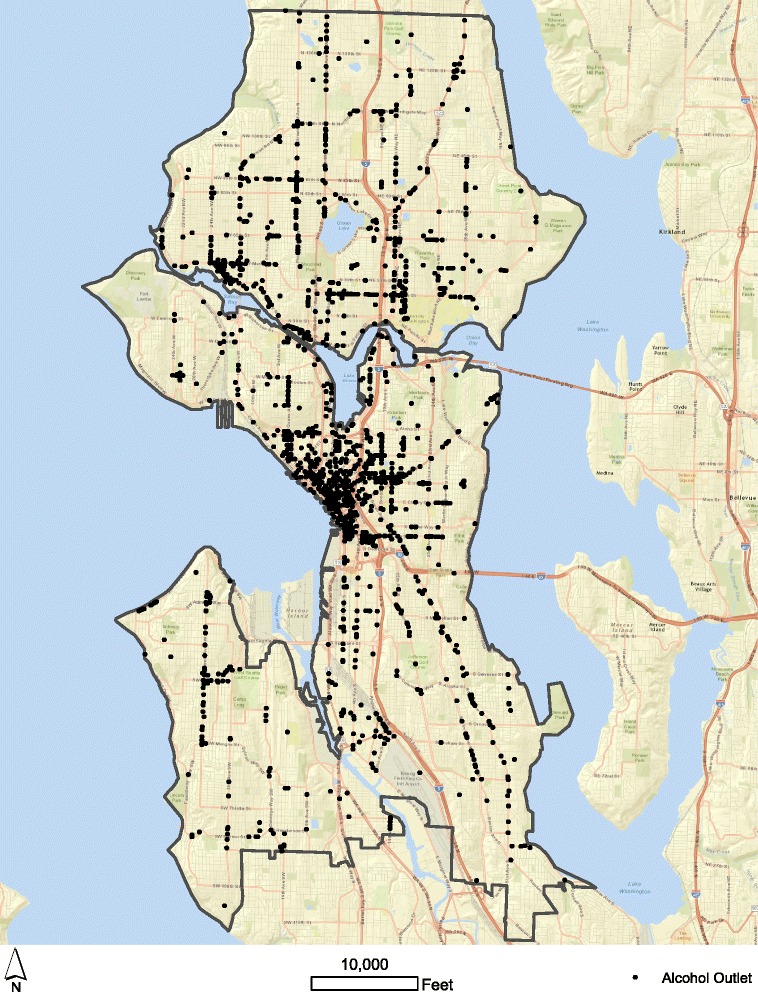
Methods: We obtained geospatial data on Seattle, including the location of 2402 alcohol outlets, United States Census Bureau estimates on 567 block groups, and a comprehensive street network. We used exploratory spatial data analysis and employed a measure of inter-rater agreement to capture differences in our taxonomy of alcohol availability measures.
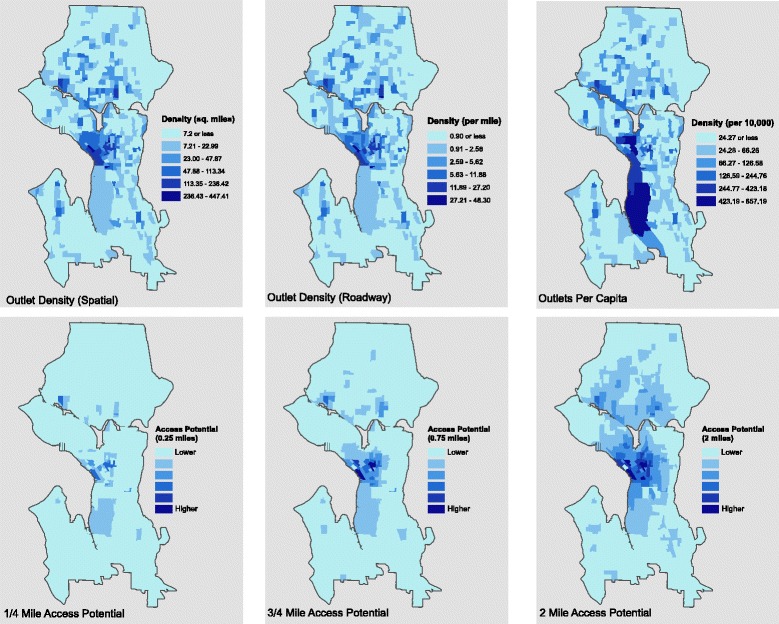
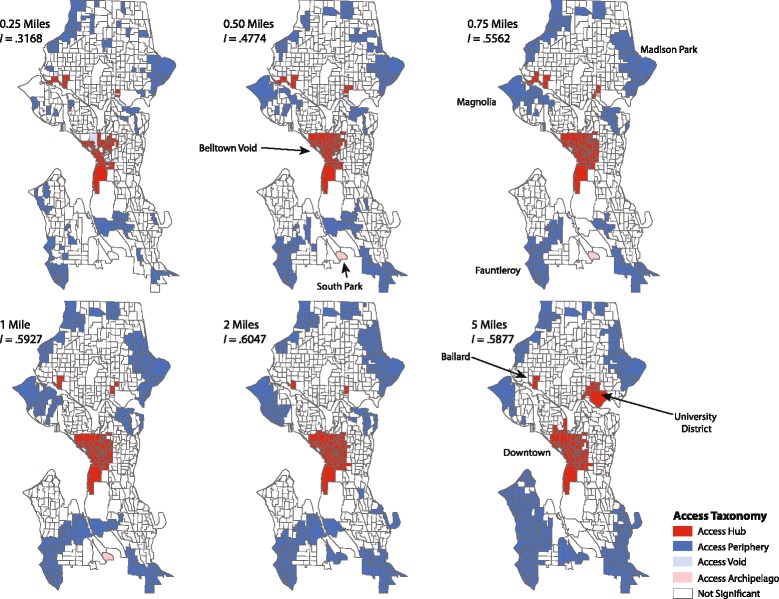
Results: Significant statistical and spatial variability exists between measures of alcohol access, and these differences have meaningful practical implications. In particular, standard measures of outlet density (e.g., spatial, per capita, roadway miles) can lead to biased estimates of physical availability that over-emphasize the influence of the control variables. Employing a gravity potential approach provides a more balanced, geographically-sensitive measure of access to alcohol outlets.
Conclusions: Accurately measuring the physical availability of alcohol is critical for understanding the causes and consequences of its distribution and for developing effective evidence-based policy to manage the alcohol outlet licensing process. A gravity potential model provides a superior measure of alcohol access, and the alcohol access-based taxonomy a helpful evidence-based heuristic for scholars and local policymakers.
Figures

References
-
- Block RL, Block CR. Space, place and crime: hot spot areas and hot places of liquor related crime. Crime Prevention Studies. 1995;4:145–83.
-
- Roman CG, Reid SE, Bhati AS, Tereschenko B. Alcohol outlets as attractors of violence and disorder. The Urban Institute. 2008. http://www.urban.org/publications/411663.html. Accessed 27 Apr 2015.
-
- Britt HR, Carlin BP, Toomey TL, Wagenaar AC. Neighborhood level spatial analysis of the relationship between alcohol outlet density and criminal violence. Environ Ecol Stat. 2005;12:411–26. doi: 10.1007/s10651-005-1518-3. - DOI
Publication types
MeSH terms
Substances
LinkOut - more resources
Full Text Sources
Other Literature Sources
Medical
