. 2016 Jul 18:7:113.
doi: 10.3389/fneur.2016.00113. eCollection 2016.

Aging Increases Compensatory Saccade Amplitude in the Video Head Impulse Test

Affiliations

Aging Increases Compensatory Saccade Amplitude in the Video Head Impulse Test

Eric R Anson et al. Front Neurol. .

Abstract

Objective: Rotational vestibular function declines with age resulting in saccades as a compensatory mechanism to improve impaired gaze stability. Small reductions in rotational vestibulo-ocular reflex (VOR) gain that would be considered clinically normal have been associated with compensatory saccades. We evaluated whether compensatory saccade characteristics varied as a function of age, independent of semicircular canal function as quantified by VOR gain.

Methods: Horizontal VOR gain was measured in 243 participants age 27-93 from the Baltimore Longitudinal Study of Aging using video head impulse testing. Latency and amplitude of the first saccade (either covert - occurring during head impulse, or overt - occurring following head impulse) were measured for head impulses with compensatory saccades (n = 2230 head impulses). The relationship between age and saccade latency, as well as the relationship between age and saccade amplitude, were evaluated using regression analyses adjusting for VOR gain, gender, and race.

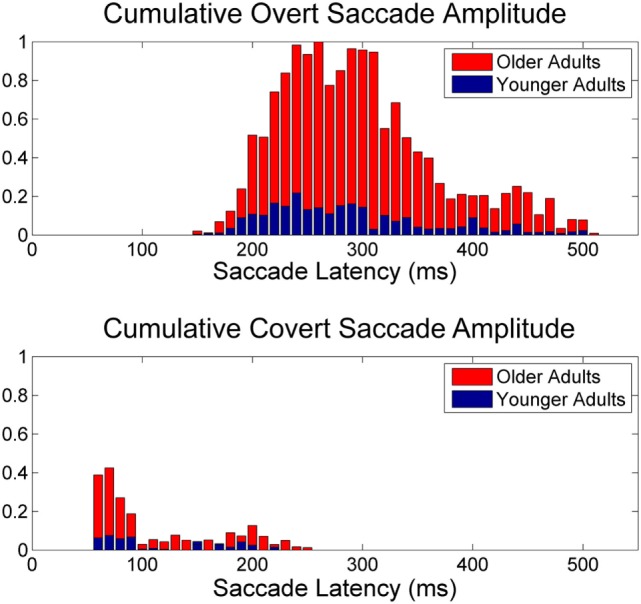
Results: Older adults (mean age 75.9) made significantly larger compensatory saccades relative to younger adults (mean age 45.0). In analyses adjusted for VOR gain, there was a significant association between age and amplitude of the first compensatory covert saccade (β = 0.015, p = 0.008). In analyses adjusted for VOR gain, there was a significant association between age and amplitude of the first compensatory overt saccade (β = 0.02, p < 0.001). Compensatory saccade latencies did not vary significantly by age.

Conclusion: We observed that aging increases the compensatory catch-up saccade amplitude in healthy adults after controlling for VOR gain. Size of compensatory saccades may be useful in addition to VOR gain for characterizing vestibular function in aging adults.

Keywords: VOR; compensatory saccades; head impulse test; healthy aging; vestibular.


Figures

Figure 1
Figure 1
Exemplar HITs with and without saccades. Exemplar vHITs showing the presence of a normal response without saccades (upper pane), an isolated covert compensatory saccade (middle pane), and an isolated overt saccade (lower pane). Saccades are indicated by arrows. Eye velocity (red) has been inverted and shown superimposed on head velocity (blue).
Figure 2
Figure 2
Calculating eye-in-space velocity. Exemplar vHIT showing how the sum of head velocity (blue) and eye-in-head velocity (red) can be used to calculate eye-in-space velocity (black). The boxed in area highlights a covert saccade and demonstrates how using eye-in-space rather than eye-in-head velocity to calculate saccade amplitude removes the bias that results from VOR-mediated eye movement.
Figure 3
Figure 3
Normalized saccade amplitude. Normalized cumulative saccade amplitude for overt (upper panel) and VOR corrected covert (lower panel) saccades as a function of latency following onset of head impulse. Note the normalized cumulative amplitude is larger for older adults (≥60 years) relative to younger adults (<60 years) and that overt saccades have larger amplitude compared to covert saccades after correcting for VOR eye velocity and amplitude.

References

    1. Li C, Layman AJ, Geary R, Anson E, Carey JP, Ferrucci L, et al. Epidemiology of vestibulo-ocular reflex function: data from the Baltimore Longitudinal Study of Aging. Otol Neurotol (2015) 36:267–72. 10.1097/MAO.0000000000000610 - DOI - PMC - PubMed
    1. Mossman B, Mossman S, Purdie G, Schneider E. Age dependent normal horizontal VOR gain of head impulse test as measured with video-oculography. J Otolaryngol Head Neck Surg (2015) 44:29. 10.1186/s40463-015-0081-7 - DOI - PMC - PubMed
    1. Matiño-Soler E, Esteller-More E, Martin-Sanchez J-C, Martinez-Sanchez J-M, Perez-Fernandez N. Normative data on angular vestibulo-ocular responses in the yaw axis measured using the video head impulse test. Otol Neurotol (2015) 36:466–71. 10.1097/MAO.0000000000000661 - DOI - PubMed
    1. Lopez I, Ishiyama G, Tang Y, Tokita J, Baloh RW, Ishiyama A. Regional estimates of hair cells and supporting cells in the human crista ampullaris. J Neurosci Res (2005) 82:421–31. 10.1002/jnr.20652 - DOI - PubMed
    1. Rosenhall U, Rubin W. Degenerative changes in the human vestibular sensory epithelia. Acta Otolaryngol (1975) 79:67–80. 10.3109/00016487509124657 - DOI - PubMed

LinkOut - more resources